
10 Reasons Homosexuality Should Be Illegal
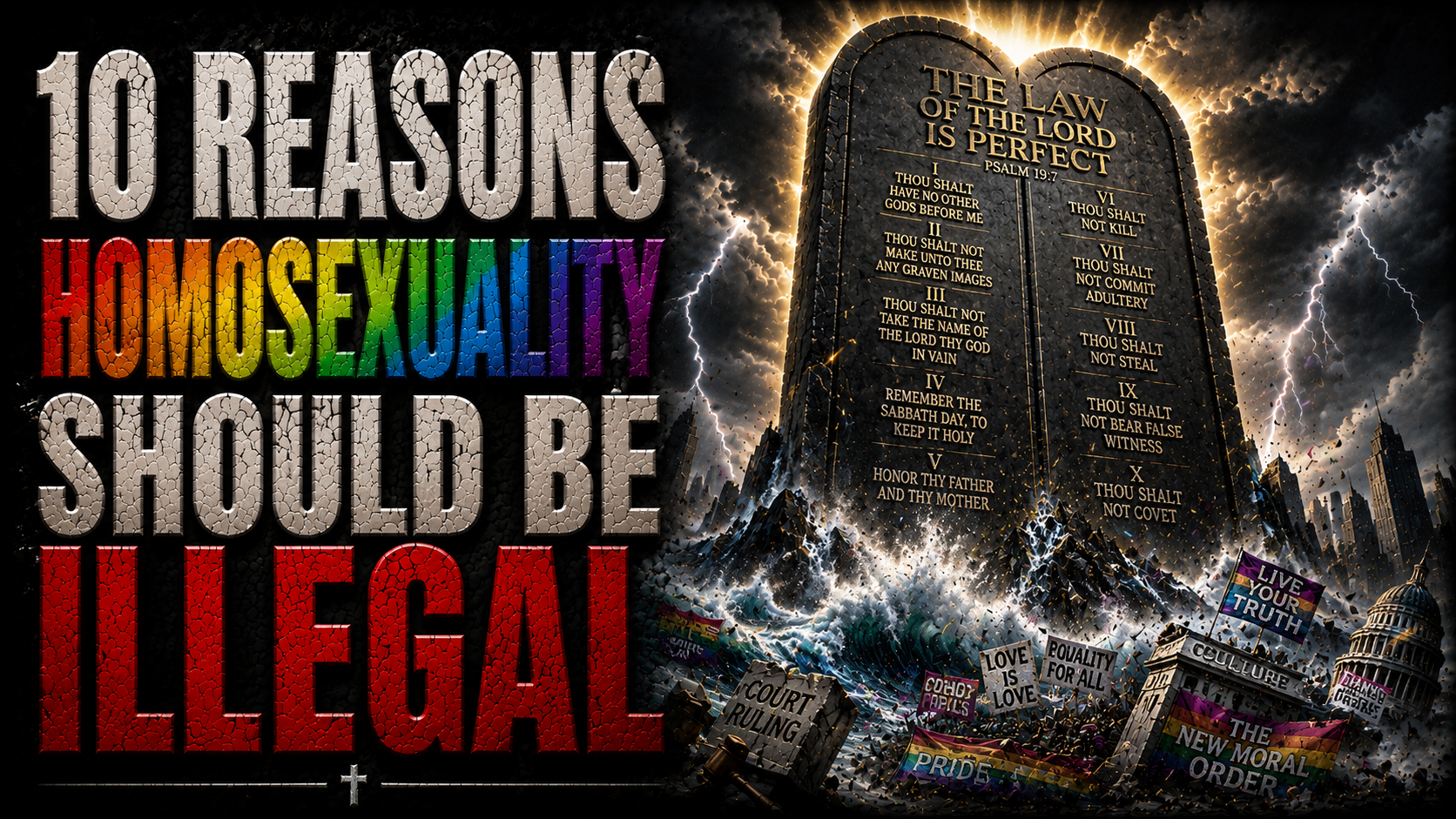
"The law of the LORD is perfect, restoring the soul." (Psalm 19:7)
One of the strangest features of modern Christianity is that many believers claim to love God's holiness while apologizing for God's law. They praise His wisdom, celebrate His goodness, defend His righteousness, and sing about His perfection, right up until they encounter a civil or moral law from the Torah that collides with the spirit of the age.
How much more is this true, when someone does the unthinkable, and even suggests that America would be a much better place, and certainly more God honoring, if we would adopt God's law for our nation. When such a premise is put forward hemming and hawing abounds, backpedaling commences, and a bunch of rosy cheeked Christians attempt to explain how such a reality would be horrible. Seriously?
This is especially true when Christians encounter the laws concerning homosexuality. Laws that were written by the finger of God, apply to all generations of people, who are blessed when they obey them, and subject to wrath when they ignore them. Laws that demonstrate the purity and righteousness of God. Yeah, those laws are the ones so many Christians will balk at, excuse, or claim that they were culture and not meant to be applied to modern governments. As if God's moral law has an expiration sticker.
At this point, someone will inevitably object that these laws belonged to the ceremonial system of Israel and therefore passed away with the coming of Christ. That argument sounds plausible until one actually opens a Bible. Ceremonial laws governed sacrifices, priesthood, ritual washings, dietary distinctions, temple worship, and the shadows that pointed forward to Christ. Those laws were fulfilled when the substance arrived. But homosexuality was never prohibited because it violated a ceremony. It was prohibited because it violated creation itself. Long before there was a tabernacle, a Levitical priesthood, or a sacrificial system, there was Adam and Eve. The prohibition does not begin at Sinai. It begins in Eden. That alone should settle the matter. God did not create Adam and Steve before replacing them with Adam and Eve. He created one man and one woman and established marriage as the normative pattern for all humanity. Ceremonial laws pointed forward to Christ. Marriage points all the way back to creation.
There is another feature of moral law that is often overlooked. Throughout Scripture, when God reveals moral laws, He frequently grounds them in His own character, His own holiness, or declares them to be perpetual statutes binding upon His people. Moral laws reflect who God is. They are not arbitrary regulations attached to a particular moment in redemptive history. They are revelations of God's righteousness applied to human conduct. This is precisely what we find in the passages concerning homosexuality. Leviticus does not present these prohibitions as temporary ceremonial markers separating Israel from the nations. Instead, God repeatedly grounds them in His own holiness. "You shall be holy, for I the LORD your God am holy" (Leviticus 19:2). The surrounding sexual laws are repeatedly connected to God's holy character and to His enduring moral standards. Likewise, the Lord repeatedly describes these commandments as statutes that distinguish righteousness from abomination and warns that the nations themselves were judged for violating them before Israel ever entered the land. That fact alone is devastating to the ceremonial-law argument. God was not judging the Canaanites for failing to observe Jewish ceremonies. He was judging them for violating universal moral laws.
Even more telling, the language surrounding these prohibitions carries the marks of permanence. God repeatedly speaks of these commands as statutes for His people and ties them to the created order He established. The nations were vomited from the land because of these sins. Israel would be vomited from the land for the same sins. The standard did not change based on ethnicity, covenant membership, or historical period because the standard was rooted in God's holiness itself. Ceremonial laws separated Israel from the nations until Christ came. Moral laws reveal what pleases and displeases God because they reflect His character. One category points forward to redemption. The other reveals righteousness. Homosexuality belongs unmistakably in the latter category.
Even more devastating to the ceremonial-law argument is the fact that the New Testament repeatedly reaffirms the prohibition after Christ's resurrection. Paul condemns homosexual practice in Romans 1, not by appealing to Moses, but by appealing to nature itself. He condemns it in 1 Corinthians 6 and 1 Timothy 1 as a violation of God's enduring moral order. Jesus Himself grounded sexual ethics in Genesis, not in temporary ceremonial regulations. The prohibition therefore appears before Moses, under Moses, is affirmed by Christ, and is reaffirmed by the apostles. That is the very definition of a moral law. Nobody argues that adultery ceased being sinful because the sacrificial system passed away. Nobody argues that murder became acceptable because the temple was destroyed. Nobody argues that idolatry expired with the Levitical priesthood. Why? Because these sins violate God's unchanging character and God's unchanging design. The same is true here.
The real issue is not whether this law is ceremonial. It plainly is not. The real issue is that many Christians have absorbed the modern assumption that sexual ethics are negotiable while everything else remains fixed. We have been taught to think of homosexuality as a uniquely difficult commandment, a strange relic from a harsher age, rather than one application of God's eternal moral order. But God did not prohibit it because He was speaking to Israelites. He prohibited it because He was speaking to human beings. The law rests upon creation, nature, marriage, family, fruitfulness, covenant order, and the holiness of God Himself. As long as men remain men, women remain women, marriage remains marriage, and God remains God, the moral principle remains exactly where it has always been.
So, in the same way we would never argue that the Ten Commandments have passed away and are no longer relevant in the modern world, Christians who take their Bibles seriously should also admit that this prohibition remains binding upon all people in all places and at all times. The logic is identical. If a law is rooted in God's character, grounded in creation, applied universally, and reaffirmed in the New Testament, then it belongs to the category of moral law. We do not get to carve out exceptions simply because modern man finds a particular commandment offensive. Yet that is precisely what so many professing Christians do. They join ranks with the pagans, eating slop from the world's trough and congratulating themselves for being more enlightened than God. They sit in judgment over the Judge. They place the finite mind above infinite wisdom. They imagine that two thousand years of Christian teaching, four thousand years of biblical revelation, and the clear testimony of Scripture itself can all be overturned by a few decades of cultural pressure. O foolish and wicked generation, who call evil good and good evil, who blush at God's commandments while celebrating man's rebellion!
The modern world treats these very laws as proof that the God of the Bible was primitive, harsh, unenlightened, and cruel. A tribal deity, they say, scarcely more sophisticated than a mythological invention. This is why it is so shameful when Christians echo the accusations of the heathen. Rather than defending God's righteousness, they rush to distance themselves from it. Rather than rejoicing in God's wisdom, they apologize for it. They treat these laws like an embarrassing family secret hidden in the attic, hoping nobody notices they are still in the Book. Yet this reaction reveals something deeply troubling about the state of modern Christendom. The problem is not God's law. God delights in His law. God calls His law perfect, righteous, pure, and true altogether. The problem is that vast portions of the modern church have learned to love the world's approval more than God's commandments. They praise God's holiness in the abstract while recoiling from its practical application. They sing about God's righteousness on Sunday and spend the rest of the week explaining why His righteousness should never govern a nation. The issue is not that God's law is defective. The issue is that many Christians have absorbed the values of a culture that hates God's law and have mistaken that hatred for compassion, wisdom, and maturity.
Again, God was not embarrassed by His commandments. God did not apologize when He gave them. He certainly was not struggling with rising cultural pressures. And He was obviously not worried about public opinion or perception. The Lord of heaven and earth looked upon His creation, understood human nature perfectly, and gave laws that reflected His own righteous character. Which means if we truly believe that God is good, then we must also believe His law was good. And, if we rightly believe His law is good, then wouldn't we also believe that it is good for a nation to implement it. That the nation who obeys Gods laws and punishes evil would be a blessed nation.
This brings us to the point. Why did God outlaw homosexuality in the first place? And why, if God's law is truly good, would the righteous standard remain good today? Here are ten reasons.
Before we begin, notice the logic. I am not arguing from political power. I am arguing from theology. If God's law reflects God's character, then God's law is good. If God's law is good, then it is good for human beings. If it is good for human beings, then it is good for families, churches, communities, and nations. And if it is good for nations, then no nation becomes more righteous by rejecting it. The question is not whether modern America has the will to implement God's standards. The question is whether God's standards remain righteous. If they do, then every deviation from them is, by definition, a movement away from blessing and toward judgment. The issue before us is not pragmatism. It is obedience. Not what modern man prefers, but what God has revealed.
REASON 1: Homosexuality was illegal because it violates the created order itself. Long before Moses climbed Sinai, long before Israel entered Canaan, long before civil penalties were ever discussed, God created humanity male and female. He did not create two interchangeable ambiguous sexes that could be rearranged like a Mr. Potato Head according to our diluted preferences. He created complementary image-bearers whose union would produce life, establish households, and fill the earth with His glory. Marriage was not invented by society. It was established by God. The foundation of all sexual ethics is not Leviticus. It is Genesis. This is precisely why Jesus, when questioned about marriage, appealed not to contemporary customs but to creation itself. The Lord always takes us back to the beginning because that is where reality begins. If this prohibition is rooted in creation rather than merely in Israel, then the moral principle cannot be dismissed as a relic of ancient Judaism. A nation that honors creation will flourish. A nation that wages war against creation inevitably wages war against itself.
REASON 2: Homosexuality was also illegal because it attacks the complementary structure built into humanity itself. Male and female are not arbitrary categories. They are not social inventions. They are not costumes. Together they display something of God's design for humanity. The sexes are distinct, complementary, and ordered toward one another. Every attempt to erase, confuse, or replace that complementarity is ultimately an assault upon the wisdom of the Creator. It is an attempt to improve what God called good. Modern societies imagine they are becoming enlightened by rejecting these distinctions. In reality, they are sawing through the very beams that hold civilization together.
REASON 3: Homosexuality was also illegal because it severs sexuality from its natural purpose. God did not create sexual union merely for pleasure. He created it within a covenant designed to produce life. The very first command given to mankind was, "Be fruitful and multiply." Fruitfulness is not an accidental feature of sexuality. It is one of its central purposes. Modern man speaks as though children are optional accessories attached to adult fulfillment. Scripture presents them as one of the primary reasons marriage exists at all. Homosexual relationships are uniquely incapable of fulfilling this creational purpose. They can imitate the appearance of marriage, but they cannot produce the fruit for which marriage was designed. Any society that systematically celebrates relationships cut off from this creational end should not be surprised when it begins running out of children, families, stability, and future.
REASON 4: Homosexuality was illegal because it distorts one of the greatest pictures in all of Scripture. Marriage was never merely about marriage. From the beginning it pointed beyond itself. Paul tells us in Ephesians that the mystery of marriage ultimately refers to Christ and the Church. The husband points to Christ. The wife points to the Church. Marriage is a living icon of redemption. It is theology made visible. This is why attacks upon marriage are never merely social issues. They are theological issues. They obscure a picture God Himself painted into creation. When a nation redefines marriage, it is not merely revising a legal code. It is vandalizing a symbol God embedded in reality itself.
REASON 5: Homosexuality was illegal because it was deeply connected to the pagan cultures surrounding Israel. The Canaanites did not merely reject God's law. They built entire civilizations around the worship of false gods. Sexual immorality was woven into their religious life. Homosexual practices were not isolated private acts. They were part of a broader rebellion against the Creator. When God warned Israel not to imitate the nations, He was not being arbitrary. He was preventing His people from becoming like the cultures He was judging. The lesson remains. Laws teach. Cultures catechize. Nations become like the things they celebrate. If God judged those civilizations for these practices, wisdom would suggest that modern nations should be cautious about institutionalizing the very sins that brought judgment upon others.
This leads directly to another reason.
REASON 6: Homosexuality was illegal because it defiled the covenant community. Modern Americans think almost entirely in individual terms. Scripture often speaks covenantally. God repeatedly warns Israel that certain sins pollute the land itself. They contaminate the covenant people. They invite judgment upon the nation. This language sounds strange to modern ears because we have forgotten that God deals not only with individuals but also with households, churches, and nations. Israel was not merely a collection of private citizens. It was a holy nation under the direct rule of God. Public rebellion carried public consequences. Modern Christians often assume that private morality has no public effects. The Bible teaches exactly the opposite. What a people celebrates eventually becomes what a people becomes.
REASON 7: Homosexuality was illegal because it represented a rebellion against nature itself. This is precisely Paul's argument in Romans 1. Notice that Paul does not appeal merely to Jewish tradition. He appeals to creation. Men exchanged natural relations for unnatural ones. Women exchanged natural relations for unnatural ones. Paul's argument is rooted in reality itself. Nature testifies. The body testifies. Creation testifies. The world God made is constantly preaching a sermon that modern man desperately tries to silence. A righteous legal order should seek harmony with reality, not rebellion against it.
REASON 8: Homosexuality was illegal because it was presented as evidence of divine judgment. Romans 1 teaches something that modern people find deeply unsettling. Homosexuality is not merely a cause of judgment. It is often evidence that judgment has already begun. Three times Paul repeats the terrifying phrase, "God gave them over." God gave them over to impurity. God gave them over to degrading passions. God gave them over to a depraved mind. The image is horrifying. It is not God reaching down to restrain sin. It is God stepping back and allowing rebellion to consume itself. A society celebrating sexual confusion is not necessarily marching toward judgment. It may already be experiencing it. If that is true, then a nation seeking blessing would move toward God's standards rather than away from them.
REASON 9: Homosexuality was illegal because it undermines the family, and the family is the foundation of civilization. Every institution ultimately depends upon the family. Churches are built from families. Schools are built from families. Economies are built from families. Governments are built from families. Nations are built from families. The family is the seedbed of civilization. Attack the family and everything else eventually weakens. This is one reason the sexual revolution has produced so much devastation. It promised liberation and delivered fragmentation. It promised freedom and delivered loneliness. It promised happiness and delivered collapse. If families are the foundation of society, then laws that protect and strengthen the family are not oppressive. They are essential.
REASON 10: Finally, homosexuality was illegal because God classified it among the capital sexual crimes that attacked the covenantal structure of society itself. Modern readers often recoil at this point. Yet the reaction itself reveals how profoundly our assumptions have been shaped by the modern world. We hear "capital punishment" and immediately assume the law must have been unjust. Scripture approaches the matter differently. The severity of the penalty reveals the seriousness of the offense. God was teaching Israel something about the destructive power of sin. He was teaching them that rebellion against creation is not a small matter. It is an attack upon the foundations of covenant life itself.
Whether one agrees with every application of Israel's judicial system is not actually the first question. The first question is whether God was right. If God was right, then His moral evaluation remains right. If His moral evaluation remains right, then nations move toward blessing when they align themselves with His standards and toward judgment when they reject them. The issue is not whether modern America currently possesses the desire to order itself according to God's law. The issue is whether God's law remains the standard of righteousness. Scripture's answer is yes. God's law was not good because it was ancient Israel's law. It was good because it was God's law. And what reflects God's character never stops being good.
The real scandal is not that God outlawed homosexuality.
The real scandal is that modern Christians are embarrassed that He did.
The question before us is not whether America will ever adopt God's standards. The question is whether God's standards are righteous. And if they are righteous, then every nation that rejects them does so to its own destruction.
The modern world treats God's law as though it were a prison. Scripture treats it as a gift. The modern world sees restrictions. God sees protection. The modern world sees oppression. God sees wisdom. The modern world sees chains. God sees guardrails standing between human flourishing and human ruin.
When a nation outlaws theft, it is not restricting freedom. It is protecting property. When a nation outlaws murder, it is not restricting freedom. It is protecting life. When a nation outlaws perjury, it is not restricting freedom. It is protecting truth. In the same way, when God legislates sexual morality, He is not acting as a cosmic killjoy. He is protecting marriage, family, children, inheritance, covenant succession, social stability, and ultimately human flourishing itself.
The modern world imagines that liberty is found in casting off God's law. Scripture teaches precisely the opposite. Freedom is found in obedience. Blessing is found in submission. Life is found in conformity to reality as God created it. Every civilization that wars against God's design eventually finds itself warring against reality itself. And reality always wins.
This is why Christians should stop apologizing for God's law.
God is not ashamed of His law.
Christ is not ashamed of His law.
The apostles were not ashamed of His law.
The prophets were not ashamed of His law.
The martyrs were not ashamed of His law.
Why then are we?
If God's law reflects God's character, then God's law is good. If God's law is good, then it is good for men. If it is good for men, then it is good for families. If it is good for families, then it is good for churches. If it is good for churches, then it is good for nations.
And if it is good for nations, then every nation that rejects it is rejecting its own blessing.
The future does not belong to those who redefine reality.
The future belongs to those who submit to it.
The future does not belong to sexual revolutionaries.
The future belongs to Jesus Christ.
And the day is coming when every nation will learn what Israel should have known, what America has forgotten, and what every Christian must once again confess without apology:
The law of the Lord is perfect. Our nation would be blessed if we implemented it.