
Buried Talents
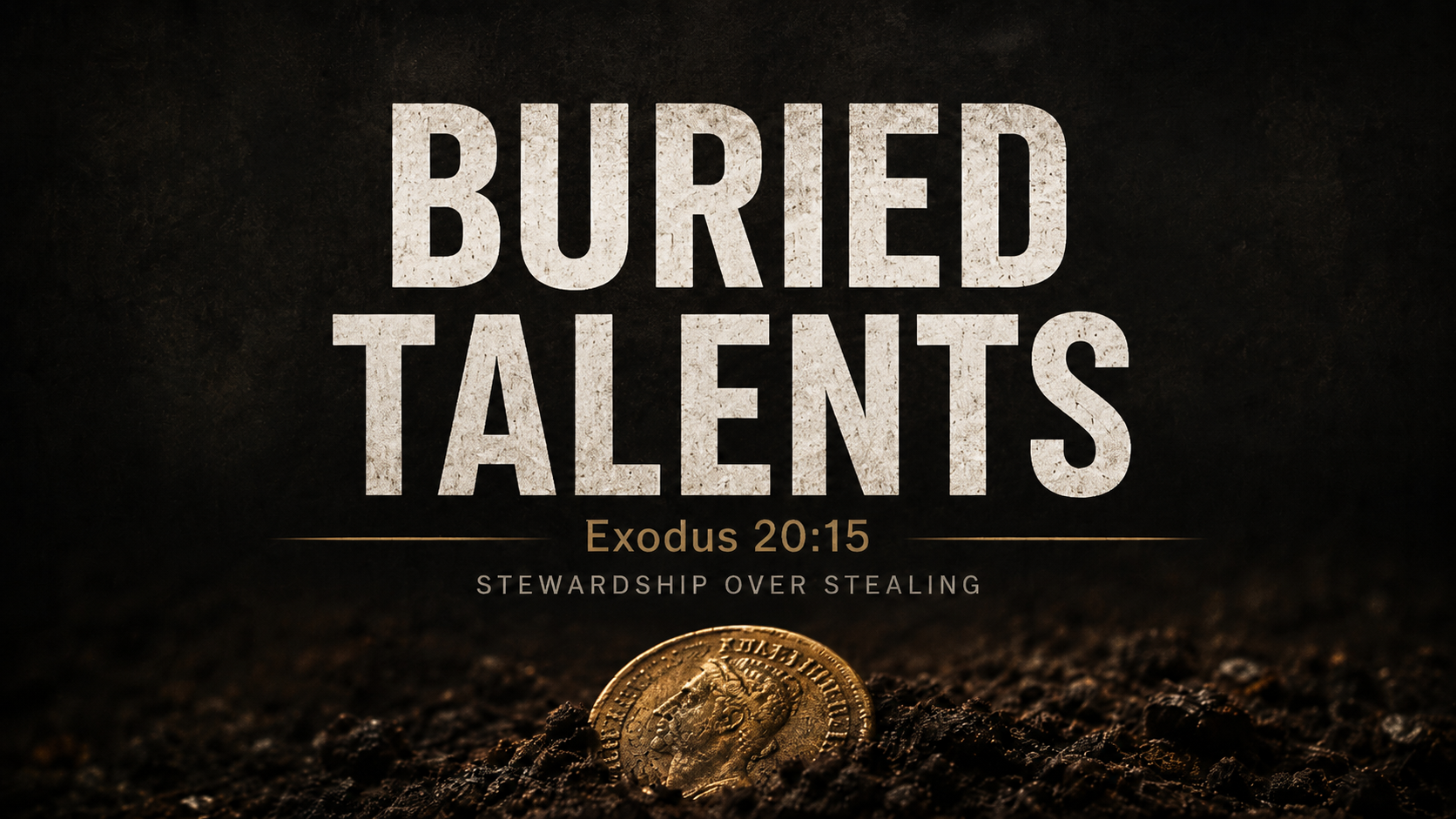
“You shall not steal.” — Exodus 20:15 NKJV
The eighth commandment surely forbids us from stealing because not everything belongs to us. It also forbids us from stealing because, in a positive sense, everything entirely belongs to God. The Psalmist tells us, “The earth is the LORD’s, and all its fullness” (Psalm 24:1). This means that everything within the bounds of earth, and everything produced upon the earth, falls comfortably upon His ledger.
Quite obviously, the sun and moon and stars belong to Him. Mount Everest belongs to Him. But your money is also His. Your house is His. Your strength, intelligence, opportunities, possessions, and schedule are all His. We are not, in the ultimate sense, owners of anything. We are but slaves and stewards living on the Master’s property, eating our Master’s bread, breathing our Master’s air, and expected to be busy about our Master’s affairs.
Thus, it is certainly true that we can steal from our neighbor by taking property that “belongs” to him, because that property was first entrusted to our neighbor by God. But we normally do not consider the larceny that happens when we steal from our Master by wasting the gifts and talents, opportunities and missions, that He has given to us. When we rob from ourselves, we do not see it as robbing primarily from God. Which makes us both thoughtless and delusional pickpockets.
Jesus illustrates this principle in Matthew 25. A man traveled into a far country and entrusted his goods to his servants. Before leaving, he gave five talents to one, to another he apportioned two talents, and to the last servant he gave one. Each servant received something that was not his, something precious to the master, and a gift that most definitely had strings attached to it. The clear expectation was that this was not only given according to potential, but given for potential: that it might be used fruitfully and that each man would multiply it.
And it seems this expectation was well understood. The first two servants immediately put their master’s resources to work. The one with five turned it into ten. The one with two made it into four. AND… when the master returned, he said to each of them:
“Well done, good and faithful servant; you were faithful over a few things, I will make you ruler over many things.”
BUT… what about the third servant?
It also seems clear that he understood the assignment, but instead of being faithful, he wickedly buried the master’s talent in the ground. Like Adam, who was commanded to be fruitful and multiply the Master’s gifts, he returned them back into the ground in stagnancy and death.
And I want you to notice something interesting. This so-called “wicked and lazy” slave did not waste the master’s coins at the local tavern or slot machines. He did not spend them on prostitutes and wild living, as the prodigal son had done. He simply buried them. He did the one thing that would guarantee they did not grow and did not shrink, which seems frugal and even responsible. And when the master returned, the servant could point to the EXACT sum he had originally received with the specificity of an exceptional auditor. In his own mind, he had stolen nothing.
Yet the master called him “wicked and lazy.”
Why?
Because the money had been entrusted to him for the master’s purposes. And the Master purposed it for growth, not for burying. In that way, the wicked and lazy servant treated his Master’s property as though it existed merely to be preserved and returned. He returned the talent unused, the opportunity totally wasted, and the Master’s trust betrayed.
He did not rob his master by taking the talent. He robbed him by burying it.
And in that way, this parable is much, much larger than money. It concerns everything Christ has placed into our hands. Some have been given five talents, some two, and some He gives one. The amount differs, but the obligation does not. The amount we are not responsible for; the obligation we are. Every servant must be faithful with what his Master has supplied him. Every servant must use what God has given to him and grow it.
Growth, development, multiplication, and building are associated with goodness and faithfulness. Sinful forms of maintenance, stagnancy, and fruitlessness are associated with wickedness, evil, slothfulness, and laziness. Plain and simple.
And because this is true, a man steals from God when he takes the gifts and talents God has supplied and does not intentionally and deliberately grow and develop them. For instance, if God has made you generous, you rob from God by not making more money so that you can give away more money. If God has given you holy ambition and leadership, you rob from God by holding back, refusing to step up, and languishing in mediocrity. If God has given you a mind, you rob from Him by lazily vegging out and refusing to cultivate it. If God has given you a body, you rob from your Maker by letting it devolve into muffin tops, man boobs, and health conditions that could have been prevented.
Of course, this list is not exhaustive. We can waste time, talents, treasures, and any other resource God has given us. The question is whether or not we are merely maintaining what God has given us or multiplying it. And if we are not multiplying it, we are criminals who need to repent to our great Master. And since all of us are criminals, there is great occasion and need for repentance.
And all of this invites us to ask the questions:
God has given us a body. How are we using it?
God has given us hours. Where are they going?
God has given us money. What does our spending reveal?
God has given us work. Are we laboring honestly?
God has given us a household, a church, abilities, opportunities, and neighbors to serve. Are these things flourishing beneath our stewardship, or are they being buried beneath our excuses?
One day the Master will return. On that day, we will not present to Him our intentions or excuses. We will present Him with the life we actually lived. Every neglected duty will be uncovered. Every wasted opportunity will be unearthed. Every buried talent will be brought into the light.
And thanks be to God Almighty that the finished work of Christ is our actual record. But for all who belong to Jesus, He did not save us so that we could be wicked and lazy. He did not cover our sins so that we could go on sinning. He redeemed us for redeeming work. He made us new creations to be about making creation new again.
So let us remember who Jesus is. Let us be reminded of who God has made us to be. Let us repent for who we now are. And let us, by the Spirit’s power, be ever reformed and conformed into His image and likeness.