
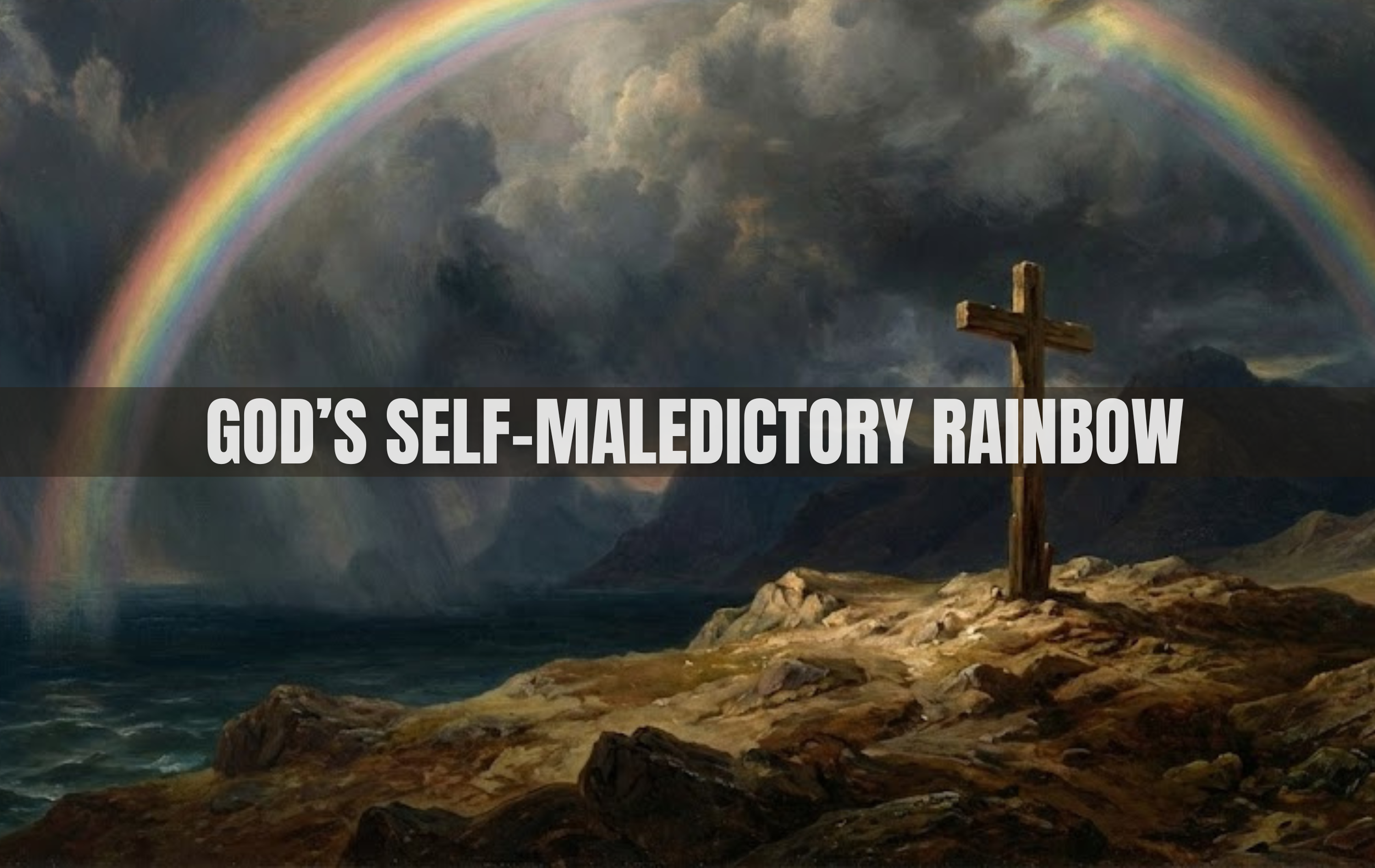
The first rainbow did not appear over a meadow of dandelions or as a vinyl sticker on a newborn’s wall. It rose above a wicked world that looked as if it had been wrung out like an old rag and hung across the mountains to dry. The soil was still soggy from God’s perilous judgment. Hillsides remained glistening with the residue of catastrophe. The air itself still undecided as to whether it belonged to a living world or a drowned one. And in that haunted stillness—silent, sullen, and freshly scraped clean—God hung a bow of war in the clouds like a smoking gun just fired. But, with one very curious detail.
As Noah looked up to behold the weapon, standing in a world just shot through with the bullet of God’s justice, the bow was no longer pointed earthward, but heavenward. And that, as you may already imagine, is incredibly important. Let us examine a few of those details.
First, we must take seriously the word God uses, which is bow. This was not the language of gift wrapping and decorations as our English language may portend. This was also not the kind of tool you would use in a child’s art project. This was a warriors bow—the curved, formidable weapon you would only lift and pull back when you were fully intending to send someone to their maker. This was not merely a pretty display of colors. This was a weapon engendering the same emotional response you might have seeing a loaded AK-47 or a stinger missile.
And while the impulse of the modern sentimentalists have attempted to defang this image, turning it either into a benign watercolor swoosh plastered on the walls of church nurseries or even worse a putrid symbol of polluted abominations against our pure and holy God, the image itself suggests that we should not be so quick to downplay or mock it. In the same way you would not mock the man holding a loaded .357 magnum, we demonstrate we have the sense of a vegetable when we downplay or pornify this most terrifying and violent image.
Genesis, even while subtly doing so, is telling us that the flood was God’s arrow, and the rainbow is God’s weapon—still curved, still pulled to a hair pin trigger, still ready to be fired like a Desert Eagle .50 at its target.
Second, the most astonishing thing about all of this is not the bow itself. It is the direction the weapon is pointed. Any archer will tell you bows do not “accidentally” get pointed at their wielder. The bow belongs to its owner. And the chief task of the bow is to point away from him and toward any threat worthy of elimination.
But consider for a moment this particular war bow in the sky. That shining arch God revealed to Noah after a storm is not pointed at the heart of Noah. It is not pointed earthward reminding the race of men that the same fate would be reserved for them if they fell again into the same sins that caused the flood in the first place. Instead, the bow is curved upward, pointing to the heavens, as though God Himself had positioned His own weapon to be cocked, loaded, and fully drawn, to be aimed squarely back at Him.
Here Scripture shocks us with a divine paradox. God places His own instrument of judgment in a posture that would cost Him everything if the covenant were ever broken. And we see in the text God explaining why: “When I see the bow, I will remember.” Not because He forgets. He does not misplace covenants like we do with contracts we sign and forget where we filed the paperwork. God hangs His bow, aimed right at Him, to make visible His commitment to the covenant terms. He will not destroy the world again by flood. He will not allow the entire race of man to fall in a single act of judgment. If that covenant failed, God is promising, that He would be run through with His own arrow.
And this brings us to the third thing we ought to consider. In the ancient world, to be killed by your own weapon was the peak of humiliation. Remember Saul being unwilling to impale himself with his own sword. Yet here, God paints this humiliation across the sky in seven shimmering colors, as if to say, “Let the world know—if my promise ever fails, I will bear the wounds.” God is promising inspite of the moral wickedness of man, no matter how much this polluted planet deserves the awesome fury of God, if He does not keep His promise He will be pierced. A self-maledictory Deicide will occur, which is an astounding promise.
Now, to understand why God would aim His bow at Himself, however, we must first understand what promise He was securing. God was not promising salvation to all the world in that moment. He was not even promising that humans would behave and give Him no more reason to pour out His judgment. Not five minutes later it seems, Noah is slobbering drunk, naked, shamed, and his grandson is cursed. So, human good behavior was certainly not in the mind of God.
He was instead promising ongoing preservation. He was promising that the world would have time—actual time—to become the stage on which redemption unfolds. Humanity would continue long enough for a Savior to come. The sun would rise, the harvest would grow, the earth would spin, not because sin had gone dormant, and not because humanity deserved to skirt justice. God did this because He had made a promise that He fully intended to keep, to preserve the world long enough for the serpent crushing child to be born (Genesis 3:15), even if it would cost Him death by His own arrow.
And in this we see that the flood teaches us a very stubborn truth: you can wash the world with the most aggressive crashing flood, but you cannot wash the human heart with water alone. If ever a man had a blank slate, it was Noah. He stepped into a cleansed world with the dignity of being made a new head over a new world. He inhaled the sweet air of mercy, planted his garden vineyard… and then promptly demonstrated that sin was not absolved with an environmental shift. Sin sprouts anywhere. It thrives everywhere. And soon enough, his descendants would be cursed again at Babels tower, because the propensity of the heart of man is only evil continually. The flood had not erased the problem. It had only exposed it.
And here is a point we rarely give adequate real estate in our brain. If God were merely a God of justice, if Holiness were the only attribute God possessed, then the war bow God used to flood the world would have also quickly sunk his arrows into Noah and all his family for their sin. In the same way, if mercy were the only divine attribute, the bow of God’s wrath would have never been bent at all, because God would have no crime worthy of punishment. But since God is both just and merciful, His bow remains in the sky, aimed upward, awaiting the moment when justice and mercy would collide without contradiction.
That moment came. The arrow would not stay suspended forever. A prophet spoke of a figure who would be “pierced for our transgressions”—a line that sounds suspiciously like the end of a story begun in Genesis 9. When the skies darkened at the crucifixion, the world was witnessing not meteorology, but theology: the drawing of the bow, the releasing of the string, the flight of the arrow. It struck the only One strong enough to absorb it without shattering the world. All the judgment that should have fallen on the sons of Adam and the descendants of Noah fell instead upon the Son of God.
The flood preserved the world.
The cross redeemed it.
The bow pointed at heaven finds its fulfillment in a Savior pierced on earth.
This is why the rainbow still hangs in the sky. It is not a symbol of human self-expression or divine leniency. It is the sign that judgment has been satisfied, that God Himself absorbed what justice demanded, and that He continues to hold back the floodwaters of wrath because His Son has already stood where the arrow fell.
So the next time sunlight breaks the clouds and that ancient bow stretches across the sky, remember that you are looking at the promise that made Bethlehem possible, that made Calvary victorious, and that makes every breath you draw a mercy, not a right.
The sky still bears the bow.
The cross still bears the scar.
And the saints should still sing in holy gratitude.