
Having The Conversation
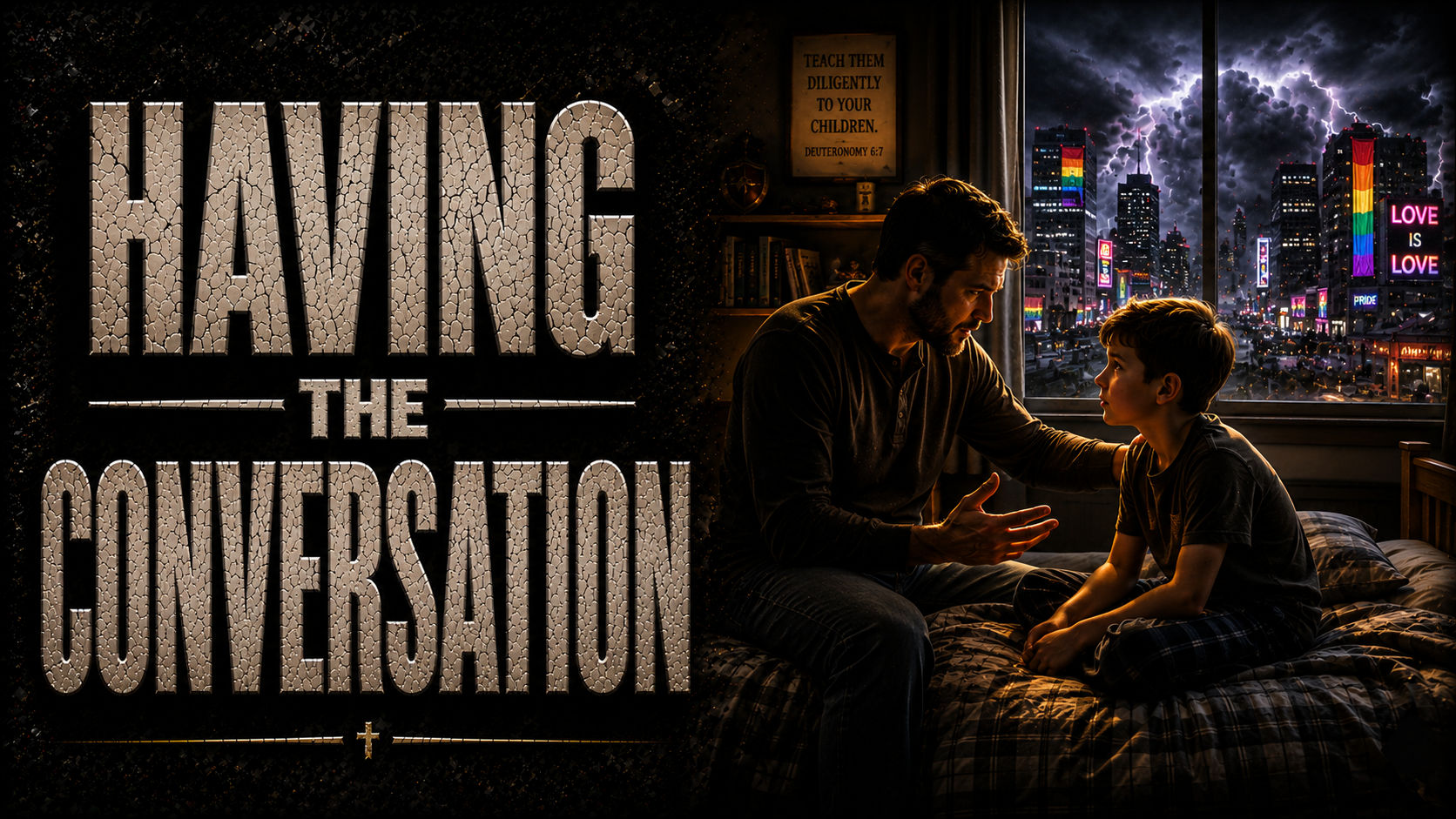
"When your son asks you in time to come, 'What is the meaning of the testimonies and the statutes and the rules that the LORD our God has commanded you?' then you shall say to your son..." (Deuteronomy 6:20-21)
Your child is going to have this conversation.
That much has already been decided, and it was not decided by you. The screen has been talking to him about sex since before he could read. The classroom has a curriculum. The advertisements have a doctrine. The songs have a creed. The friend on the bus has a sermon ready. The only question left open, the single variable still in your hands, is whether the first clear voice your child hears on the most contested subject of the age will be yours, or whether yours will arrive years late, breathless, trying to rebut a catechism that has already set in the soft clay.
Most Christian parents lose this fight not by saying the wrong thing but by saying nothing at all. They are waiting for a magic age. They are waiting for the child to ask. They are waiting until it feels less awkward, which is to say they are waiting forever. And while they wait, the world does not wait. The world is bold. The world is early. The world is patient and repetitive and unembarrassed, and it has decided that your silence is consent.
So let us settle the first thing before we say one word about method. There is no neutral childhood, and there is no neutral conversation. Cornelius Van Til spent his life pressing one hammer against one nail, that there is no neutral ground anywhere in the universe, no fact that is not God's fact, no square inch that is not claimed. That is doubly true of the human heart of a six year old. If you decline to disciple your child's sexuality, you have not protected his innocence. You have simply handed the lesson plan to someone who hates him. The conversation is not optional. The only thing optional is who teaches it.
THE TELLING IS A COMMAND
We tend to imagine the sex talk as a modern invention, a uniquely uncomfortable burden dropped on the shoulders of parents who would rather be doing anything else. It is nothing of the kind. The telling is ancient. The telling is commanded. The telling is woven into the very liturgy God gave His people.
When God delivered Israel out of Egypt, He did not merely save them. He built into the deliverance a machine for transmitting it, and that machine was a conversation between a parent and a child. "And you shall tell your son on that day" (Exodus 13:8). The Hebrew is vehiggadta, from nagad, to tell, to declare, to make plain. The whole Passover meal was engineered to provoke a question. The strange food, the bitter herbs, the blood on the door, all of it was designed so that the child would lean over and ask, "What do you mean by this service?" (Exodus 12:26). The later Jews named the entire ceremony after this single act. They called it the Haggadah, the Telling. The most important meal in the calendar of Israel was, at its heart, a structured conversation in which a father answered his child's question about a hard and bloody subject.
God does not leave parents to improvise. He gives them the pattern. "When your son asks you in time to come, What is the meaning of the testimonies, then you shall say to your son, We were Pharaoh's slaves in Egypt, and the LORD brought us out" (Deuteronomy 6:20-21). Notice what God assumes. He assumes the child will ask. He assumes the parent will answer. He assumes the subject will be difficult, because slavery and blood and judgment are not easy nursery topics. And He assumes the answer will not be a rule but a rescue.
This is the model. Not a single dreaded talk delivered in a parked car at the worst possible age, but a thousand small tellings, layered over years, until the truth is engraved past forgetting. Moses already told us the schedule in the verses just before: when you sit, when you walk, when you lie down, when you rise. The conversation is not an event. It is the weather of a Christian home.
TEACH THE MELODY BEFORE THE NOISE
Here is where most well meaning parents, the moment they finally do open their mouths, get the order exactly backward. They lead with the perversion. They open with the warning. The very first thing the child ever hears about his own God given sexuality is a list of horrors and a tone of disgust, and so the subject arrives in his mind permanently fused to shame, fear, and the curled lip of a frightened parent.
That is not how God teaches it, and it is not how you should either.
Shepherds do not train sheep to flee the wolf by parading wolves in front of them. They make the shepherd's own voice so familiar, so loved, so deeply known, that every other voice sounds instantly wrong. "The sheep follow him, for they know his voice. A stranger they will not follow, but they will flee from him, for they do not know the voice of strangers" (John 10:4-5). You do not produce discernment by saturating a child in counterfeits. You produce it by saturating him in the real thing until the counterfeit announces itself.
So teach the melody before you ever name the noise. Long before your child hears the word that the world wants to define for him, he should already know, in his bones, the good and glorious thing the world is counterfeiting. He should know that God made the world by dividing and distinguishing, light from dark, sea from land, male from female, and that He called it good. He should know that his own body is not an accident or a cage or a costume, but a gift, fearfully and wonderfully made, with a design and a purpose stamped into it by the hand of God. Nancy Pearcey has spent a whole book making the case that the deepest lie of the age is a contempt for the body, a quiet gnosticism that treats the flesh as raw material to be overridden by the inner self. The antidote is taught early and taught warmly: your body is good, your sex is good, the difference between men and women is good, and one day, if God wills, the covenant of marriage and the gift of children will be good too.
A child raised to love the music recognizes the static the first time he hears it. A child who has only ever been handed static does not even know a song was supposed to be playing.
MEASURE THE MEAT TO THE MOUTH
Now to the question every honest parent is actually asking. What do I say, and just as importantly, what do I leave out?
The Bible answers with a principle of measure. "I fed you with milk, not solid food, for you were not ready for it" (1 Corinthians 3:2). The writer of Hebrews rebukes a congregation that should be eating meat but still needs milk, and he tells us what meat is for: "solid food is for the mature, for those who have their powers of discernment trained by constant practice to distinguish good from evil" (Hebrews 5:14). The word behind trained is gegymnasmena, from which we get gymnasium. Discernment is a muscle, and muscles are built by graduated load, not by being crushed.
This is the wisdom the modern world has entirely lost in both directions. The progressive world dumps the whole adult catechism of sex on a kindergartner, awakening what God designed to sleep, and calls it education. But frightened Christian parents make the mirror image mistake. In a panic to inoculate, they overexpose. They sit a tender eight year old down and pour out a graphic, fearful, exhaustive account of every perversion in the culture, and they wonder later why the child is anxious, why his imagination is now stained with images he can never unsee, why a subject that should have unfolded slowly like a flower was instead detonated like a bomb in his conscience.
A physician does not give an infant an adult dose. A good father does not hand a toddler a steak. So here is what you leave out, and you leave it out not from cowardice but from wisdom.
Leave out the graphic mechanics that a young child has no category for and no need to carry. You are planting categories, not pornographic detail. A small child needs to know that God made boys and girls, that marriage is one man and one woman for life, that some people are confused and sad and angry about this and say things that are not true, and that mom and dad will always tell him the truth. That is a complete and faithful conversation for that age. It does not require a diagram of every sin in Leviticus.
Leave out fear as the engine. Fear is a terrible fuel. It produces brittle children who either rebel against the panic the moment they are free of it or carry a lifelong dread of their own bodies. The aim is not a child who is terrified of sex. The aim is a child who treasures God's design so much that the counterfeit holds no charm.
Leave out contempt. We will come back to this, because it is the hidden hinge on which so many children are lost.
And leave out, forever, the idea that this is one conversation. The single sweaty talk is a modern myth and a modern failure. You are not detonating one charge. You are tending a fire over twenty years, adding the right log at the right time, milk first and meat later, each conversation building on the muscle of discernment the last one trained.
AIM AT THE HEART, ARM THE MIND
When you do speak, aim where God aims. Tedd Tripp gave a whole generation of Reformed parents one indispensable sentence: shepherd the heart, not merely the behavior. It is entirely possible to raise a child who can recite that homosexuality is sin and transgenderism is rebellion, and who has never once been led to love the God whose design these things deface. You will have produced a little Pharisee with correct opinions and a cold heart, and a cold heart is no protection at all. Correct opinions are abandoned the instant they become socially expensive. Only loves hold.
So do not merely hand your child the rules. Hand him the reasons, and behind the reasons, the Author. The Reformers did not leave the formation of children to chance or to mood. They wrote catechisms, and the very word tells you the method. To catechize, katecheo, is built from kata and echeo, to sound down, to echo. You sound the truth down into a child by repetition until it echoes back out of him on its own. The Heidelberg Catechism opens not with a rule but with the sweetest question ever asked of a child, what is your only comfort in life and in death, and answers, that I am not my own, but belong with body and soul to my faithful Savior Jesus Christ. That single answer settles the entire question of sexuality before the question is ever raised. You are not your own. Your body is not a self expression project. You were bought with a price.
Then arm the mind. Pre load the answers before the world asks the questions, because we are commanded to raise children who "destroy arguments and every lofty opinion raised against the knowledge of God" and take "every thought captive to obey Christ" (2 Corinthians 10:5). Teach your child the lies before the age whispers them, and teach him to take them apart. Teach him that a desire is not an identity, that a feeling is not a fact, that "born this way" is not an argument but a slogan, that no one reasons that way about anger or greed or any other appetite that arrives early. You are not trying to keep your child from ever meeting the serpent's question. You are training him to answer it, dismantle it, and walk away unshaken.
But here Moses guards us from the deepest danger, which is moralism dressed up as discernment. Look again at the pattern in Deuteronomy 6. When the child asks why, when he asks what all these statutes and rules mean, God does not tell the father to answer with a rule. He tells him to answer with the gospel. "We were slaves, and the LORD brought us out." When your child asks why the world is the way it is, why people are confused, why the parade marches and the screens lie, the answer never terminates in "because that is sin and we are the good ones." The answer terminates in the cross. We were all slaves. Every one of us was in Adam, dead, blind, in love with our chains. And the LORD brought us out, not because we were better, but because He is merciful. That is the answer. Not a rule. A rescue.
TRUTH WITH A TENDER FACE
Now to the hinge that decides so much, and that frightened parents almost always get wrong.
The register of the public square is not the register of the dinner table. In an essay, in a sermon, in the open war for a civilization, the prophet may speak with a whip of cords and a curse on his lips, and he should. But your seven year old is not a civilization. He is a soul, and the lesson he is absorbing is not only the content of your words but the posture of your face. If the only emotion your child ever sees attached to these people is your contempt, you are not raising a Daniel. You are raising a Pharisee, and you are unfitting him to do the one thing Christ will eventually send him to do, which is to love a lost neighbor enough to tell him the truth and walk him home.
Your child will have a gay classmate. He will have a cousin who announces a new name. He will sit beside, befriend, and one day perhaps marry into the very confusion this series has been describing. The question is not whether he will meet these people. He will. The question is whether you have prepared him to meet them the way Christ met sinners, with a holiness that will not bend one inch and a compassion that will not break one reed.
Rosaria Butterfield was an entrenched lesbian professor of queer theory before Christ took her, and she will tell you plainly that she was not argued into the kingdom. She was loved into it, across a dinner table, by a pastor and his wife who never once softened the truth and never once weaponized it. That is the balance to teach your children. Hate the lie with everything in you. Never hate the person the lie is killing. We do not despise the man drowning. We swim out to him.
And teach your child the most humbling truth of all, the one that murders self righteousness in the cradle. The same sin lives in his own heart in seed. Paul ran through a catalog of the very sins our age now celebrates, the sexually immoral, the adulterers, the men who practice homosexuality, and then he turned to the church and said, "and such were some of you. But you were washed, you were sanctified, you were justified" (1 Corinthians 6:11). Such were some of you. There but for the grace of God. The child who learns to say that learns to hold the truth without becoming cruel, and to love the sinner without becoming soft. That is the whole art of it.
BUILD THE OPEN DOOR
This may be the most important paragraph in this entire essay, so do not skim it.
Your child may feel something he does not understand. Somewhere between the innocence of childhood and the storms of adolescence, your son may feel a pull he cannot explain, your daughter may feel a confusion she has no words for, and in that moment everything depends on a door you either built years earlier or never built at all.
Here is the catastrophe that happens in conservative Christian homes more often than anyone admits. The child has been raised to believe that "those people" are the enemy, the disgusting, the contemptible other. Then the child feels a flicker of the very thing, and the entire architecture of his world collapses into one unbearable conclusion: I am the enemy. I am the disgusting one. And because the only posture he has ever seen modeled toward this temptation is revulsion, he does the one thing that will destroy him. He hides. He buries it in shame and tells no one, and the silence rots him from the inside while you go on believing all is well.
You must build the open door before he ever needs to walk through it. Teach your children, early and often, the truth this series has hammered from every angle: a temptation is not an identity. A feeling is not a fact. To be tempted is not to have fallen, and even to have fallen is not to be beyond the reach of grace. Tell them, in so many words, while they are still small, that there is no struggle they could ever bring to you that would make you love them less or turn them away. Tell them that the only thing that breaks a father's heart is not the confession but the hiding. Make your home the safest place on earth to say a hard thing out loud.
This is the gospel architecture of every Christian home. When the prodigal finally came up the road, having squandered everything in the very sins his father hated most, the father did not cross his arms. He ran. He ran while the son was still a long way off, and he fell on his neck and kissed him (Luke 15:20). A home that cannot run to a struggling child is a home that has misunderstood the gospel it claims to preach. Build the door. Hold it open. Let your children know the light is always on.
THE TELLING THAT ENDS AT THE CROSS
And so we arrive where Moses said we would. The child asks what all of this means, and the faithful parent answers not with a rule but with a rescue.
Everything we have said folds finally into this. You cannot, with all your catechizing and all your discernment training and all your tender open doors, do the one thing that actually saves your child. You cannot reach inside his chest and make a dead heart beat. You can plant. You can water. Only God gives the growth (1 Corinthians 3:6-7). The whole reason we labor as if it depended on us is that we have already prayed as if it depended on God, because it does, and we have leaned the entire weight of our hope on the covenant promise that the God who saves loves to save in family lines. "The promise is for you and for your children" (Acts 2:39).
So have the conversation. Have it early, before the world goes first. Have it in the right order, the melody before the noise. Have it in the right measure, milk before meat, leaving out what wisdom says to leave out. Have it aimed at the heart and not merely the behavior. Have it with a face that hates the lie and loves the liar, and have it behind a door you will never let close. And have it, every single time, ending where Deuteronomy ends, where the Passover ends, where all true telling ends. Not at a rule. At a rescue.
We were slaves in Egypt, and the LORD brought us out.
We were dead in Adam, and Christ made us alive.
That is the conversation. Tell it to your children when you sit and when you walk and when you lie down and when you rise. Tell it until it echoes back out of them without you. And one day, when the music plays and the whole earth bows to the golden image of the age, your children will not bow, because long before the world ever asked them the question, their father and mother had already told them the answer.