
Stealing Rainbows and Swallowing Wrath
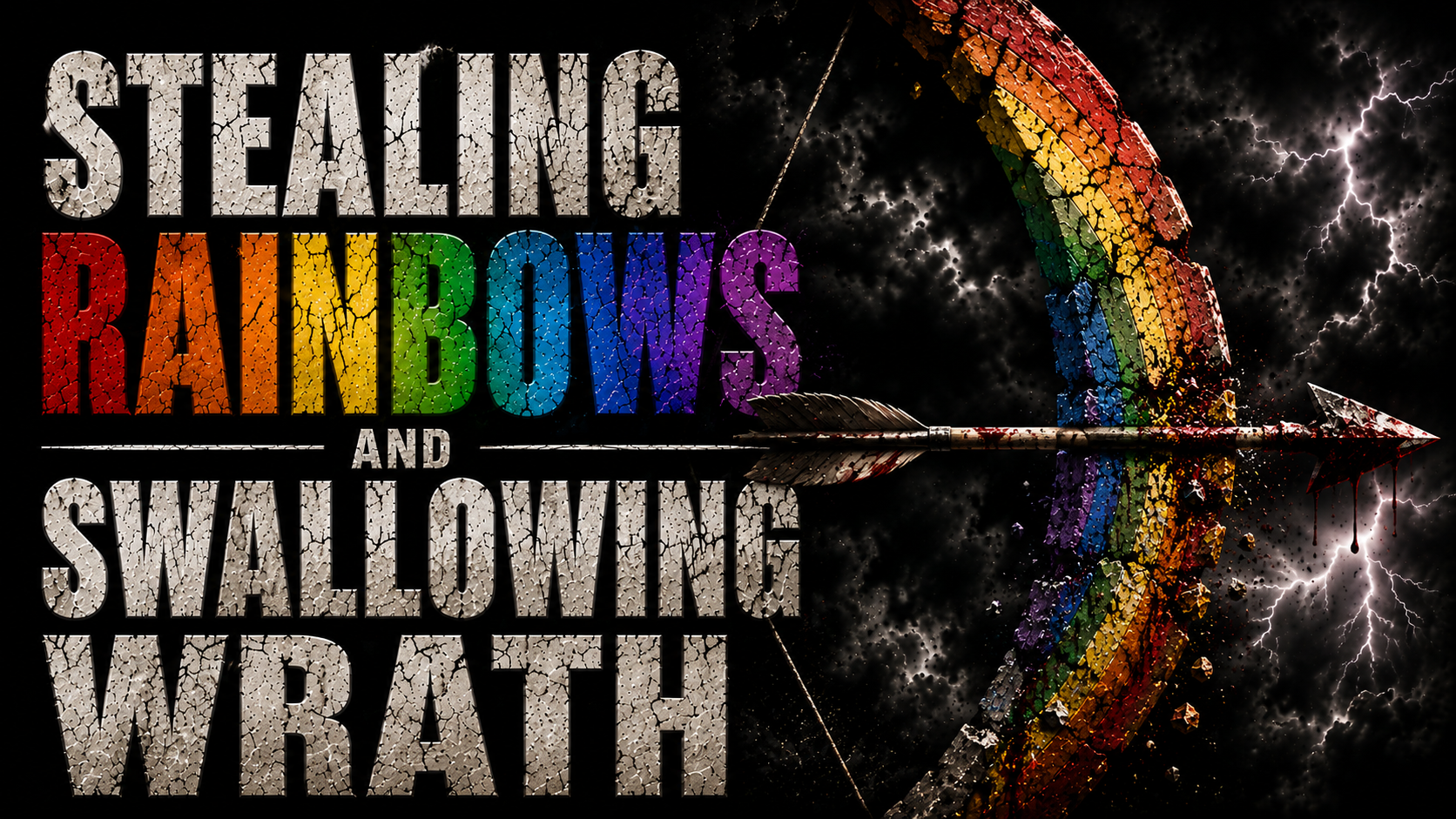
There are few ironies in human history more remarkable, or more darkly humorous, than the modern appropriation of the rainbow. A symbol originally given by God as a reminder of judgment has become a symbol used to celebrate rebellion against the God who gave it. A sign intended to direct sinners toward mercy has been transformed into a banner beneath which men proudly announce that they have no intention of repenting. A covenant symbol designed to point toward salvation has become, for many, an emblem of autonomy. The irony is almost too perfect. It is like stealing a lifeboat and using it as a stage for a drowning contest. It is like tearing down a hospital sign and hanging it above a poison factory. It is like taking the evacuation map from a burning building and turning it into an advertisement for arson. One scarcely knows whether to laugh at the absurdity or weep at the tragedy.
The rainbow was never given to celebrate human freedom from God. The rainbow was given to remind humanity what happens when God judges sin. That fact alone is enough to change the entire conversation. Most modern people think of the rainbow as a gentle, harmless, sentimental image. It appears on children's toys, greeting cards, clothing, and advertisements. It evokes thoughts of peace, happiness, and carefree optimism. The Bible presents something far more terrifying. Scripture does not introduce the rainbow against a backdrop of picnics and sunshine. It introduces the rainbow against a backdrop of corpses.
The rainbow first appears after the Flood. That matters. The rainbow does not appear in Eden. It does not appear before sin. It does not appear before judgment. It appears only after the greatest catastrophe the world had ever seen. The Flood was not a pleasant story about animals entering a boat two by two. It was the most comprehensive act of divine judgment recorded in Scripture. Mountains disappeared beneath the waters. Entire civilizations vanished. The earth became a watery graveyard. Every breath outside the ark was extinguished beneath the wrath of God. Men, women, children, kings, merchants, soldiers, craftsmen, philosophers, and peasants all sank beneath the same waves. The world became one vast cemetery with water for a headstone.
Only after the waters receded did the rainbow appear. The rainbow therefore cannot mean that God ignores sin. The rainbow exists because God judged sin. The rainbow only shines because wrath already fell. It is not the smile of a grandfather who has become indifferent to evil. It is the memorial marker erected over a battlefield after the war has ended. It is the divine reminder that God is patient, but not permissive; merciful, but not indifferent; gracious, but never unjust.
And that brings us to one of the most fascinating details in the entire passage. The Hebrew word used in Genesis for the rainbow is qesheth. It is the ordinary word for a war bow. A weapon. A battle instrument. A bow used by a warrior. This means the image is not merely decorative. God is presenting Himself as a victorious warrior hanging up His weapon after battle. The world had rebelled. The world had been judged. The Warrior-King had acted. And now the bow hangs in the heavens.
Yet there is another detail that is often overlooked. The bow is not pointed downward. It is pointed upward. The ancient war bow normally faced one's enemies. This one faces heaven. The imagery is astonishing. It is as though God hangs His weapon in the sky and says, "I will not destroy the earth by water again." Yet the bow raises an unavoidable question. If God remains holy, what happens to future sinners? If mankind continues rebelling, where will the judgment go? If God remains righteous, where will the arrows land?
The rainbow creates a tension that echoes throughout the rest of Scripture. The bow remains. The justice remains. The holiness remains. The wrath remains. Yet the world continues. How? How does a holy God permit an unholy people to keep breathing His air, eating His food, and walking upon His earth? How does the Judge delay the sentence when the evidence of guilt continues to multiply? The rainbow hangs over the world like an unanswered question. The bow is there. The arrows are there. The Judge is there. Yet the execution is delayed.
The answer does not arrive fully until Calvary.
The bow was never discarded. It was redirected.
The judgment that once drowned the world gathered itself above another mountain. The wrath that should have fallen upon rebels fell upon Christ. The arrows that should have pierced sinners pierced the Son. The floodwaters of divine judgment did not disappear. They crashed upon Jesus. The rainbow therefore is not primarily a symbol of human freedom. It is a symbol of divine substitution. It does not announce that sin is harmless. It announces that someone must bear the consequences of sin. It does not proclaim that God has abandoned justice. It proclaims that justice has found its fulfillment in Christ. It does not say that rebellion no longer matters. It says that mercy has been provided for rebels.
That is what makes the modern use of the rainbow so tragic. The symbol itself points away from human autonomy. The symbol points toward divine mercy. The symbol points toward judgment satisfied through sacrifice. The symbol points toward the cross. Yet many now use it to celebrate the very thing from which the symbol was intended to rescue us. The rainbow was given to direct sinners toward grace. Modern man often uses it to announce his determination to remain in rebellion. The covenant sign has been severed from the covenant God. The symbol has been detached from its meaning.
The result is a kind of theological absurdity that would make even Chesterton shake his head in disbelief. Imagine a condemned criminal tearing down the governor's pardon proclamation and using it as wallpaper for his prison cell while refusing to accept the pardon itself. Imagine a man dying of thirst stealing the sign that points toward fresh water and using it as decoration while refusing to drink. Imagine a drowning sailor ripping apart the map to shore because he prefers floating farther out to sea. Imagine a patient with stage-four cancer framing his prescription on the wall while refusing to take the medicine. Imagine a starving man polishing a menu while refusing the meal. Such behavior would be considered madness everywhere else. Yet this is precisely what happens whenever sinners seize the sign of mercy while rejecting the God of mercy.
The rainbow was never intended to encourage pride. It was intended to produce gratitude. It was never intended to celebrate rebellion. It was intended to magnify patience. It was never intended to embolden sinners. It was intended to remind them that judgment is real and mercy is astonishing. The rainbow is not God's endorsement of human autonomy. It is God's declaration that He has withheld a judgment we deserve. It hangs above the world like a royal proclamation announcing that the execution has been postponed.
This is why Scripture consistently treats God's patience as a gift rather than a permission slip. The delay of judgment is not the cancellation of judgment. The patience of God is not the approval of God. The mercy of God is not the surrender of God. Every moment between the Flood and the Final Judgment is borrowed time. Every sunrise is mercy. Every breath is mercy. Every heartbeat is mercy. Every opportunity to repent is mercy. The rainbow hangs over the world as a covenant reminder that God is patient beyond comprehension.
Yet patience must never be mistaken for indifference. A man standing on railroad tracks may misinterpret the delay of the train as proof that no train is coming. He may dance, celebrate, laugh, and mock the warnings of others. But the train's delay is not the train's absence. It is merely the train's delay. In the same way, the world repeatedly mistakes God's patience for God's approval. It confuses silence with surrender. It mistakes mercy for weakness. It imagines that because judgment has not yet arrived, judgment never will.
But the same Scriptures that reveal the rainbow also reveal a coming day when Christ will judge the living and the dead. The same God who extended mercy through Noah also promises final justice through His Son. The same God who hung His bow in the heavens remains the Judge of all the earth. The rainbow is not proof that judgment is gone. It is proof that judgment has been delayed.
This is why the Gospel remains the only safe place for sinners. Not because God ignores sin. Not because God lowers His standards. Not because judgment disappeared. But because Christ stood beneath the storm. He entered the floodwaters. He absorbed the arrows. He endured the wrath. He became the ark for all who would flee to Him.
The rainbow ultimately points beyond itself. It points beyond Noah. It points beyond the Flood. It points beyond the clouds. It points toward the cross. The great message of the rainbow is not, "Live however you want." The great message of the rainbow is, "God has provided mercy for those who deserve judgment."
The tragedy of our age is not merely that many have misunderstood the symbol. The tragedy is that many have embraced the sign while rejecting the Savior to whom the sign points. They admire the rainbow and ignore the cross. They celebrate mercy while refusing repentance. They love the covenant sign while rejecting the covenant Lord. They grasp the wrapping paper and throw away the gift. They kiss the King's seal while tearing up the King's letter.
Yet the rainbow still stands in the heavens, silently proclaiming the same message it has proclaimed since the days of Noah. Every storm that passes and every rainbow that follows preaches the same sermon. God judges sin. God shows mercy. And the only refuge from His wrath is the One who bore it in our place.