
Whoring Under Every Tree: The Sin Under Every Sin
"You shall not commit adultery." — Exodus 20:14
The Scandal of Divine Language
The Scriptures do not blush when they name the horrific ugliness of our sin. While we like to reach for euphemisms, God reaches for the scalpel. What we prefer to call struggle, God calls harlotry and whoredom. What we excuse as mistakes, God calls adultery. And, precious few have let the full gravity of that weight sink in.
Deeper still, from Eden forward, marriage has been God's chosen parable, the earthly shadow meant to point us to a heavenly reality. A man, by cleaving to his wife in exclusive, unbreakable faithfulness is not only participating in the propagation of the species, or the stabilization of a society, but to reenact, in the most intimate relationship on earth, what has existed from eternity in the Godhead. This is why idolatry is never sanitized or whitewashed in Scripture. Because every sin, regardless of how small it may appear in our reckoning, is the spiritual equivalent of the most lurid forms of adultery you could ever perpetrate against your own spouse. This is scandalous, but only in the good ways that we are in need of being scandalized.
When God Calls Sin by Its True Name
When Israel bows before Baal, Yahweh does not accuse her of philosophical confusion or religious curiosity. He does not diagnose her with bad catechesis or cultural pressure. He calls her a whore. When Jerusalem hedges her bets—keeping temple rituals on one hand while opening her body up to foreign gods on the other—God does not call it syncretism. He calls it adultery. A wife still bearing His name, still living in His house, climbing into another man’s bed, washing off, and coming home like nothing ever happened.
And when the prophets search for language capacious enough to contain the horror of this covenant treason, they do not reach for euphemisms. They reach for visceral, bodily, humiliating imagery—writing things so graphic that modern translation committees won’t translate the words because of their vulgarity.
Examples include:
Judah is accused of spreading her legs to every passerby at every street corner, turning the city itself into an open-air brothel where her whoring is done shamelessly out in the open (Ezek. 16:25).
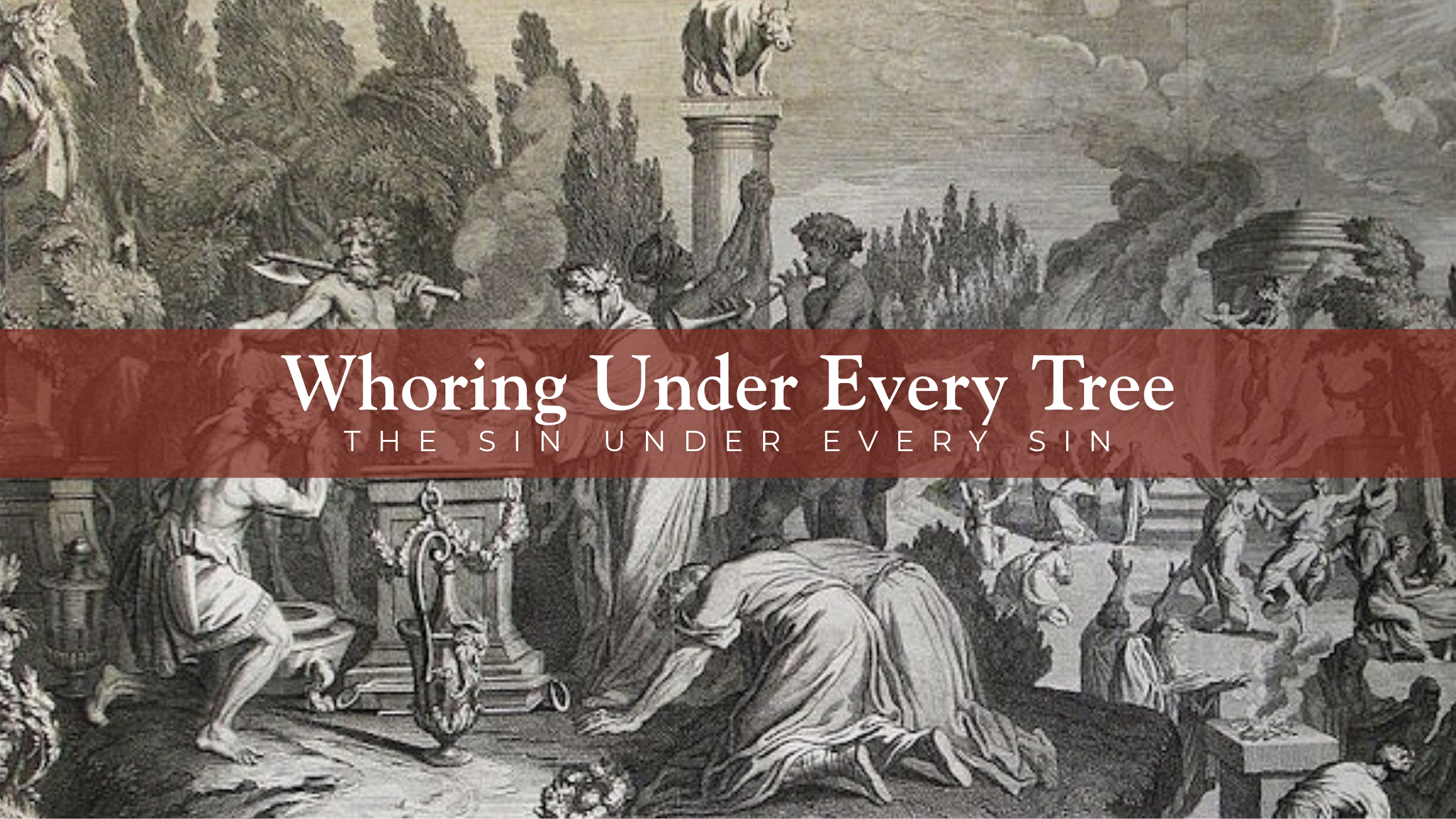
She is accused of laying down as a prostitute under every green tree, engaging in ritualized sexual infidelity woven directly into pagan worship—holy places turned into beds, groves turned into bedrooms, and the land itself polluted by her body (Jer. 2:20; 3:6, 13).
She is accused of paying her lovers to come inside her and pollute her, reversing even the natural logic of prostitution where the whoring woman at least gets paid for degrading herself. Judah, reaches a new level of perversion, now paying others to defile her (Ezek. 16:33–34).
She is accused of lusting after foreign men described in grotesquely exaggerated sexual terms (such as men have genitals the size of horses), and that she has become aroused not merely by their bodies but by their violence, uniforms, and dominance—Scripture is deliberately invoking animalistic anatomy to portray how far her desires have degenerated from purity and holiness (Ezek. 23:20).
She is accused of being a serial prostitute of a wife, incapable of covenant fidelity, chasing lovers for bread, water, wool, oil, and security—even giving her lovers the credit for her blessings that Yahweh, her bridegroom, gave her (Hosea 1–3).
And, she is accused of pursuing intimacy even with death itself, sending envoys down to Sheol, flirting with the grave, seeking lovers among the dead—an image of spiritual necrophilia—idolatry eroticized to the point that she seeks intimacy not merely with false gods, but with death itself.” (Isa. 57:3–9).
Jeremiah goes so far as to say God issued her a certificate of divorce—and even then, she kept whoring. (Jer. 3)
We recoil at such imagery precisely because we recognize its vileness. And that recoil is the point. That is the way we are supposed to flinch and squirm when considering our own sin. O, but how many of us, have sanitized it, moved past it, and forgotten about it. But, this is not true of God, who was serious when He made His wedding vows to Israel and Judah.
Consider Hosea, God's living sermon on covenant faithfulness. In chapter two, the Lord speaks words of staggering tenderness: "I will betroth you to Me forever; yes, I will betroth you to Me in righteousness and in justice, in lovingkindness and in compassion, and I will betroth you to Me in faithfulness. Then you will know the Lord." Here is covenant love in its most concentrated form—vows stronger than death, saturated with mercy, anchored in divine character, sealed with blood.
And then the rest of the book unfolds like a case of gangrene. God's Bride, again and again, runs naked after other lovers, allowing the rot to completely putrify her.
The Anatomy of Every Transgression
This, then, is the scandal under every sin. Said simply, our sin is not just rule breaking, but bed-hopping. Every act of disobedience is an act of infidelity. Every cherished transgression is a rival lover invited into the marriage bed. When we sin, we take the devotion, trust, fear, love, and obedience that belong exclusively to our God and offer them as tribute to another. We say by our actions what our lips would never dare confess: "God, you are not enough for me." And having said that, we go nastily seeking satisfaction everywhere but God—while still presuming upon His husbandly protection, still expecting the blessings of being His bride, and still spending His gifts from His account, without ever seeing the cruel hypocrisy.
The seventh commandment, then, does not merely regulate sexual conduct. It unveils the anatomy of all sin. Beneath every transgression lies this fundamental adultery: the worship of another in place of the One who has bound Himself to us in covenant love.
This is why the Revelation does not flinch from calling apostate Jerusalem "the great harlot." She had known God. She had borne His covenant name. She had dwelt under the shadow of His wings and under the love of His embrace. And yet, while being perfectly loved, she sold herself—to false worship, to self-righteousness, to political expedience—all while maintaining the posture of spiritual respectability. God names that duplicity for what it is: prostitution polluting purple priestly vestments, whoredom draped in the garments of religion. And we must reckon with what we, in our sin, have done.
The Mirror Turns Toward Us
Do not do what you normally do, and simply look away. This indictment is not confined to ancient Israel. It searches us out in the hidden whoring recesses of our hearts and minds as well. Every one of us has played the harlot. Every secret sin is one of a litany of secret lovers we have on speed dial. Every tolerated bitterness, every cherished lust, every refusal to forgive, every autonomous declaration that "I will decide what is good for me" is no different than laying bare breasted and legs spread wide open, under every green tree in town, just like Israel before you.
We sin because we believe the serpent's whisper will satisfy us more than God's word. We transgress because we believe the forbidden fruit will reward us better than our Father's provision. We wander because we forget—or refuse to believe—that the One who betrothed us to Himself in righteousness and lovingkindness is good, faithful, and sufficient for our every need.
The weight of this truth should undo us. God is not an indifferent spouse content in an open marriage. He is not polyamorous or a covenantal swinger who does nothing but stare as we shame ourselves in front of Him. He is a jealous Husband, and His jealousy is not the insecurity of human passion but the white-hot holiness of divine and perfect love. He will not share His Bride with idols. He will not countenance divided affections. He will not pretend that our flirtations with sin are harmless dalliances. The law strips away our fig leaves and exposes us not merely as criminals but as covenant-breakers, not merely as lawless but as altogether loveless, which again, means we must come to Him in the deepest repentance.
The Return That Cannot Be Cosmetic
And that repentance cannot be the smooth crafted words of a politician who says: “forgive me, I have had a grave lapse in judgment… I have made a mistake” True repentance is the torn-garment, ash-covered return of the wayward wife to her Husband, confessing without excuse that we have loved others more than Him, trusted things more than Him, feared circumstances more than Him. Repentance is the cry of the prodigal: "I have sinned against heaven and before you and I am no longer worthy to be called yours…." It is the prayer of the publican: "God, be merciful to me, a sinner."
If this word cuts you, be grateful. It means the law is doing its appointed work, driving you to the end of yourself, forcing you to see your sin as God sees it—not as minor lapses in judgment but as marital treachery against the infinite and holy love of God. The commandment is a mirror, and the face that stares back is that of an adulterer.
But here—precisely here, at the point of our deepest shame—grace also ambushes us. For there is one Husband who has never broken covenant. One Bridegroom who has loved His Bride with a love that will not let her go. One who, when she had played the harlot with every passing suitor, did not divorce her but came after her. Who paid the bride-price not in silver or gold but in His own blood. A bridegroom who took upon Himself the curse of her adultery, bore in His body the judgment her unfaithfulness deserved, and died the death that covenant-breakers die—so that she might be cleansed, forgiven, made new, and presented to Himself without spot or wrinkle or any such thing.
And in this way, the gospel hidden in the seventh commandment. The law shows us our adultery. Christ covers it with His righteousness. The law condemns us as faithless. Christ redeems us by His faithfulness. The law exposes our wandering hearts. Christ gives us new hearts that beat in rhythm with His own.
And so we return. Not in our own strength, not by our own resolve, but drawn by the cords of a love we cannot resist and do not deserve. We return to the Husband who has never ceased to call us His own. We cling to the One who is worthy of our exclusive, undivided, covenant love.
And may God grant us the grace to hate our sin as much as He hates it. May He give us tears for our adultery. And may He turn our affections back to Him, to love what He loves, and to love Him about all other loves!