
An Age of Hollow Speech
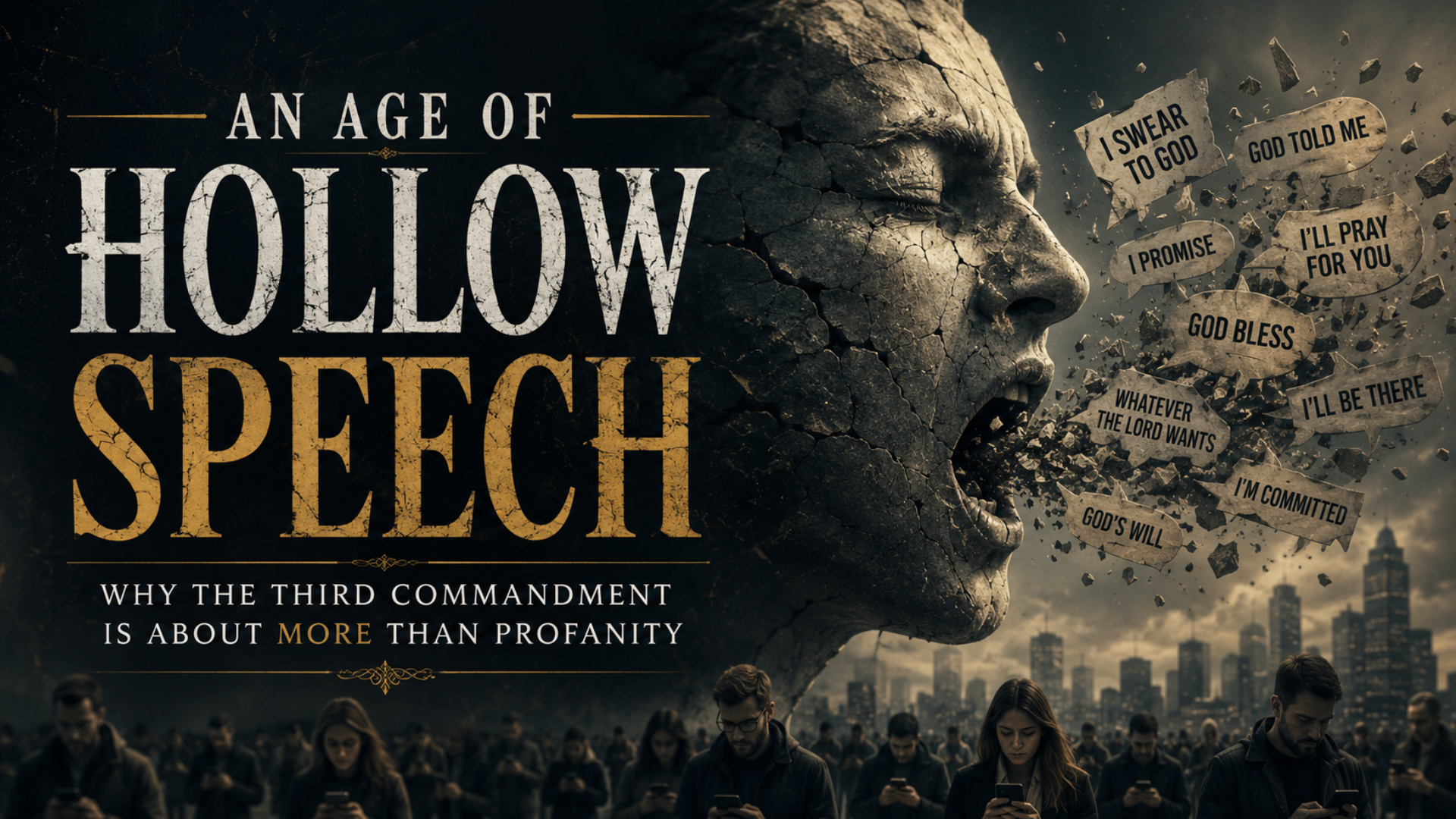
A man stands before God, his bride, his family, and his church, trembling as he vows lifelong faithfulness, saying “until death do us part.” The room is thick with tears, prayers, covenant promises, and joyful expectation. Ten years later he speaks to his wife like a weary customer-service representative trapped in a loveless contract. His words on the wedding day were burnished bronze, but his life afterward became like wet cardboard. Parents stand before the congregation holding their newborn child while solemnly promising to raise him in the nurture and admonition of the Lord. The church prays. Psalms are sung. Tears are shed. Then the next eighteen years are spent catechizing that child in the faith delivered by ESPN, TikTok, vanity, achievement, celebrity culture, sexual confusion, and practical atheism, while the Scriptures gather dust on a shelf like an abandoned family heirloom. Church members publicly vow submission to Christ and His church, then vanish because someone failed to shake their hand, because the sermons became too pointed, or because travel sports became the new liturgy of the home. And yet modern Christians still think the Third Commandment is mostly about saying “Oh my God” too casually.
No wonder the church is weak. We have reduced one of the most terrifying commandments in Scripture into a lesson about spiritual table manners while ignoring the vast cathedral of covenant treachery rising all around us. The Third Commandment is not merely about profanity. It certainly is that, but it is about reality itself. It is about whether words mean anything at all. It is about whether human speech reflects the God whose image we bear, or whether our mouths have become carnival machines manufacturing noise, exaggeration, manipulation, branding, smoke and vapor. And in that way, modern civilization is drowning in words and language detached from reality. Politicians make promises they never intend to keep. Corporations manufacture advertisements full of synthetic sincerity. Social media algorithms rewards theatrical outrage, vitality, and counterfeit virtue. Influencers curate a kind of civic holiness with ring lights and affiliate links. We inhabit an age of inflated speech and microscopic integrity.
And into this swamp of verbal fraudulence, God thunders: “You shall not take the name of the LORD your God in vain.” This is because the commandment reaches far deeper than crude language. To take God’s name “in vain” means to carry that same name, whether by word or by deed, emptily, falsely, frivolously, or deceptively. It means not only speaking about the Holy name of God, but treating it as if it were weightless and insignificant. It means using divine language to decorate human rebellion. The Third Commandment is not merely about curse words. It is about cursed worship. It is about singing lyrics your life has no intention of backing up. It is about using “God told me” as a Christianeasy form of self-authentification. It is about pledging covenant loyalty while quietly engineering escape routes in your heart. The modern church is filled with people who would never say “GD” in anger, yet routinely take God’s name in vain through hollow worship, weightless vows, performative spirituality, and embellished righteousness. We have clean mouths and contaminated speech.
Ecclesiastes 5:4–5 cuts through this kind of religious fog, saying “When you make a vow to God, do not be late in paying it; for He takes no delight in fools. Pay what you vow! It is better that you should not vow than that you should vow and not pay.” Notice Solomon’s language carefully. God takes no delight in fools. The fool in Scripture is not merely the screaming pagan with a beer bottle in his hand. The fool is also the polished churchman whose lips outrun his obedience. The fool is the man who says, “Christ is my everything,” while panicking the moment Christ demands his comforts, schedule, money, lust, or reputation be given up in service to Him. The fool speaks religious lingo fluently while living in practical rebellion. That is the terrifying edge of this commandment. God is not mocked by verbal pageantry. He is not dazzled by emotional worship lyrics sung by men who refuse to lead their homes. He is not manipulated by public prayers offered by people secretly nursing bitterness, pornography, greed, gossip, envy, and cowardice. He is not impressed by theological branding detached from holiness. Many modern Christians treat God’s name like a decorative sticker slapped onto a life still governed by idols.
And this disease runs deeper than we realize. We casually say: “I’ll pray for you.” “God laid this on my heart.” “I feel called.” “I promise.” “I’ll be there.” “I’m committed.” “Whatever the Lord wants.” Then we vanish like smoke into thin air the moment obedience costs us something. The modern world has turned language into inflatable plastic. Words are stretched, distorted, commercialized, politicized, sexualized, sentimentalized, and weaponized until almost nothing means what it once meant. Love no longer requires sacrifice. Friendship no longer requires loyalty. Truth no longer requires correspondence with reality. And vows no longer require permanence. We are raising generations inside a hollow civilization where words evaporate on contact with hardship. And Christians are not immune from the rot. We sing about surrender while making plans for disobedience. We proclaim Christ’s total Lordship while quarantining off the parts of our life we do not want His sovereign hand to touch. We speak of biblical authority while filtering every command through personal preference and therapeutic comfort. We live in a hollow age where people use wedding vows like movie trailers, church membership like gym memberships, and truth like political currency.
This is why Jesus says, “Let your, ‘Yes, yes’ or ‘No, no’; anything beyond these is evil.” With that, the citizen of Christ’s kingdom should possess such integrity that dramatic embellishment becomes unnecessary. His honesty should carry its own gravity. But ours often does not, because fallen man loves appearances more than substance. We would often rather sound holy than become holy. That is why “God told me” has become one of the most abused phrases in modern evangelicalism. Many people invoke divine authority the same way ancient pagans consulted omens, read the entrails, or appealed to astrological signs. “God-language” becomes a sanctified mechanism for self-validation. And this commandment exposes all of us and in every way. Not merely the liar. Not merely the manipulator. All of us. Because every believer knows what it is to sing truths more confidently than he lives it. Every Christian knows the shame of promising consistency and delivering instability, of pledging discipline and returning to slothfulness, of confessing surrender while quietly preserving idols in the back alleyways of our heart.
And if salvation depended upon the integrity of our vows, every one of us would collapse under the rubble of our own speech. But this is where the Gospel erupts into glory. Jesus Christ never once carried His Father’s name emptily. Not once. Every word He spoke was perfectly true. Every promise He made was perfectly fulfilled. Every covenant obligation was carried flawlessly to completion. Where Adam spoke treachery, Christ spoke truth. Where Israel swore loyalty before chasing idols, Christ remained faithful. Where Peter denied Christ with curses, Jesus stood firm in perfect obedience. The history of the world is the history of man uttering broken words. Then Christ entered history as the true Word made flesh, and became the only man whose speech never collapsed beneath reality. At the cross, the perfectly faithful Son bore the judgment deserved by oath breakers, hypocrites, manipulators, cowards, and religious frauds like us. The wrath reserved for covenant violators fell upon the Covenant Keeper.
And now the Gospel does not merely pardon our speech. It remakes the speaker. Christians should sound different than the world while we are living in this world. Not merely cleaner. Weightier. Our words should possess structural integrity. When a Christian says, “I will pray for you,” heaven and earth should almost move instinctively toward expectation because his availing prayers have become so dependable. When he vows fidelity, he means fidelity. When he confesses sin, he means repentance. When he worships, he means adoration. A Christian’s words should not rattle around like loose change in a toddlers piggy bank. They should land like battering rams and catapult stones hurled in covenant loyalty. This is why the Third Commandment is not a small commandment. It is a commandment about whether the image of God is being restored in His people. The devil is the father of lies. Christ is the Truth incarnate. And every careless, manipulative, hollow, performative use of language trains us either toward Satanic disorder or Christlike integrity. Which means this commandment is not ultimately about vocabulary management. It is about whether our lives have become truthful.
So repent. Repent of using holy language to conceal unholy living. Repent of worship lyrics sung without intent to obey. Repent of “God told me” spirituality detached from Scripture. Repent of promising faithfulness while cultivating secret escape plans. Repent of carrying God’s name lightly while claiming to belong to Him publicly. And then flee to Christ. Because the same Savior who condemns empty words is also the Savior who forgives liars, restores hypocrites, cleanses fools, and teaches broken people how to become truthful again. For in a hollow civilization built on counterfeit speech, Christ is still the Word made flesh, and He is still kind to sinners like you and me.