
From Puritan to Pornographic
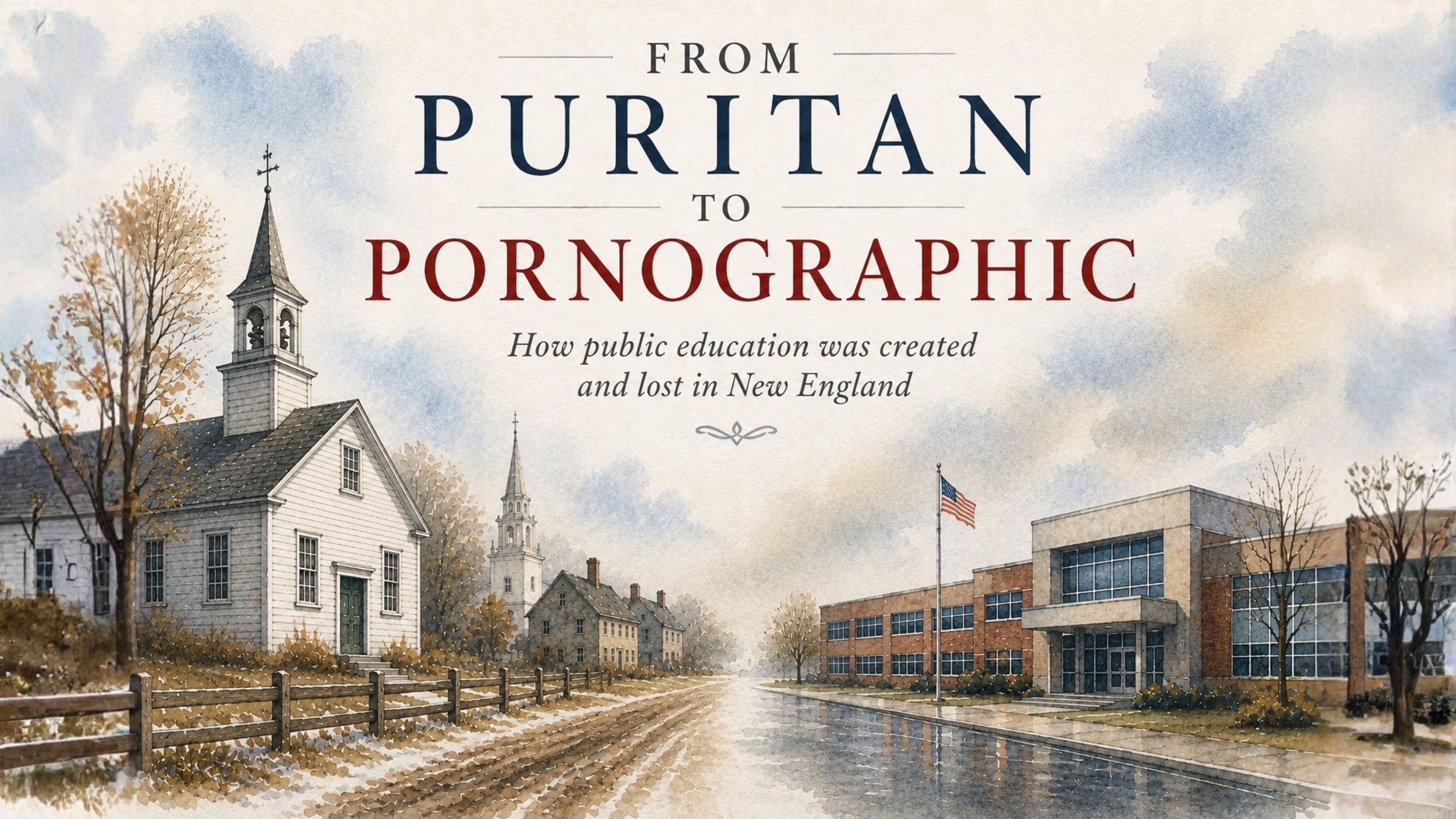
The men of early New England believed Satan preyed upon biblical ignorance the way wolves prey upon lambs separated from the flock. They crossed an ocean carrying Geneva Bibles in their hands and covenant theology in their bones, because they believed Christ was Lord over every inch of life, including the formation of children. They feared a generation unable to read Scripture. They feared a church vulnerable to deception. They feared a civilization sliding into theological darkness. And so, in 1647, Massachusetts passed what came to be called the Old Deluder Satan Act, requiring towns to establish schools so children could learn to read and thereby resist "that old deluder, Satan."
Now, as someone who owes my entire theological formation to the Puritans, I want to say upfront there is so much that they got right. For instance, the instinct that a robustly Christian education and the literacy requisite to read the Scriptures was absolutely right. Why? Because education is never neutral. Literacy matters because truth matters. Truth matters because God has spoken and given us His Word. In this way, the Puritans did not believe children were brains floating in jars waiting to absorb data. They believed children were covenant beings who would either worship the living God or be discipled by idols. The famous New England Primer taught theology alongside the alphabet. Harvard was founded primarily to train ministers. The Puritans believed Christ ruled over the mind no less than the soul.
And they were right about that.
Modern Christians often treat education like a morally neutral delivery system, as though chemistry, literature, history, and ethics could somehow float above questions of worship and authority. The Puritans would have regarded such a thought as lunacy. They knew every civilization educates according to its highest loves. They knew every classroom eventually becomes a sanctuary for some vision of reality. In this, they were immeasurably wiser than modern America.
But wisdom in one area does not produce infallibility in every area. And the Puritans, for all their towering theological clarity, made one critical miscalculation whose consequences we are still living inside. Consider what has happened on the same patch of New England ground. The Commonwealth of Massachusetts passed the Old Deluder Satan Act in 1647 to ensure children could read Scripture and resist the devil. The Commonwealth of Massachusetts now hands those same children, in those same towns, pornographic sex education curriculum that the Puritans would have burned in a public square. Two acts of the same legislature, separated by three and a half centuries, governed by two entirely different gods. The geography did not change. The lordship did. How that happened, and what the Puritans failed to see coming, is the question we must answer carefully.
And before we do that, I want to state something clearly. The argument is not that the Puritans created modern secular education. They did not. The argument is not that the Puritans would have approved of pornographic sex education, gender ideology, or humanistic statism. They would have regarded such things as civilizational insanity and open rebellion against Christ. The argument is subtler than that.
The Puritans, operating within a deeply covenantal society, tied educational structures closely to civil authority because they assumed the magistrate himself would remain broadly Christian. They built educational institutions within the framework of an explicitly Christian commonwealth. That made sense inside their historical moment. They did not envision a future America ruled by secular humanism, expressive individualism, and bureaucratic paganism. They did not foresee a civilization where the state itself would become aggressively hostile to Christ while still retaining institutional authority over education.
But institutions often outlive the theology that built them.
The early New England system functioned within a culture saturated by Protestant assumptions. Over generations, Enlightenment rationalism began severing knowledge from revelation. Human reason increasingly replaced Scripture as the final authority. Theological liberalism hollowed out the churches. Then came Horace Mann, the architect of the common school movement, who reorganized education around what he called "non-sectarian" morality. But non-sectarian never meant neutral. It meant moral instruction detached from historic Protestant orthodoxy, vague enough for Unitarians and Universalists, evangelicals and skeptics to share a single bench. The doctrinal center had already begun collapsing inward.
The twentieth century then accelerated the revolution. John Dewey openly rejected supernatural Christianity and reconceived education as the chief instrument of social reconstruction. Listen carefully to what he believed his colleagues were doing. In his 1897 essay My Pedagogic Creed, he declared that "the teacher always is the prophet of the true God and the usherer in of the true kingdom of God." That sounds wonderful until you understand that Dewey believed there was no God. He understood education to be liturgical formation. He simply changed the liturgy, keeping the pragmatic form while abandoning the supernatural substance. In that way, the schoolroom would no longer form Christians beneath the authority of God. It would form democratic citizens beneath the authority of the modern state.
The machinery of New England remained. The theology, of course, had changed.
This is the point modern Christians desperately need to understand. Institutions are never self-governing. They always reflect the religion of those controlling them. Once educational authority becomes centralized within civil structures, whoever captures those structures eventually catechizes the children. So goes the state, so go the schools, so goes the civilization.
Our present moment, therefore, should not surprise us nearly as much as it does. Modern schools did not become ideological. They have always been so. Today's schools have merely become more honest about the theology they have been drifting toward for generations. A civilization that removes Christ from the center will never remain empty for long. Someone always occupies the throne, and modern secularism has filled that vacuum with the religion of autonomous selfhood. That is why children are now taught that identity is self-created, morality is self-defined, gender is self-determined, and desire is self-authenticating. The issue is not merely "bad curriculum." The issue is lordship.
Who has the authority to define reality?
That is the real question beneath every educational debate. And here Scripture speaks with devastating clarity. God repeatedly places the primary responsibility for covenantal formation upon parents, especially fathers, beneath the authority of His Word. "These words... shall be on your heart. You shall teach them diligently to your sons" (Deut. 6:6-7). Paul carries that ancient charge into the new covenant when he commands fathers to bring up their children "in the paideia and instruction of the Lord" (Eph. 6:4), borrowing the very word classical antiquity used to describe the total cultural formation of a citizen. Greek paideia was not tutoring. It was the comprehensive shaping of a soul into a member of the polis. Paul does not narrow that concept when he picks it up. He claims it. He hands its keys to Christian fathers. And the psalmist names the eschatological stakes when he writes that God established a testimony in Jacob "that the next generation might know them, the children yet unborn, and arise and tell them to their children, so that they should set their hope in God" (Ps. 78:5-7).
The picture across the canon is profoundly personal. Truth handed down covenantally from generation to generation beneath the fear of the Lord. Not outsourced reflexively to distant bureaucracies increasingly hostile to Christ.
This does not mean every Christian family throughout history has sinned by using public institutions, nor that every Christian teacher inside the current system is morally compromised. Many faithful believers labor inside difficult structures with genuine integrity, and Christ honors that labor. The issue is larger than individual intentions. The issue is the theological direction of the institution itself, and the danger of assuming centralized educational power will remain perpetually Christian in a fallen world.
The Puritans were right to fear Satanic ignorance. What they could not fully foresee was a future where the state itself would become a primary engine of theological rebellion.
All of which raises the practical question every Christian parent eventually has to answer, usually somewhere around a kitchen table covered in math worksheets. If we cannot hand our children to a state catechizing them against Christ, and Jesus is not physically descending each morning to teach them algebra, then what?
The answer is older than the question. Christ governs His world through means.
He governs His church through pastors and elders. He governs the civil realm through magistrates. He governs the home through fathers and mothers. And He governs the education of covenant children through covenantal stewardship rooted first in the family, assisted by the church, and only secondarily aided by whatever tools may be lawfully useful beneath Christ's authority. Christian parents cannot outsource discipleship to magistrates, governors, or school boards while retaining only sentimental involvement in their children's formation. A man may delegate aspects of instruction without delegating covenantal responsibility itself, just as he may hire a carpenter without surrendering ownership of his house. But he must not hand the soul of his child to an institution that confesses a rival god, and he must not pretend that institution is neutral simply because the algebra textbook still works.
The church, likewise, must recover her role as more than a Sunday motivational seminar wrapped in fog machines, video loops, and therapeutic platitudes. The church is meant to form an entire Christian world-and-life view. Pastors are to equip parents. Older saints are to model wisdom. Christian communities are to create cultures where children breathe Christian assumptions naturally, instead of gasping for them like swimmers surfacing through the dark waters of secularism.
And this formation must touch everything. Math must reveal order, because Christ is not chaotic. Science must produce worship, because creation is not random. History must reveal providence, because nations rise and fall beneath the hand of God. Literature must cultivate virtue, because words shape loves. Even discipline must become discipleship, because children are not pets to manage or state property to process, but immortal image bearers being prepared for dominion beneath the reign of Christ.
Christian education is not merely about protecting children from bad ideas. It is about raising children who can recognize Christ's fingerprints on every square inch of reality.
The line, then, is not finally between buildings or curricula but between confessions. A school may be tax-funded and still teach a child to fear God if the parents and the church remain its true catechists. A school may be Christian in its branding and still surrender a child to a rival god if the family hands over the soul along with the tuition. The line runs through every home before it runs through any institution.
All of which would crush any honest parent who tried to bear it alone. The standard is too high. The stakes are too eternal. The flesh is too weak. And so an essay on Christian education cannot end with the demand. It has to end where every faithful word eventually ends, at the feet of the One who bore the demand on our behalf.
Because no parent does this perfectly. Every father has moments of cowardice. Every mother grows weary. Every Christian school contains sinners. Every homeschooling family struggles with frustration, inconsistency, and weakness. The solution is not pretending Christian families are flawless while the world alone is broken. The solution is remembering that God is pleased when His children faithfully, sincerely, and imperfectly attempt to obey His Word, and that Christ remains the faithful covenant keeper modern parents never fully become.
Adam failed to guard the garden. Israel failed to teach the covenant faithfully. The modern church has too often surrendered her children to the spirit of the age for comfort, convenience, and economic survival.
Yet Jesus Christ has not failed.
The true Son feared the Father perfectly. The true Wisdom obeyed flawlessly. The true Teacher spoke only truth. And when fools like us had wandered into rebellion, Christ carried our guilt to the cross, rose triumphantly from the grave, and now pours out His Spirit to reform households, churches, and civilizations beneath His gracious reign.
This is why Christian parents need not retreat in panic like loose shopping carts in a storm while civilization collapses around them. The same Christ who declared that all authority in heaven and on earth had been given to Him still reigns from a throne that was not vacated when Horace Mann started a newspaper or when John Dewey wrote a creed. The kingdom advances. The leaven works through the lump. The mustard seed becomes a tree. And every faithful Christian household, however imperfect, however small, however ordinary in its weekday rhythms of math and Latin and morning prayer, becomes a small embassy of that kingdom planted in the middle of a disintegrating world.
Because civilizations do not remain Christian accidentally. Children do not become Christian accidentally. And neither will the future.