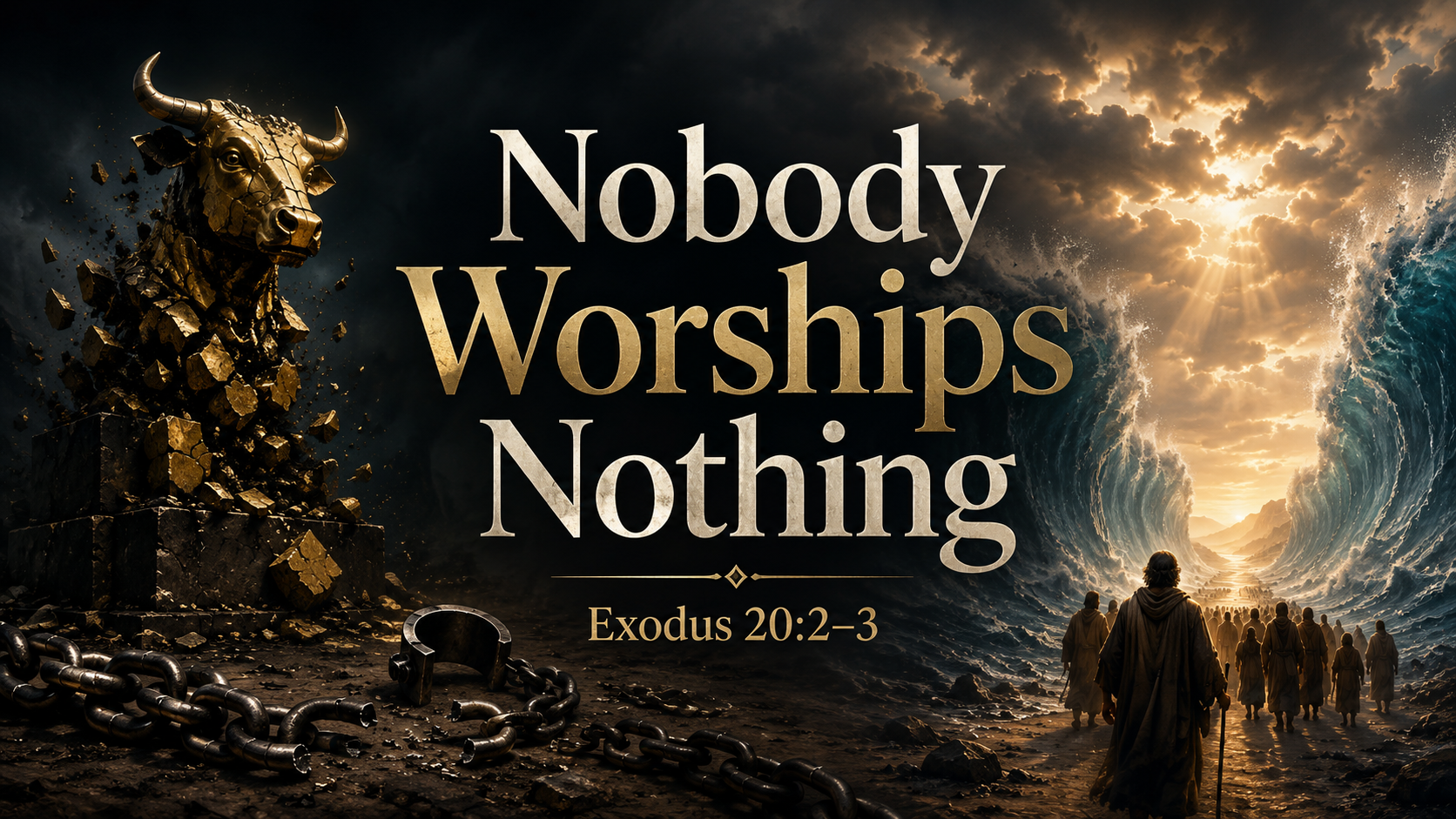
Nobody Worships Nothing
The decalogue does not begin with a list of rules. It has those, ten of them in fact, but it does not begin there. It opens, instead, with the question of who you belong. It tells you whose you are before it tells you what to do.
"I am the LORD your God, who brought you out of the land of Egypt, out of the house of slavery. You shall have no other gods before Me." (Exodus 20:2-3)
Three things need to be understood in this text. First, God gives an order that cannot be reversed. Second, there is a claim that cannot be escaped. And third, there is a question that can only be answereåd with a whole life surrendered to Him. Let’s take them one at a time.
THE ORDER
God did not begin the Ten Commandments by barking orders from heaven. He began by reminding His people that He had already set them free. From what?
Well, we have to remember that for four hundred years Pharaoh owned Israel's back, her days, and her sons. He threw their infants into the Nile and buried their future beneath the bricks he used to build his monuments. He did not merely want their labor. He wanted their dejected loyalty, their subjugated children, and even their dismal future. Every empire wants the whole man from cradle to grave, and Egypt was simply one of the first empire large enough to execute it on an industrialized scale.
So God came down, and He did not negotiate. He did not request kinder conditions or convene a committee on the brick shortage. He went to war with every god Egypt owned: the Nile, the sun, the priests, the crocodiles, the king who called himself divine. Ten plagues stripped Egypt naked before the watching world. Pharaoh said, "Israel belongs to me." God said, "Israel is My son." That is what the exodus actually was. Not a transfer from one master to no master, but from a butcher to a Father. That is the entire difference between slavery and freedom, and it is why the First Commandment can only be understood once Exodus twenty, verse two has already been read.
Look at the order. Before God gives a single command to this newly freed people, He says, “I brought you out.” He is remind them that He alone had broken Egypt’s back. He is the one who shattered Pharaoh’s power. He had split the sea open and led His people through on dry ground. For what purpose? That He might deliver His people and make them His own. This is why the commandments do not begin with Israel climbing up to God. They begin with God coming down to rescue them.
That matters because the order changes everything.
Here’s why. If you obey God in order to make Him save you, that is just another kind of slavery. The chains may look more religious, but they are still chains. The whip may no longer be in Pharaoh’s hand, but now it is in the hand of your own guilty conscience, your own failing strength, your own desperate attempt to prove you are enough.
But if you obey because God has already saved you, then obedience becomes something entirely different. It is not the labor of a slave trying to purchase freedom. It is the life of a son learning how to live in his Father’s house.
Obedience after grace is sonship. Obedience before grace is another kind of Egyptian slavery with a fresh rebrand. This is why the order matters.
THE CLAIM
Once we understand the order, we need to understand the claim God is making in the First Commandment.
And the claim is this: nobody worships nothing.
Every person bows somewhere. Every man, woman, and child looks to something as the highest thing, the final thing, the thing that gets the last word. It may not have a temple. It may not have a priesthood. It may not have songs, incense, or sacrifices. But it still functions like a god.
You can see it every time a person has to make a choice. When two desires pull in opposite directions, something has to decide which one wins. Why choose comfort over obedience? Why choose approval over truth? Why choose money over family, or pleasure over holiness? There is always some deeper authority beneath the decision, something sitting on the throne and ranking everything else underneath it.
That is why the man who says, “I do not worship anything,” is not being honest with himself. He may worship happiness. He may worship himself. He may worship science, success, control, comfort, public opinion, or whatever feels right to him this week. But he has not escaped worship. He has only changed the name of his god.
And if you watch that man long enough, his deity will become visible. He may mock a Christian for structuring his whole life around an unseen God, but he cannot imagine missing a single day at the gym. He may roll his eyes at tithing, then grip his finances like Ebenezer Scrooge counting coins by candlelight. He may call worship a primitive habit from a less enlightened age, then let his mood rise and fall with the number of followers he has online. That man has a god. Just not a good one. He has traded the living God, holy, generous, and good, for a cluster of cruel little masters that never give him rest.
Some may object, “I am an atheist. I do not bow. I have no god.”
But that does not really work. The question is not whether you use religious language. The question is what holds final authority over you. What belief could no one talk you out of? What principle stands above every other principle? What love would you protect even if it cost you your reputation, your career, your marriage, your comfort, or your life?
That is the real test. Not what you say you worship, but what you will not betray. Not what creed you recite, but what command you obey when everything else is stripped away.
And once you answer that question, you have found your god. You may not pray to it. You may not sing hymns to it. You may not call it divine. But if it has the final word, if it governs the way you think and move and choose, if it decides what must be sacrificed and what must be spared, then that is your god. Atheist or not, you bow to something.
This is why the golden calf is both wicked and almost comedic. God had just shattered Egypt, split the sea, and thundered from the mountain. Israel had seen the plagues, felt the spray of the Red Sea, eaten bread from heaven, and heard the voice of God shake the earth. And yet, after all of that, they were free for about five minutes before they started melting jewelry into a new master.
That is what idolatry does. It takes a man who has been brought out of slavery and teaches him to kneel again. It puts a freed man on the ground, patting around in the dust for his old chains.
Every idol runs the same con. It walks into the house as a servant and ends up ruling like Pharaoh. Money says, “Use me to build a life,” then slowly spends your life instead. Approval promises peace, then makes you a coward. Comfort offers rest, then hollows you out into uselessness. Pornography promises pleasure, then quietly annexes the imagination. Every idol promises to serve you. Every idol ends by owning you.
That is the claim of the First Commandment. Not that some people worship and others do not. Not that religious people have gods and irreligious people are free. The claim is far more searching than that. Everyone worships. Everyone bows. Everyone serves some final authority. The only question is whether you will bow before the one true God who can break your chains, or before some new Pharaoh who is already warming up the whip to lay across your back.
THE QUESTION
To finish, we need to end with the most important question. Whom will you serve?
For the moralist, this question is for you, precisely because you assume it is not. You have been damnably good your whole life. You have never bowed to a golden statue. You have never offered incense in the service of demons. And that gives you tremendous comfort.
But, have you ever stopped to ask what you cannot bear to lose? What if your reputation was gone, or your rightness, or the good opinion of people whose opinion really matters to you? Respectability, reasonability, and self-righteousness are all little altars that many a religious man have bowed down to. And, if you serve them, you are no different than the pagans you look down your nose at.
And sinner, this question is for you too: whom do you serve?
You say no one. You say you are free. You say you are just living your truth, following your heart, refusing to let anyone control you. But be honest. If you cannot say no to your lust, you are not free. If your anger owns your mouth, you are not free. If your phone can command your attention whenever it buzzes, you are not free. If comfort decides your obedience, if pleasure writes your schedule, if your appetites drag you around by the throat and you still call that liberty, then you have not escaped slavery. You have only learned to enjoy the sound of your chains.
That is the serpent’s oldest lie. He told Adam and Eve that life would finally open up once God’s Word was pushed out of the way. They reached for freedom and found shame. They reached for independence and found death. And sin has not changed its sales pitch. It still walks in smiling. It still calls itself liberation. It still says, “No master. No rules. No chains.” But once you let it in, it starts giving orders. The thing you called freedom becomes a leash. The desire you thought you controlled begins controlling you. And whether you feel the weight yet or not, if sin has the final word, you are not free.
THE POINT
So here is the point. When God says, “You shall have no other gods before Me,” He is not asking for first place on a crowded shelf. He is not saying, “Put Me above your other loves, your other trusts, your other fears, your other masters.” He is clearing the shelf.
The command is not, “Make sure I am your favorite god.” Instead, the command is, “Bring no other god into My presence.”
That means the Lord will not share any room or place with any idols. He will not be one loyalty among many. He will not be the religious topping on an otherwise self-ruled life. He does not come to take His place alongside our reputation, comfort, lust, money, control, bitterness, ambition, or the need to be admired. He comes as Lord and sovereign over all. As Hudson Taylor famously said: “Christ is either Lord of all, or not Lord at all.”
Whatever you fear most, love most, trust first, run to first, and cannot imagine living without, that is the god you are trying to drag before His face. And that god will not save you. It will master you and enslave you. Jesus said it plainly: “Everyone who commits sin is the slave of sin.”
But dear beleaguered believer, never forget the good news. This is exactly what God came to free you from. The God who says, “You shall have no other gods before Me,” first says, “I am the LORD your God, who brought you out of the land of Egypt, out of the house of slavery.” He does not begin with chains. He begins by breaking them. He does not command His people so they can earn deliverance through legalism. He delivers His people first. Why? So that they can finally learn how to freely live, in service to Him.
The idols promise freedom as they buckle fast your chains. God gives His own Son. And whoever the Son has set free, he is free indeed (John 8:36)