
A Child Left To Himself
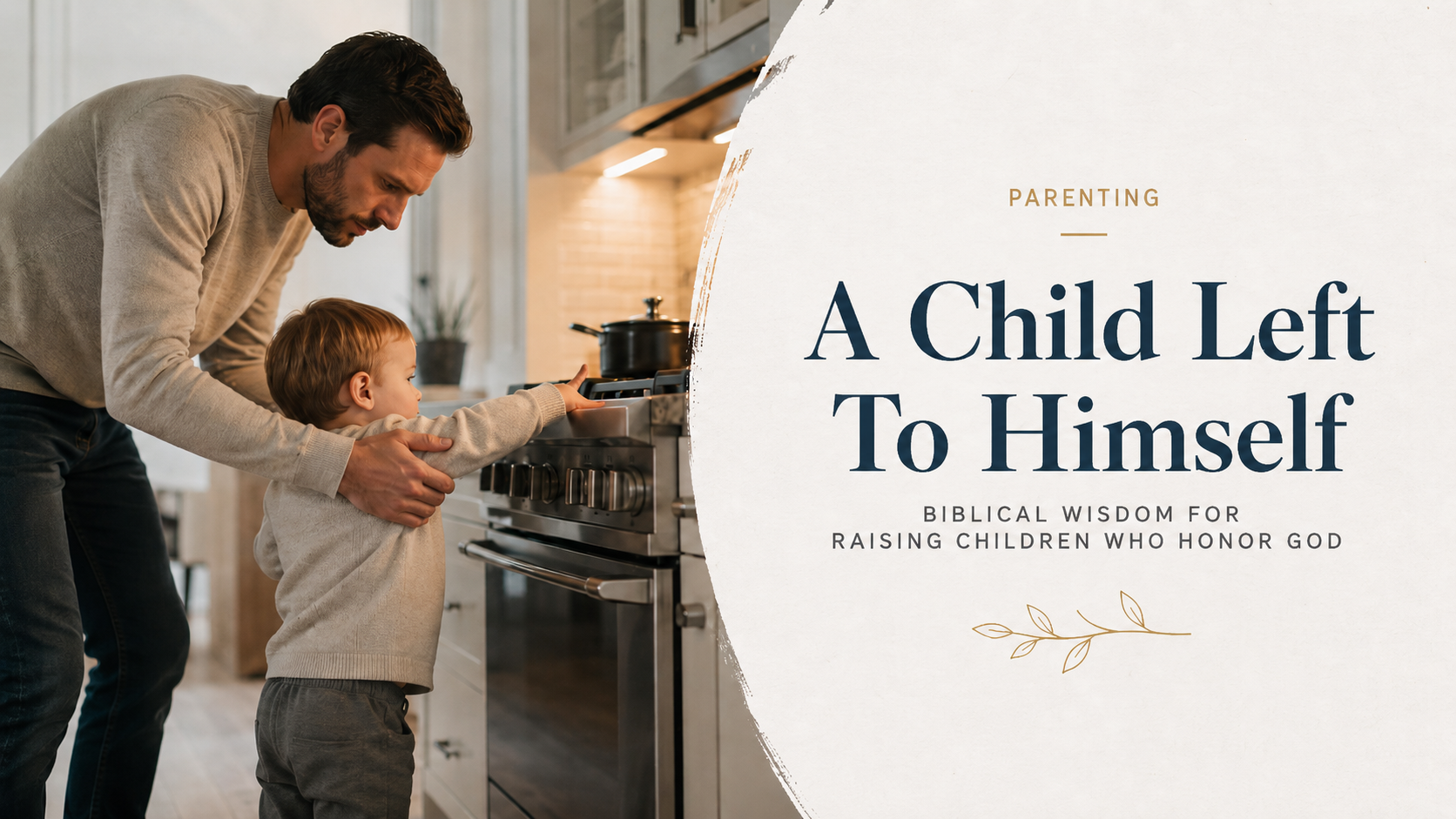
Picture a toddler reaching toward a hot stove.
A loving father does not stand ten feet away and begin a lecture about heat transfer. He moves. He crosses the room. He grabs the small wrist before it lands. The grip hurts a little. The child cries. For one confused second he may even think his father is the danger. But the father is not the danger. The fire is. That small pain was mercy.
This is the whole logic of Christian parenting, and most parents never say it out loud. Parenting is not merely the work of putting good things into a child. It is also the work of lovingly confronting the bad things already growing inside him. You teach truth. You cultivate wisdom. You model godliness. You fill the home with Scripture and aim the affections of your children toward Christ. But eventually every Christian parent meets the other half of the task. What do you do when the child understands the command perfectly and disobeys it anyway? What do you do when the little heart in front of you is not an empty cup waiting to be filled, but a cup already sloshing over with anger, selfishness, and defiance?
The modern world has an answer. Let the child express himself. Do not bend him. Do not bruise his spirit. Whatever is inside him is authentic, and whatever is authentic must be affirmed.
Scripture has a very different answer, because Scripture has a very different understanding of the child.
"Folly is bound up in the heart of a child, but the rod of discipline drives it far from him." (Proverbs 22:15)
Almost everyone knows this truth. Almost no one is still willing to say it out loud. Children are not naturally wise. They are not morally neutral. They are not blank slates waiting for society to ruin them. Folly is already bound up in their hearts, and folly in the language of Proverbs is not childish clumsiness or an honest mistake. It is not spilled milk, untied shoes, or a six year old who cannot remember his multiplication tables. It is the stubborn little will that does not want to be ruled.
Nobody has to teach a child to lie. Nobody holds a seminar on selfishness before a toddler starts snatching toys from his sister. Nobody explains how to stiffen the neck, clench the fists, and collapse to the floor screaming because Mom said no to another cookie. Sin comes naturally. Original sin sometimes wears dinosaur pajamas.
Your children are precious gifts from God, welcomed into the covenant home, taught to pray, brought among the saints, and continually pointed to the promises of Christ. But precious does not mean innocent. Cute does not mean righteous. Folly is bound up in their hearts because folly is bound up in ours. And folly does not grow out. It grows up.
The five year old who cannot hear the word no may become the fifteen year old who despises every authority. The fifteen year old who will not receive correction may become the man who explodes whenever anyone questions him. Folly rarely disappears because a child gets taller. Sometimes it simply grows a beard, gets a license, and opens a checking account.
That is why Solomon writes, "Whoever spares the rod hates his son, but he who loves him is diligent to discipline him." (Proverbs 13:24)
That verse sounds shocking to a culture that defines love as perpetual affirmation. But Solomon is not confused about love. Love seeks the true good of another person even when the seeking is painful and costly. The parent who refuses to discipline may call it kindness. More often he simply loves his own comfort more than his child's character. He does not want the tears. He does not want to put down his phone and deal with the rebellion in front of him. So he overlooks it. Then he overlooks it again. Eventually the child learns that defiance works, that commands are suggestions, and that authority retreats if he makes enough noise.
That child is not being loved. He is being abandoned with a thousand pleasant smiles.
The loving parent, Solomon says, is diligent to discipline. The word carries the sense of rising early and acting in earnest. He does not wait for a sinful pattern to harden into character before he addresses it. Love gets up early. Love does not keep hitting the snooze button while rebellion takes root. Love corrects small sins before they grow teeth.
None of this licenses an angry parent. Biblical discipline is not a grown adult unloading his fury onto someone smaller and weaker. It is not screaming, slapping, shaking, or humiliating a child because a parent has lost control. That is not discipline. That is violence. Biblical discipline never comes from a parent who has lost control. It comes from a parent who has it. It is the calm hand of love, not the hot hand of anger. It is the surgeon's knife, cutting only to heal, never the brute's club, striking only to hurt.
Discipline and punishment are not the same thing, and the difference matters more than most parents realize. God punished the sins of His people at the cross. Christ bore the curse there. Christ endured the wrath there. Christ paid the debt there, in full. Christian parents are not little judges carrying out divine vengeance on their children. They are fathers and mothers called to correct, teach, restrain, and restore, the way God Himself deals with His own children, disciplining without condemning, because there is no condemnation left to add.
Solomon gets specific: "The rod and reproof give wisdom, but a child left to himself brings shame to his mother." (Proverbs 29:15)
Two tools, not one. The rod is a brief, measured, controlled consequence, given by a parent who is calm, in response to a sin the child understood and chose. Reproof is the explanation that follows it, naming the sin, telling the child why it mattered, and assuring him that love has not gone anywhere. The hand corrects. The mouth teaches. Both aim at the heart, not merely the behavior.
The rod without reproof becomes pain without meaning. Reproof without a rod becomes noise. Some parents warn and lecture and count to three so many times that their words turn to wallpaper. The child learns that Dad does not mean "obey." Dad means "you may continue disobeying until I reach the number three." He does not learn obedience. He learns delay.
But the rod and reproof together give wisdom, and correction is not a break from a child's education. Correction is his education. Every time you faithfully correct your child you are teaching him that God rules, that authority matters, that sin has consequences, that forgiveness is real, and that love does not leave people alone in their rebellion.
A child left to himself is not free. He is abandoned. Eli knew his sons were corrupt and did nothing to restrain them. His silence at the family altar became a catastrophe for the nation. His sons profaned the worship of God, died on the same day, and helped bring shame on Israel. David failed in the same way with Adonijah. Scripture says it plainly: his father had never at any time displeased him by asking, "Why have you done so?" Never crossed him. Never demanded an account. That uncorrected son grew up and reached for his father's crown.
The world is downstream from your living room. Homes produce citizens. Nurseries shape nations. The boy who is never made to answer for cruelty to his sister may one day be the man who cannot answer for cruelty to his wife. The folly a parent refuses to drive out of a child may one day drive the child, all the way to a throne that was never his.
Folly does not grow out. It grows up, and it takes whatever shape you allow it to keep. None of this should make a Christian parent proud, because every honest parent knows how badly he has failed at it. We have been too soft and too harsh in the same week. We have ignored serious sin and exploded over a spilled cup of juice. We have disciplined because a child embarrassed us in public rather than because we loved him in private. Parents need grace as much as their children do, and that grace has a name.
"The Lord disciplines the one he loves, and chastises every son whom he receives." (Hebrews 12:6)
God does not correct His children because the cross failed to finish the job. Jesus did not leave a little wrath behind for the Father to pour out later. There is no condemnation for those who are in Him. Yet God still corrects His own. He humbles us. He exposes what we would rather hide. He leads us through providences that hurt. He cuts away what is diseased and bends what has grown crooked, not because He hates us but because He loves us too much to leave us alone in our foolishness. God does not punish His children. He perfects them.
Jesus was the one Son who never needed correction. No folly was bound up in His heart. He never lied, never rebelled, never dishonored His Father. Yet the rod our rebellion deserved fell on Him instead.
"He was pierced for our transgressions; he was crushed for our iniquities; upon him was the chastisement that brought us peace." (Isaiah 53:5)
Christ bore the punishment so that you could give correction without condemnation. He endured the wrath so that you could discipline without vengeance. He was buried and He rose so that foolish parents and foolish children alike could be forgiven, remade, and given hearts of wisdom in place of hearts of folly.
Your hope was never perfect parenting. Your hope is Jesus. The goal was never merely quiet children, or impressive children, or children who make you look good at church. The goal is wise children, who fear God, receive correction, hate their sin, love righteousness, honor authority, and cling to Christ long after they have left your house.
Folly does not grow out. It grows up. Love your children enough to confront it while there is still time.