The Graves of Craving
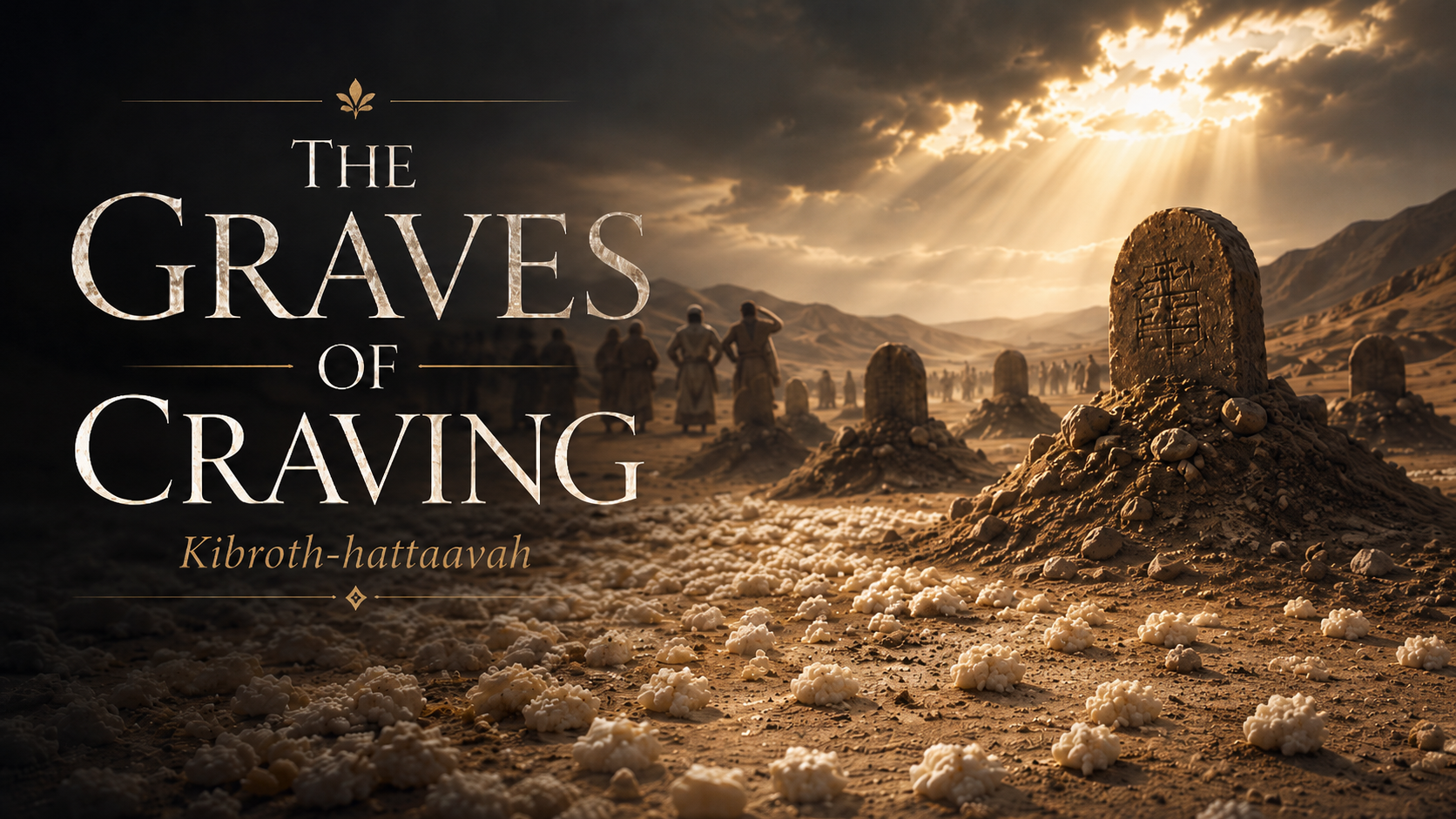
In the wilderness, in the book of Numbers, God buried an entire generation of Israelites beneath the desert sands and named the cemetery after the appetite that killed them.
Kibroth-hattaavah. The Graves of Craving.
They did not die of thirst. They did not fall beneath an enemy’s sword. They were not mauled by wild animals. They died from a kind of wanting that had gone rotten. All the while, bread was falling from heaven. Every morning it came, sweet as honey and scattered across the earth like frost, yet the people stood there disappointed, aching for cucumbers. CUCUMBERS!?!?!?!
God had just catered a miraculous breakfast, and they sent it back because they preferred the menu in Egypt. They remembered the fish. They reminisced about melons, leeks, onions, and garlic. Their memories wandered backward through such a delusional fog that they forgot the slave camps, the whips and chains, and the brick quotas without straw. They forgot the murdered sons floating in the Nile.
Bondage began looking beautiful to them, which is precisely what covetousness does. It makes slavery fragrant and providence tasteless.
God had delivered them from Pharaoh, split the sea beneath their feet, drowned their enemies behind them, shaded them by cloud, warmed them by fire, and fed them with angelic bread. Yet they looked at the daily generosity of God and said, in effect, “Is this all?”
That attitude has dug graves in every generation.
The reason is simple. Covetousness is not merely the desire to possess something. It is the heart’s mutiny against providence. It is the creature looking at what the Creator has given, looking at what the Creator has withheld, and deciding that God has mismanaged the distribution.
It is the heart saying, “What God gave me is not enough, and what He gave someone else really oughta belong to me.”
That is why the Tenth Commandment is such a terrifying crescendo to the law of God. The violations of the other commandments often break into public view. Idolatry erects an altar. Murder leaves a corpse. Adultery defiles someone else’s bed. Theft empties someone else’s pocket. Perjury poisons a courtroom.
Covetousness, however, can do its entire work without moving a muscle.
You can break the Tenth Commandment while sitting quietly in church, smiling politely, singing loudly, and shaking the hand of the man whose life you secretly resent. You can covet with your Bible open. You can envy your neighbor while thanking God for him in prayer. Your hands may remain folded while your heart rifles through another man’s house.
Covetousness is theft rehearsed in the imagination.
It is adultery before the hotel room, murder before the knife, rebellion before the raised fist. This is why Paul said he would not have known coveting except the law had said, “You shall not covet” (Romans 7:7). The commandment did not merely prohibit one more outward action. It turned the lantern inward and exposed the criminal hiding behind his ribs.
The Tenth Commandment reveals that sin is not only about what you do with your body, but what you entertain in your mind and crave within your heart. Sin begins with polluted desires long before it ends with bloodstained hands.
There is also a profound relationship between the Fourth Commandment, which concludes the first table of the law, and the Tenth, which concludes the second. The Sabbath commands your body to stop working, while the Tenth commands your heart to stop grasping. The Sabbath is visible rest. Contentment is invisible rest.
Together they confront you with a question that runs beneath the whole law: Can you stop?
Can you sit down for an entire day, not merely for an hour of worship, and devote all your energies and faculties to the service of God? Can you trust the portion He has assigned you, enjoy it without measuring it against your neighbor’s, receive today’s bread without demanding tomorrow’s guarantee, and let your heart stop grasping after what does not belong to you? Can you inhabit the life God actually gave you instead of endlessly auditioning imaginary lives in your head?
The answer, apart from grace, is no.
The covetous heart does not know how to stop. It can lie down without resting. It can sleep through the night without finding peace. It can possess abundance while experiencing famine. It can hold the whole world in its hands and still feel cheated by the one thing clenched in someone else’s fist.
Covetousness is a stomach with no bottom and a grave with a mouth.
Yet to understand covetousness properly, we must understand what it is not. Covetousness is not merely wanting something intensely. The Bible does not treat desire itself as wicked. Desire was God’s creation before it became man’s corruption.
The Hebrew behind Kibroth-hattaavah is the language of craving or desire, which can be either righteous or sinful. The same verbal root appears in Deuteronomy’s form of the Tenth Commandment: “You shall not desire your neighbor’s house, his field, or his male servant or his female servant” (Deuteronomy 5:21).
Desire itself is not the enemy. The question is what it desires, how it desires it, whether it has the right to possess it, and whether it bows before the providence of God.
Even more strikingly, this same word can describe the holy desire of God.
Psalm 132 declares, “For the LORD has chosen Zion; He has desired it for His habitation. ‘This is My resting place forever; here I will dwell, for I have desired it’” (Psalm 132:13–14).
That contrast matters enormously. God’s desire is not human covetousness with a more respectable object. It is not divine need reaching outward to repair some deficiency in God. The Almighty does not experience emptiness. He does not ache for some missing ingredient. Nothing outside of God completes God, because the Triune God has eternally possessed infinite life, infinite love, and infinite joy within Himself.
The Father has eternally loved the Son in the fellowship of the Holy Spirit. Before the first star burned, before the first angel sang, before light had a name, God was already boundlessly alive and perfectly blessed. Creation did not cure divine loneliness. God did not make the world because His infinite life felt incomplete or empty. He did not create man because He needed company.
He created from fullness, not famine.
His desire, therefore, is the movement of fullness toward the empty. Ours, corrupted by sin, is often the movement of emptiness toward whatever we imagine will make us full. God’s desire gives. Covetousness grabs. God’s desire builds a home. Covetousness digs a grave. God’s desire says, “I will dwell among them and fill them with glory.” Covetousness says, “I will take what is theirs and use it to fill myself.”
The same language of desire can therefore move in radically different moral directions. Desire is not the enemy. The problem is desire severed from God, rebelling against His providence, and bowing before created things as though they were gods.
Covetousness is desire that kneels before everything except God.
And this is where Christ enters the wilderness.
Adam grasped for forbidden fruit. Israel craved the food of Egypt. We reach for our neighbor’s life. But Jesus, hungry after forty days, refused to grasp at bread, glory, or kingdom apart from His Father’s will. Satan offered Him bread without trust, glory without obedience, and a kingdom without a cross.
Christ would have none of it.
Where Adam grabbed, Christ trusted. Where Israel complained, Christ obeyed. Where we clutch, Christ opened His hands.
Those hands were nailed to a cross for covetous men like us. The only Man who never wanted wrongly bore the curse of those who cannot stop wanting. Then, when the work was complete, He spoke the one sentence covetousness can never say:
“It is finished.”
Covetousness always says, “Not enough.” Christ says, “Finished.” Covetousness tells you that your happiness is buried in another man’s field. Christ tells you that every treasure worth having is already yours in Him.
So stop despising your manna. Stop staring across the fence. Stop treating your neighbor’s blessing as evidence that God has forgotten you.
Receive your portion. Cultivate your field. Love your people. Build what God has placed in front of you. The hand that fed you today will not be empty tomorrow.
The Graves of Craving do not have to become your address.
Open your hands.
Take the Bread.
And live.