
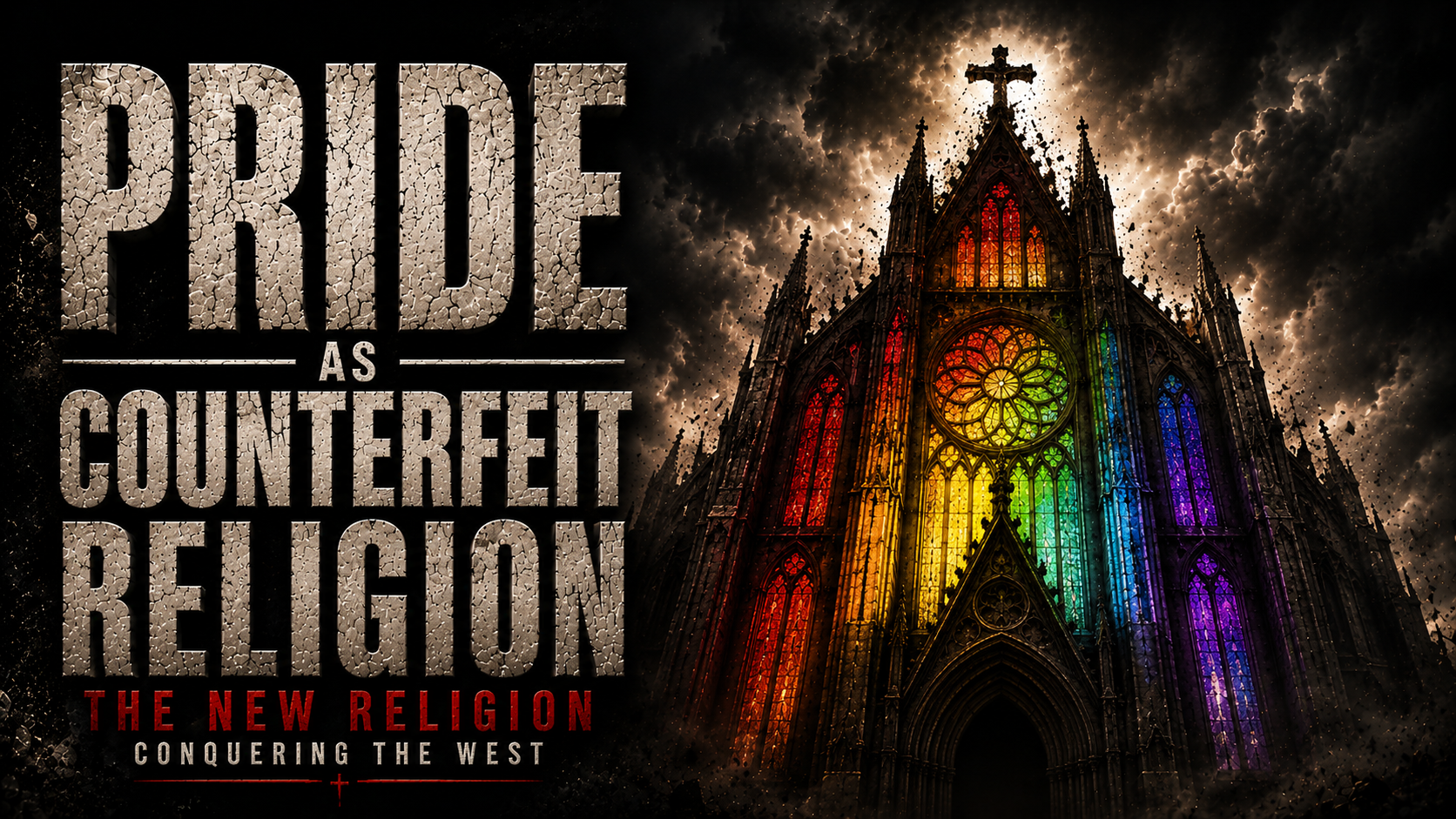
One of the greatest myths of the modern world is that America is becoming less religious.
We are told that churches are declining, secularism is advancing, and religion is slowly retreating from public life. According to this narrative, mankind is finally emerging from the primordial darkness of belief in a deity and stepping into the light of humanistic reason. Cathedrals are emptying, science is winning, and religion is quietly dying.
Or so we are told. Why? Because the evidence suggests precisely the opposite. America is not becoming less religious. America is becoming religious in an entirely different direction.
Human beings were created to worship. We cannot help ourselves. Remove one god and another immediately takes its place. Tear down one altar and another is constructed before the dust settles. The question has never been whether a civilization will worship. The question has always been what it will worship.
This is why Christians consistently misunderstand the LGBTQ movement. They assume they are confronting a political movement, a civil rights movement, or a cultural movement. They are challenged on whether they are being loving, tolerant, or accepting... And while those elements certainly exist, many do not ever get around to explaining the movement's extraordinary power of faith. Political movements do not inspire worship. Political movements do not demand confessions of allegiance. Political movements do not create saints, martyrs, holy days, sacraments, and systems of excommunication. Religions do. And that is what June has become. An entire month of sexualized idolatry.
In that way, PRIDE is not a political movement pretending to be a religion. Pride is a religion pretending to be a political movement.
Every religion begins by defining humanity's fundamental problem. Christianity teaches that man's greatest problem is sin. We have rebelled against our Creator and stand in need of reconciliation with God through Jesus Christ.
The religion of Pride offers a different diagnosis. According to its doctrine, humanity's fundamental problem is not rebellion against God but repression of the "authentic self." Instead of being born in sin, Pride says that they were "born this way" which in plain speak means virtuous instead of broken. The great evil therefore is not sin but restraint. The villain is not transgression but limitation. The path to salvation is therefore not repentance but self-expression. Christianity says, "Deny yourself." Pride says, "Discover yourself." Christianity says, "Die to yourself." Pride says, "Celebrate yourself." Those are not merely different opinions. They are rival gospels.
Every religion also offers a doctrine of salvation. Christianity proclaims that Christ saves sinners through His death and resurrection. Pride proclaims that coming out will set you free. If only you can discover your true self, embrace your deepest carnal desires, and cast off every inherited boundary your creator has placed upon you, then you will finally become whole.
This promise is preached everywhere. It appears in movies, television shows, classrooms, corporate training seminars, social media campaigns, and political speeches. It is the modern creed of self-actualization. Yet the irony is difficult to miss. The culture most obsessed with self-discovery has become one of the most anxious, lonely, medicated, and confused cultures in human history. The religion promises liberation and routinely produces despair.
Every religion also has saints. Christianity remembers Abraham, Moses, David, Peter, Paul, and the martyrs who suffered for Christ. Pride has its own canon of heroes. Their stories are repeated, celebrated, commemorated, and force-fed to the next generation every chance they get. Their images adorn banners. Their names are invoked as symbols of virtue. Their lives function as moral examples for the faithful.
Every religion has martyrs as well. Martyrs occupy a unique place because they transform a movement into something sacred. Their stories become more than history. They become the stories that shape identity, establish loyalty, and define the boundaries of the community.
Every religion also sanctifies time. Christianity has Christmas, Easter, Pentecost, and the Lord's Day. Pride has June. For one month each year, corporations, governments, schools, media organizations, and cultural institutions participate in a coordinated celebration. Flags are raised. Ceremonies are held. Public declarations are made. Symbols appear everywhere. Entire institutions participate in a ritualized observance that closely resembles what previous generations would have recognized as a religious festival.
This is not accidental. Religions create holy days because religions understand that what a people schedule and celebrate eventually becomes what a people worship.
Every religion has sacraments as well. Christianity has baptism and the Lord's Supper. Counterfeit religions create their own visible signs of belonging. Flags, pins, profile pictures, pronoun declarations, public affirmations, and symbolic participation all function as outward demonstrations of inward allegiance. These rituals communicate membership. They distinguish the faithful from the unbelieving. They serve the same social purpose sacraments have served throughout history.
Every religion also has creeds. The church has historically confessed, "Jesus is Lord."
The new religion has its own confessions.
"Love is love."
"Born this way."
"Trans women are women."
and the flat out ridiculous "Sparkle Creed"
Notice that these slogans are rarely offered as arguments. They function as declarations. Their purpose is not to persuade but to identify. Like all creeds, they establish who belongs and who does not.
Every religion also has heretics. Ask a simple question. What happens when someone publicly rejects the movement's most sacred claims? What happens when an athlete refuses to participate? What happens when a teacher dissents? What happens when a corporation declines to celebrate? What happens when a pastor refuses to affirm?
The response is often swift and severe.
Careers are threatened.
Reputations are destroyed.
Social pressure intensifies.
Public denunciations follow.
The modern world frequently mocks Christianity for having heresy trials while conducting its own every day.
Most revealing of all, every religion practices excommunication. The church historically excluded those who stubbornly rejected the teachings of Christ and true repentance of sin. The modern religion does the same thing under a different name. We call it cancellation. The terminology changed. The practice remained.
The irony is almost too perfect. The people who spent decades attacking Christianity as intolerant have built one of the least tolerant moral systems ever established in human history. The people who condemned the church for judging now spend enormous amounts of energy identifying, exposing, shaming, and punishing dissenters. The old religion was not abolished. It was replaced, perverted, and amplified.
In this way, the modern West has not become secular. It has become more sacred for pagan things. It has not abandoned worship. It has redirected it. It has not destroyed religion. It has manufactured a counterfeit.
This explains why Pride has become so powerful. It offers everything religion offers. It offers meaning, identity, belonging, purpose, community, ritual, symbols, heroes, saints, martyrs, and salvation. What it cannot offer is forgiveness. What it cannot offer is reconciliation with God. What it cannot offer is freedom from sin. What it cannot offer is eternal life.
That is why Pride is far more dangerous than many Christians realize. We are not witnessing a mere political disagreement. We are witnessing the rise of a rival rainbow coated religion, proclaiming a rival gospel, administered by a rival priesthood, and demanding allegiance to a rival god.
Counterfeit religions have always existed. The prophets have always confronted them. The apostles died exposing them. And the church militant has faithfully and rightly confronted them for the last two thousand years.
The task before Christians is therefore not merely to oppose Pride as a political movement. It is to expose it as a counterfeit religion and to proclaim the only Gospel that can actually save.
For every counterfeit gospel ultimately makes the same promise the serpent made in Eden: "You shall be as God."
And every counterfeit gospel ultimately leaves its followers exactly where the serpent left Adam and Eve: naked, ashamed, and in desperate need of a Savior.