
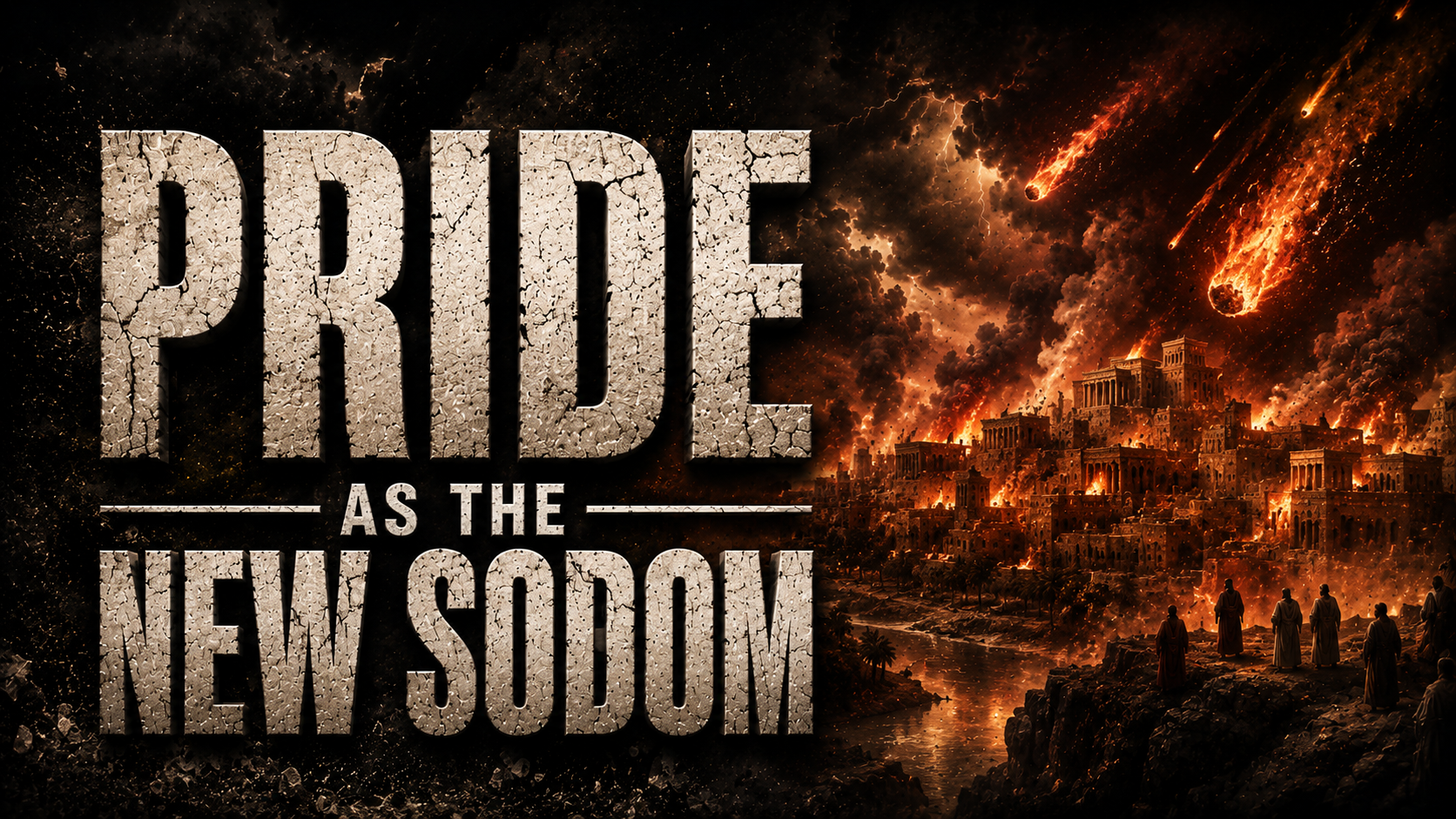
One of the most successful propaganda campaigns of the modern age has been the attempt to convince Christians that Sodom and Gomorrah were destroyed for being inhospitable. According to this revisionist reading, the problem was not sexual immorality, rebellion, or depravity. The problem was poor manners. Sodom was apparently reduced to ashes because its citizens failed a hospitality seminar.
The interpretation is so absurd that it would be laughable if it had not been repeated so often.
The Bible's account is neither vague nor mysterious. God did not rain fire upon Sodom because someone forgot to say "welcome." He destroyed the city because it had become a civilization organized around pride, rebellion, violence, and sexual perversion. Sodom stands in Scripture as a blazing monument to every culture that imagines it can celebrate evil indefinitely without consequences.
That monument deserves renewed attention today.
The story begins long before fire falls from heaven. Like many societies throughout history, Sodom's collapse began with prosperity. The prophet Ezekiel provides the divine diagnosis: "Behold, this was the guilt of your sister Sodom: she and her daughters had arrogance, abundant food and careless ease" (Ezekiel 16:49).
Notice where the indictment begins. It begins with pride.
Before the sexual corruption came arrogance. Before the depravity came self-sufficiency. Before the judgment came the intoxicating belief that prosperity had somehow liberated them from dependence upon God.
This is the oldest delusion in human history. Men receive blessings from God and then convince themselves they no longer need the God who gave them. They eat His food, breathe His air, enjoy His world, spend His wealth, and then imagine themselves independent. Like spoiled heirs squandering an inheritance, they mistake borrowed capital for self-made greatness.
In this respect, Sodom bears an uncomfortable resemblance to modern America.
We possess unprecedented wealth, unprecedented technology, unprecedented comfort, and unprecedented entertainment. We can summon food with a phone, knowledge with a search engine, and distractions with the touch of a screen. Yet with every increase in comfort has come a corresponding decrease in gratitude. We increasingly speak as though our prosperity emerged from human ingenuity rather than divine blessing. We have become wealthy enough to imagine we no longer need God.
Pride always comes before the fall because pride always convinces a people that they have become too sophisticated for obedience.
That pride eventually manifested itself in more visible ways. By the time we arrive at Genesis 19, the moral fabric of the city has completely unraveled. The men of Sodom surround Lot's house and demand access to his guests. The text does not present this as an isolated incident involving a handful of deviants lurking in an alleyway. Genesis emphasizes that men from every part of the city had gathered together. The corruption was not confined to a fringe element. It had become cultural. It had become communal. It had become normal.
This detail changes everything.
Every nation contains sinners. Every generation contains wicked people. The issue was never the mere existence of evil. The issue was that evil had become respectable.
The Bible never presents Sodom as a city struggling against sin. It presents Sodom as a city celebrating sin.
That distinction is the entire point.
Sodom was not attempting to restrain wickedness. It was organizing itself around wickedness. Evil was no longer hidden. It was no longer shameful. It was no longer acknowledged as evil at all. The city had collectively decided that what God called abominable would now be called admirable.
Every civilization has sinners. Only certain civilizations throw festivals for sin and call it virtue.
This is why the comparison to modern Pride culture is so striking. The defining characteristic of Pride Month is not that sexual immorality exists. Sexual immorality has existed since Adam and Eve sewed fig leaves together. The defining characteristic is that society now demands public celebration of what God condemns.
It is no longer enough to tolerate rebellion.
The citizen must affirm it.
The corporation must sponsor it.
The school must catechize children into it.
The politician must champion it.
The celebrity must advertise it.
The church must eventually surrender to it.
The rainbow must hang over every institution like a sacramental banner announcing that the old moral order is dead.
Sodom's greatest problem was not that evil existed there. Evil exists everywhere. Sodom's greatest problem was that evil had become honorable. The city had reached the point where righteousness appeared offensive and wickedness appeared righteous. Once a civilization inverts those categories, collapse is no longer a possibility. It is merely a matter of timing.
The parallels become even more disturbing when we consider the aggressive nature of Sodom's rebellion. The men surrounding Lot's home were not asking to be left alone. They were not requesting privacy. They were demanding participation. Their wickedness had become militant.
This is the pattern of every mature rebellion against God. Sin is never content to remain private.
It seeks validation.
It seeks converts.
It seeks power.
Every false religion eventually becomes evangelical.
The builders of Babel wanted the world united beneath their project. The citizens of Sodom wanted their corruption normalized throughout their city. Modern Pride activism frequently operates according to the same instinct. It is not satisfied with liberty. It seeks legitimacy. It seeks dominance. It seeks universal affirmation. Dissent must be silenced. Objections must be punished. Consciences must be reeducated. Reality itself must be rewritten.
When a culture abandons God's standards, it eventually begins treating dissent as the real crime.
Lot experienced this firsthand. The mob turned on him and accused him of acting as their judge. The wicked have always hated moral standards because moral standards remind them that God still exists. His existence means their autonomy is an illusion.
A civilization is in grave danger when it begins awarding medals to the very sins that once required repentance.
Yet perhaps the most chilling detail in the story is that the citizens of Sodom appear completely unconcerned about the danger they were in. No one appears worried. No one fears judgment. No one imagines that consequences are coming. The city carries on as though tomorrow is guaranteed.
That is often how judgment works.
It arrives upon people who have convinced themselves that judgment cannot come.
The people of Sodom must have believed one of three things. Either God could not see what they were doing, God did not care what they were doing, or God was incapable of stopping what they were doing. They may never have articulated those beliefs formally, but they lived as though they were true.
Modern America increasingly suffers from the same delusion.
We are told that our best days are ahead of us. We are assured that history is bending in our direction. We are promised that every moral revolution is progress. Warnings of judgment are mocked as relics of a primitive age. The prophets are ridiculed. The watchmen are dismissed. Those who speak of consequences are treated as enemies of human flourishing.
Noah preached while the skies remained blue.
Lot warned while the markets remained open.
Jeremiah preached while Jerusalem's walls still stood.
The defining characteristic of every civilization approaching judgment is not merely its wickedness. It is its confidence. The people become convinced that tomorrow is guaranteed. They mistake God's patience for God's approval. They interpret His restraint as indifference. They imagine that because judgment has not yet arrived, judgment never will.
But Scripture teaches the exact opposite. The delay of judgment is not the absence of judgment. It is mercy. It is God giving sinners time to repent before the storm breaks.
The tragedy of Sodom was not merely that it was wicked. The tragedy was that it interpreted God's patience as weakness. Then the fire fell.
Throughout Scripture, Sodom becomes a permanent symbol of divine wrath. Moses references it. Isaiah references it. Jeremiah references it. Ezekiel references it. Jesus Himself references it. The city becomes a sermon written in sulfur and ash across the pages of redemptive history.
The lesson of Sodom is not that Christians should panic.
The lesson is that Christians should stop pretending.
We should stop pretending that celebrating evil carries no consequences. We should stop pretending that moral revolutions are morally neutral. We should stop pretending that civilizations can mock God's design indefinitely without eventually paying the bill.
America increasingly resembles Sodom, not because homosexuals live here, but because rebellion is celebrated here. Pride is no longer merely practiced. It is preached. It is marketed. It is institutionalized. It is celebrated with banners, festivals, corporate sponsorships, and government endorsement. We have reached the point where many of the very things that once brought shame now bring applause.
Sodom therefore stands before us as more than an ancient city buried beneath divine judgment. It stands as a warning. It stands as a monument. It stands as a sermon. It reminds every generation that God is not mocked, that reality cannot be rewritten, and that civilizations which celebrate what God hates eventually discover that His warnings were not empty threats.
Yet even here there is hope.
Before the fire fell, God rescued Lot.
Before judgment came, mercy was extended.
Before wrath descended, a way of escape was provided.
The same God who judged Sodom also delivered the righteous from its midst. That remains the pattern of Scripture. God warns before He wounds. He calls before He judges. He extends mercy before He extends wrath.
The deepest tragedy of Sodom was not that God destroyed the city. The deepest tragedy was that the city refused every opportunity to repent before destruction arrived.
The question facing America is therefore not whether Sodom's story matters.The question is whether we will learn from it before the smoke begins to rise.