
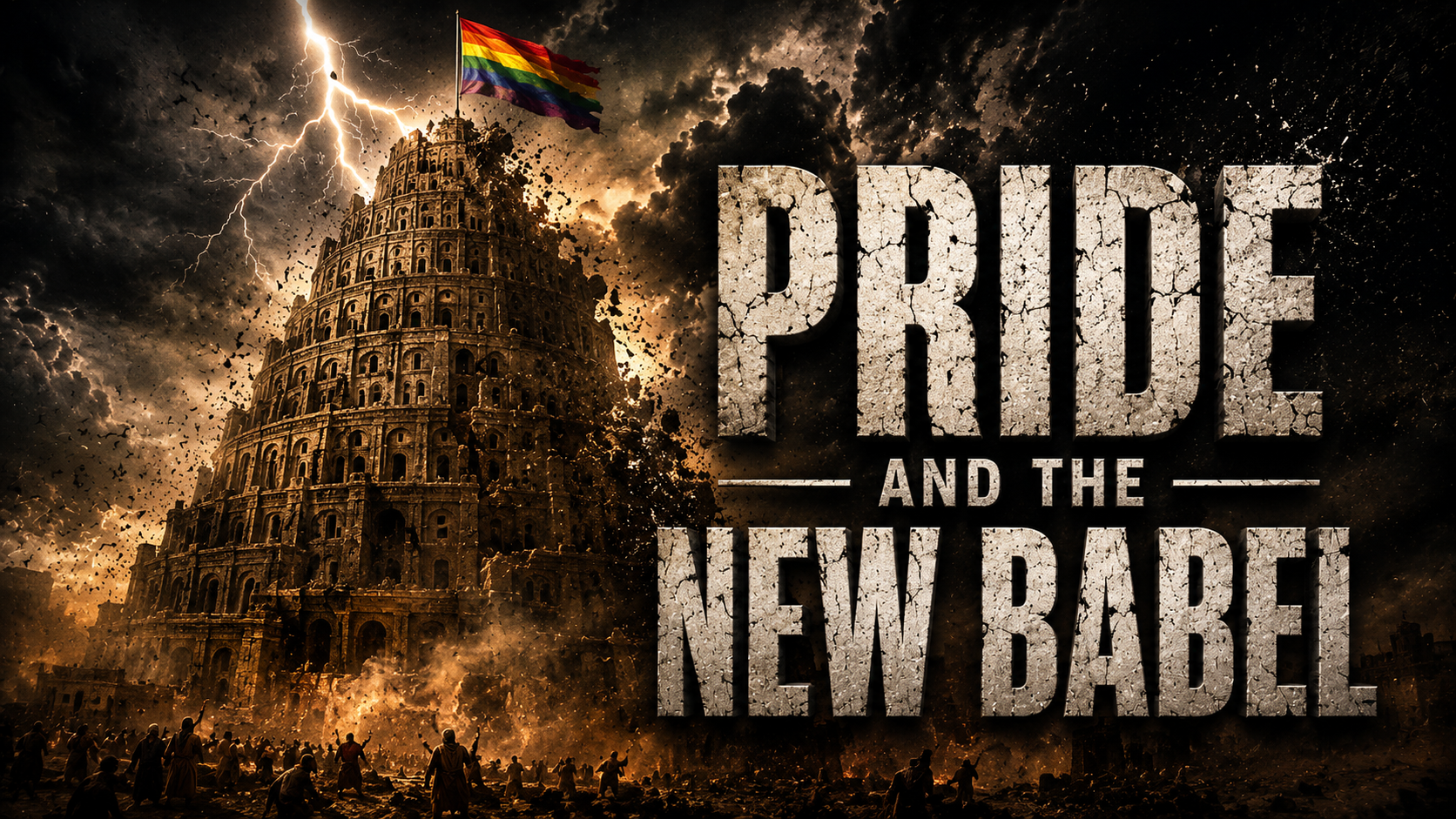
One of the greatest mistakes modern Christians make when evaluating the LGBTQ movement is assuming that it is primarily about sexuality. Certainly sexuality is involved, and certainly sexual ethics are among the most visible battlegrounds in the conflict. Yet to focus exclusively upon sexuality is to mistake the symptom for the disease. The deeper issue is not what modern man does with his body. The deeper issue is what modern man believes about God.
At its core, Pride is not a sexual revolution. It is a theological revolution.
The modern movement asks a question that is far older than rainbow flags, activist organizations, social media campaigns, and political movements. In fact, it asks a question as old as civilization itself: Who gets to define reality? Does God possess the authority to declare what is true, good, beautiful, and normative for human life, or may man seize that authority for himself? That question did not originate in our generation. It first appeared in Eden, it resurfaced in Babel, and it continues to animate every rebellion against God to this very day.
For that reason, if we wish to understand Pride rightly, we must travel back to the plains of Shinar.
The story of Babel in Genesis 11 is often reduced to a children's lesson about different languages. While the confusion of tongues is certainly part of the narrative, it is not the heart of the story. The judgment is not the sin. The judgment came because of the sin.
The people gathered together and said, "Come, let us build for ourselves a city, and a tower whose top will reach into heaven, and let us make for ourselves a name" (Genesis 11:4).
Notice carefully what they desired. Their ambition was not merely architectural. They were not condemned because they were skilled builders, innovative engineers, or ambitious city planners. Their sin lay in the repeated phrase, "for ourselves."
They would build for themselves.
They would establish themselves.
They would glorify themselves.
They would make a name for themselves.
The tower was merely the outward expression of an inward rebellion. Humanity no longer desired to receive its identity from God. Humanity desired to manufacture its own identity apart from God.
That is why Babel stands as one of the defining moments in biblical history. It was mankind's first great collective attempt at self-creation. God had already defined reality. He had already defined humanity. He had already established the boundaries of creation. Yet mankind gathered together to announce that God's definitions would no longer suffice. They would create their own.
In this respect, Babel never truly ended.
The bricks have changed. The tower has changed. The slogans have changed. The rebellion remains remarkably familiar.
The modern Pride movement is animated by the same impulse. The central claim of the movement is not fundamentally that certain sexual behaviors should be tolerated. The central claim is that individuals possess the authority to define themselves apart from God's revealed order.
God says He created mankind male and female.
Modern Pride responds that gender is self-defined.
God says marriage joins one man and one woman.
Modern Pride responds that marriage is infinitely malleable.
God says our identity is received as a gift from our Creator.
Modern Pride responds that identity is a personal construction project.
The conflict is therefore much deeper than politics, legislation, or public policy. It is a collision between two rival doctrines of reality. One view insists that human beings discover who they are by submitting to God's design. The other insists that human beings create who they are by asserting their own desires.
This is why modern discussions about sexuality so quickly move beyond sexuality itself. Before long the conversation turns to identity, self-expression, authenticity, autonomy, and personal truth. These concepts function as the theological vocabulary of modern Babel. They all assume that the self occupies the highest seat of authority.
The irony is difficult to miss.
The builders of Babel sought unity, yet they received confusion.
Our own generation seeks liberation, yet it receives confusion as well.
Never has a civilization spoken more frequently about identity while appearing less certain about what a human being actually is. Never has a culture celebrated self-expression so passionately while producing such widespread anxiety, loneliness, instability, and despair. Never has a people spoken more about authenticity while becoming increasingly detached from reality itself.
This should not surprise us. Scripture repeatedly teaches that when men reject the Creator, they eventually lose their ability to understand creation. The Apostle Paul describes precisely this process in Romans 1. Although men knew God, they refused to honor Him as God. Their thinking became futile, their hearts were darkened, and their rebellion accelerated. The result was not greater enlightenment but greater confusion.
Reality possesses a stubborn habit of resisting our fantasies.
A civilization may redefine words, rewrite laws, alter educational curricula, and pressure its citizens into compliance, but it cannot alter the created order established by God. The modern project therefore requires a perpetual war against reality itself. Every new contradiction must be defended by another contradiction. Every new fiction requires additional fictions to sustain it.
This also explains why dissent has become increasingly intolerable. The Babel project depends upon universal participation. Alternative viewpoints cannot merely be rejected; they must be silenced. Dissenters cannot simply be answered; they must be punished. The project demands conformity because it cannot withstand sustained scrutiny. Truth welcomes investigation. Falsehood fears it.
Yet the story of Babel contains a warning as well as a diagnosis.
The builders believed their project was unstoppable. They imagined that their city would endure and their tower would reach the heavens. Yet God effortlessly shattered their ambitions. What appeared invincible proved fragile. What appeared permanent proved temporary. What appeared destined for triumph collapsed under divine judgment.
The lesson is as relevant today as it was then.
Every Babel eventually falls.
The kingdoms of men rise and disappear. Empires dominate the earth and then become chapters in history books. Movements that once seemed inevitable eventually fade into obscurity. Human rebellion may be loud, fashionable, well-funded, and culturally celebrated, but it never proves durable.
God alone defines reality because God alone created reality.
The answer to Babel has therefore never been self-expression. The answer is repentance. The answer is not the creation of a new self but submission to the One who made us. The answer is not constructing an identity from our desires but receiving an identity from our Creator.
The builders of Babel sought to make a name for themselves. The Gospel offers something infinitely better. Through faith in Christ, sinners are given a new name, a new heart, a new family, and a new creation. The modern world continues to build towers that cannot stand. Christ alone offers a kingdom that cannot be shaken