
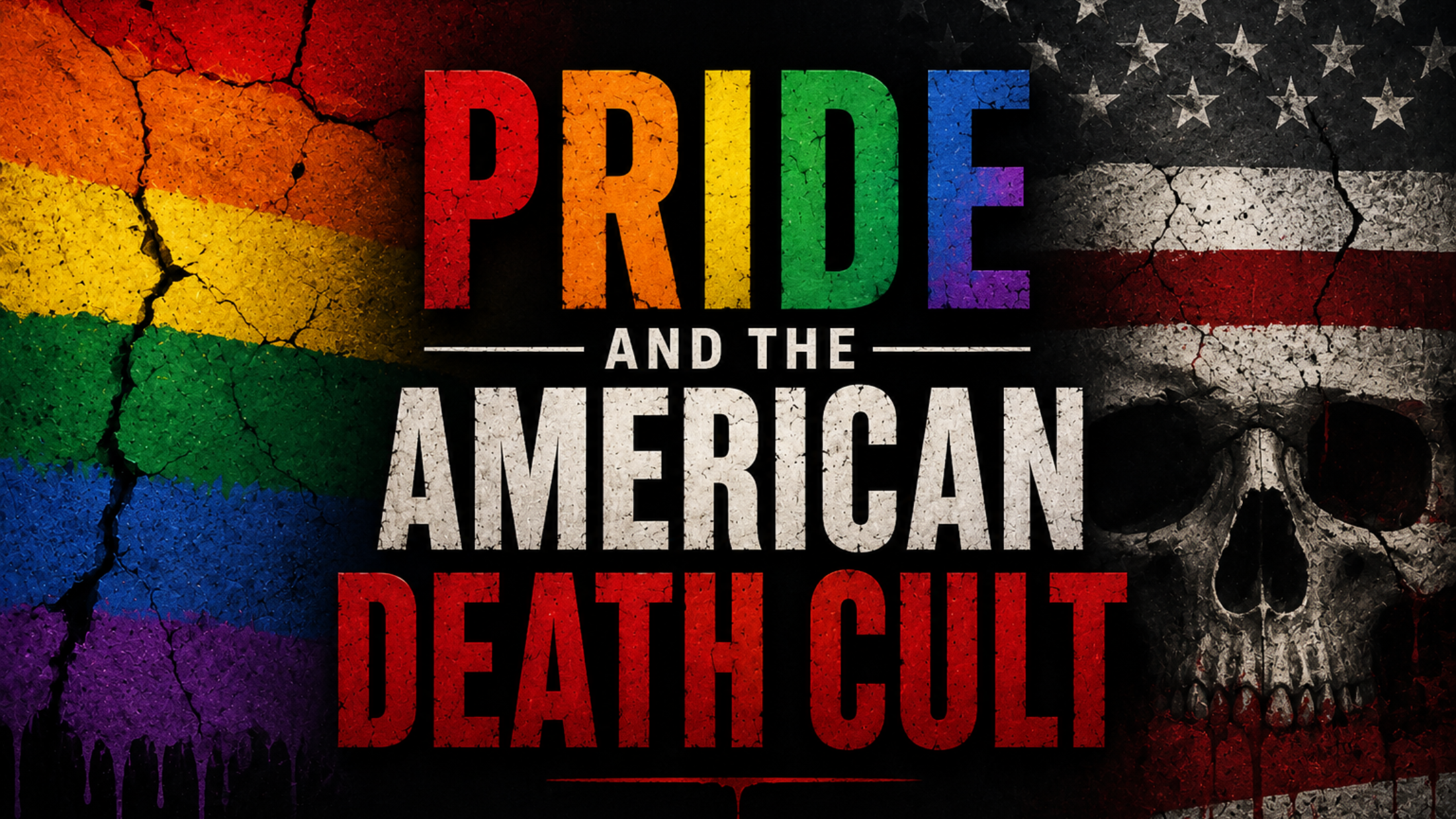
PRIDE MONTH AND THE AMERICAN DEATH CULT
June 2, 2026
Most Christians instinctively associate the Sixth Commandment with homicide. When they hear the words, "You shall not murder," they think of violent crime, bloodshed, and the unlawful taking of human life. While this understanding is certainly correct, it is incomplete. Throughout Scripture, the commandment reaches much further than the act of murder itself. The prohibition against murder rests upon a larger theological principle: God is the author of life, and therefore human beings are called not merely to refrain from destroying life but to cherish, protect, cultivate, and multiply it.
This broader understanding explains why the Westminster Larger Catechism teaches that the Sixth Commandment requires "all careful studies, and lawful endeavors, to preserve the life of ourselves and others." The commandment is therefore not merely a prohibition against death. It is a positive command to promote life. It calls men and women to embrace those institutions, habits, and practices through which life flourishes. Marriage, family, childbearing, inheritance, peace, reconciliation, and social stability all fall under its scope because each contributes to the preservation and continuation of human life under God's blessing.
This framework is essential if Christians are to understand why Pride Month deserves far more serious consideration than it often receives. The contemporary discussion is frequently reduced to questions of personal identity, private behavior, or individual rights. Yet these categories fail to reach the heart of the issue. Pride Month is not fundamentally a celebration of individual persons. It is the public celebration of an entire moral vision. It is the annual festival of a particular understanding of sexuality, marriage, family, and human flourishing. Consequently, the question Christians must ask is not whether individuals who identify as LGBTQ possess dignity. They do. Every human being bears the image of God. The real question is whether the vision of humanity being celebrated advances the biblical culture of life or contributes to what Scripture consistently identifies as a culture of death.
The Bible presents fruitfulness as one of the fundamental blessings of creation. Before sin entered the world, God commanded mankind to "be fruitful and multiply." This command was not arbitrary. It reflected God's intention that life would expand outward through faithful families, covenant succession, and generational inheritance. Throughout the Scriptures, children are repeatedly described as blessings, heritage, rewards, and arrows in the hand of a warrior. The ordinary pattern of God's blessing is not merely individual salvation but the extension of His covenant mercies through successive generations.
For this reason, the family occupies a central place in biblical civilization. It is the institution through which life is created, nurtured, educated, protected, and transmitted into the future. Every civilization that has endured has depended upon this reality. Men and women marry, children are born, those children mature, and the next generation inherits what the previous generation has built. Remove this pattern, and a civilization eventually consumes itself.
The modern LGBTQ movement stands in direct tension with this creational order. Whatever else may be said about it, it celebrates relationships that are inherently incapable of fulfilling the creational mandate of fruitfulness. By their very nature, same-sex relationships cannot produce children. They cannot generate biological posterity. They cannot extend family lines. They cannot contribute to the continuation of human society apart from borrowing from the reproductive fruitfulness of others.
This observation is not offered as a personal insult but as a biological and theological reality. The issue is not whether individuals involved in such relationships can display affection, commitment, or sacrifice. The issue is whether the relationships themselves embody God's life-giving design for humanity. Scripture's answer is unambiguous. They do not.
What makes Pride Month especially significant is that it asks society not merely to tolerate this reality but to celebrate it. Celebration is never morally neutral. Every celebration communicates values. National holidays teach citizens what to honor. Festivals reveal what a culture loves. Public commemorations function as civic liturgies that shape the moral imagination of a people. Pride Month therefore tells us something profound about the soul of modern Western civilization. It reveals what our culture believes deserves honor, praise, and public affirmation.
The tragedy is that Pride Month has emerged within a society already deeply committed to various forms of self-destruction. We abort our children by the millions. We postpone marriage indefinitely. We regard fertility as a burden rather than a blessing. We speak of children as obstacles to personal fulfillment. Birth rates across the Western world continue to collapse while governments grow increasingly desperate to compensate for demographic decline. The modern West possesses immense technological sophistication, yet it increasingly lacks the most basic confidence in its own future. It has become a civilization reluctant to reproduce itself.
Within this context, Pride Month appears not as an isolated phenomenon but as a particularly vivid expression of a broader cultural pathology. It celebrates a sexual ethic that is detached from fruitfulness, detached from posterity, and detached from the creation of future generations. It is therefore difficult to avoid the conclusion that it embodies, in symbolic form, the larger deathward trajectory of Western culture.
This is why the connection to the Sixth Commandment is more substantial than many Christians realize. The commandment is not exhausted by the question, "Have I physically killed someone?" Rather, it forces us to ask whether we love life as God defines it. Do we cherish the institutions through which life flourishes? Do we promote the structures that sustain future generations? Do we honor the family, encourage fruitfulness, and protect children? Or do we celebrate patterns that gradually erode the very foundations upon which human flourishing depends?
The deepest irony of Pride Month is that it presents itself as a movement of life, liberation, and flourishing while celebrating a vision of sexuality fundamentally disconnected from life's most basic biological and covenantal purposes. It promises freedom while severing freedom from responsibility. It celebrates desire while detaching desire from creation. It honors personal fulfillment while increasingly disregarding posterity.
In this sense, Pride Month functions as a revealing symbol of a civilization engaged in prolonged suicide. It is not the sole cause of our cultural decline, nor even its original cause. Rather, it is one of its clearest symptoms. It serves as a brightly colored banner waving above a culture that has gradually abandoned the biblical understanding of life, family, inheritance, and covenant continuity.
The Christian response must therefore be neither fear nor hatred. It must be clarity. Christians must recover a robust theology of life. We must remember that God's commandments are not arbitrary restrictions but descriptions of reality as He created it. The God who forbids murder is the same God who blesses fruitfulness, establishes marriage, fills homes with children, and promises covenant mercies to future generations.
Ultimately, the answer to the culture of death is not merely opposition. It is the recovery of a culture of life rooted in Jesus Christ. The gospel does not merely rescue individuals from judgment. It restores humanity to its proper purpose. It creates faithful husbands and wives. It fills homes with children. It establishes churches that endure across generations. It builds a civilization ordered around life rather than death.
The Sixth Commandment therefore confronts modern Christians with a pressing question. Will we join a culture that increasingly celebrates sterility, fragmentation, and self-destruction, or will we build communities marked by fruitfulness, inheritance, covenant faithfulness, and life?
The answer to that question will determine far more than how we think about Pride Month. It will determine what kind of future we leave to our children.