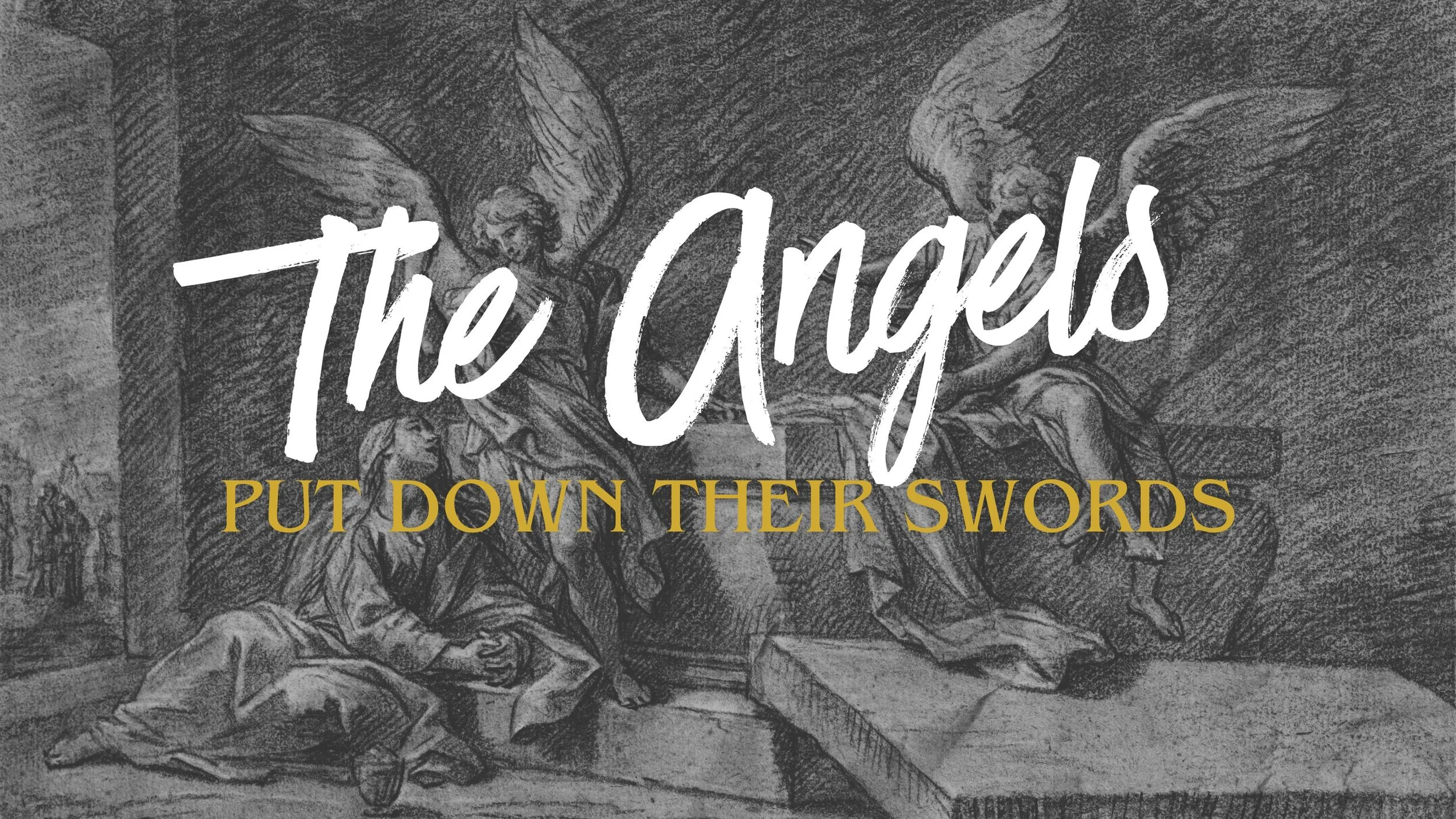
The Angels Put Down Their Swords
The last thing Adam saw as the garden closed behind him was a sword made of fire, and he understood immediately that if he took one step back toward it, it would kill him.
Not wound him. Not warn him. Kill him. The cherubim at the eastern gate were not a deterrent, they were an execution waiting to happen, and the sword turning in every direction in the hand of a creature that had never known fear and never would was the clearest possible statement of where things stood between a holy God and a man who had just committed treason against Him. Adam had heard the word before the fall. The day you eat of it you shall surely die. He had eaten it. The physics were now in motion. The sword was the physics made visible, the justice of God given an edge and set ablaze, and every animal instinct in the man who had just destroyed paradise was telling him the same thing: do not go back. You will not survive it. The way to God is closed and the price of forcing it is your life.
He walked east, and he kept walking, and he never came back.
Neither did anyone else.
His children were born east of Eden and they were born knowing, the way animals know before an earthquake, some low vibration in the blood, the sense that the world is not what it was supposed to be and that there is something behind them and to the west that they cannot return to. They built civilizations out of the wreckage of the image of God they still carried, magnificent and savage civilizations, and they loved fiercely and created beautifully and killed each other regularly and buried each other constantly, and every grave was the sword doing what the sword was made to do, every death was the proof that the gate was closed and the exile was permanent and no man who valued his life would test the cherubim twice.
God did not leave them without mercy. But even the mercy came wrapped in warning.
In the wilderness after the exodus He gave Moses the design for a sanctuary, and at the center of that sanctuary, in the innermost room where no natural light reached and no ordinary man was permitted, sat the ark of the covenant with the mercy seat stretched across its top, and rising from each end of that golden lid were two cherubim, hammered from the same piece of gold, wings forward, faces down, one at the head and one at the feet, hovering over the place where God said He would come and speak. The mercy seat was the throne of God on earth, the single most concentrated point of holy presence anywhere in the world, and it was guarded by cherubim because everything in God's presence since Eden has been guarded by cherubim, because the cherubim are what stands between a holy God and anything that is not holy, and holiness at that concentration is not safe.
The high priest understood this in his body once a year and that was enough.
He dressed in burial linen because the man who entered the holy of holies on the Day of Atonement was not a dignitary attending a ceremony, he was a soldier walking into live fire, carrying the weight of an entire nation's guilt into a room that could kill him for his own sins alone, and everyone knew it, and the rope they tied to his ankle before he went through the curtain was not ceremonial, it was practical, because if the holiness consumed him the body had to come out and no one could go in after him to retrieve it. The curtain he pushed through was sixty feet tall and woven with the image of the cherubim so that even in the act of entering he could not forget what he was entering toward. He had the blood of a bull for his own sin and the blood of a goat for the people's sin and he had incense to fill the room so the cloud of it might stand between him and the mercy seat long enough for him to do what he came to do, and he went in knowing he might not come out, and when he came out the exhale of relief from everyone waiting outside was the exhale of people who had genuinely not been certain the holiness would let him live.
This was the closest any human being got to God for four thousand years.
One man. Once a year. With blood and smoke and a rope around his ankle and the real possibility of death, and then back out, quickly, carefully, the curtain closing behind him, the cherubim back at their stations, the holy of holies sealed again, the gate still closed, the sword still turning, the exile still real, the debt still running.
And then Jesus came.
He came to end the exile the only way the exile could end, not by negotiating with the sword but by standing in front of it. The cross was not a tragedy that God redeemed after the fact. The cross was the destination, the place where the Son of God walked deliberately and with full knowledge into the full draw of the blade, every blow the sword had stored up across four thousand years of exile, every debt, every grave, every generation born east of Eden who deserved the death the physics demanded, all of it coming down on Him on the sixth day in a garden while the sky went black and the earth cracked open and the curtain of the temple tore from top to bottom as if the room behind it had finally, violently, been set free.
He took the swords. Both of them. The sword at the gate and the sword above the mercy seat and every blade that the justice of God had ever drawn against the people He was dying for. He took them into His body and He held them there and He did not let go until every last drop of what they had to give had been given, and when it was done He said it is finished not as a man who has been defeated but as a man who has done exactly what He came to do, a soldier who walked into the worst fire in the history of the universe and absorbed it completely so that everyone coming behind him could walk through without a scratch.
He died. He was buried in the garden.
And on the third day, John ran to the tomb.
He was young and he outran Peter and he got there first and he stooped and looked in and he saw the linen burial clothes lying there, and then Mary came later, weeping, and she looked in, and John records what she saw with the quiet precision of a man who spent fifty years understanding what it meant. She saw two angels in white sitting, one at the head and one at the feet, where the body of Jesus had been lying.
One at the head.
One at the feet.
Every Israelite who had ever been to the tabernacle would have felt the breath leave their body at that sentence. The geometry was unmistakable. John was describing the mercy seat. The tomb was the new holy of holies, the stone slab was the new kapporeth, and the two figures flanking it were the cherubim of the new covenant, except that something was catastrophically, gloriously different about these cherubim, something that changed the entire architecture of what it meant to approach God.
They had no swords.
They were sitting. Unarmed. Still. At rest in white linen in the early morning quiet of an empty tomb, and when Mary walked up weeping they did not move to stop her, did not reach for anything, did not fill the air with fire and terror and the authority of creatures whose entire purpose for four thousand years had been to make sure that nothing unholy survived the approach to the presence of God. They simply looked at her and asked why she was crying.
Because Jesus had taken their weapons.
He had taken every sword the justice of God held over the human race and driven them all into His own body on the cross, had paid the debt so completely and finally that the cherubim who had stood their post since Eden, who had stood in the embroidered curtain and in the hammered gold and in the justified terror of every high priest who had ever tied a rope to his ankle and gone through the curtain, those cherubim had nothing left to do. The fire was spent. The blade was empty. The debt was settled in the only currency that could settle it, the blood of the one man in history who owed nothing and paid everything.
The sentence was served and the soldiers stood down.
This is what the resurrection is. Not merely a miracle. Not merely a dead man coming back to life. It is the announcement, written in the language of swords and mercy seats and angels sitting down in white, that the gate has been opened from the inside by the only one who had the power to open it, and it is open permanently, and the creatures who once would have executed any man who tried to come in without the blood are now sitting in the entrance with empty hands asking why you are weeping.
Because here is what Adam could not do, and what every high priest did in terror, and what every human being east of Eden was born knowing they could not do, you can now do. You can walk into the presence of God. Not once a year. Not with blood in your hands and a rope on your ankle and the genuine fear that the holiness might kill you before you make it back through the curtain. You can walk in the way Mary walked up to that tomb, the way Peter walked through the entrance, the way the disciples walked into the upper room and found Jesus standing in the middle of it and alive, which is to say completely, permanently, with nothing between you and the Father except the finished work of the Son who cleared the way with His own body.
The cherubim are sitting in white with empty hands.
The sword is gone because He took it.
Come in.
He is risen.