The “Christian” Pantheon Of Acceptable “gods”
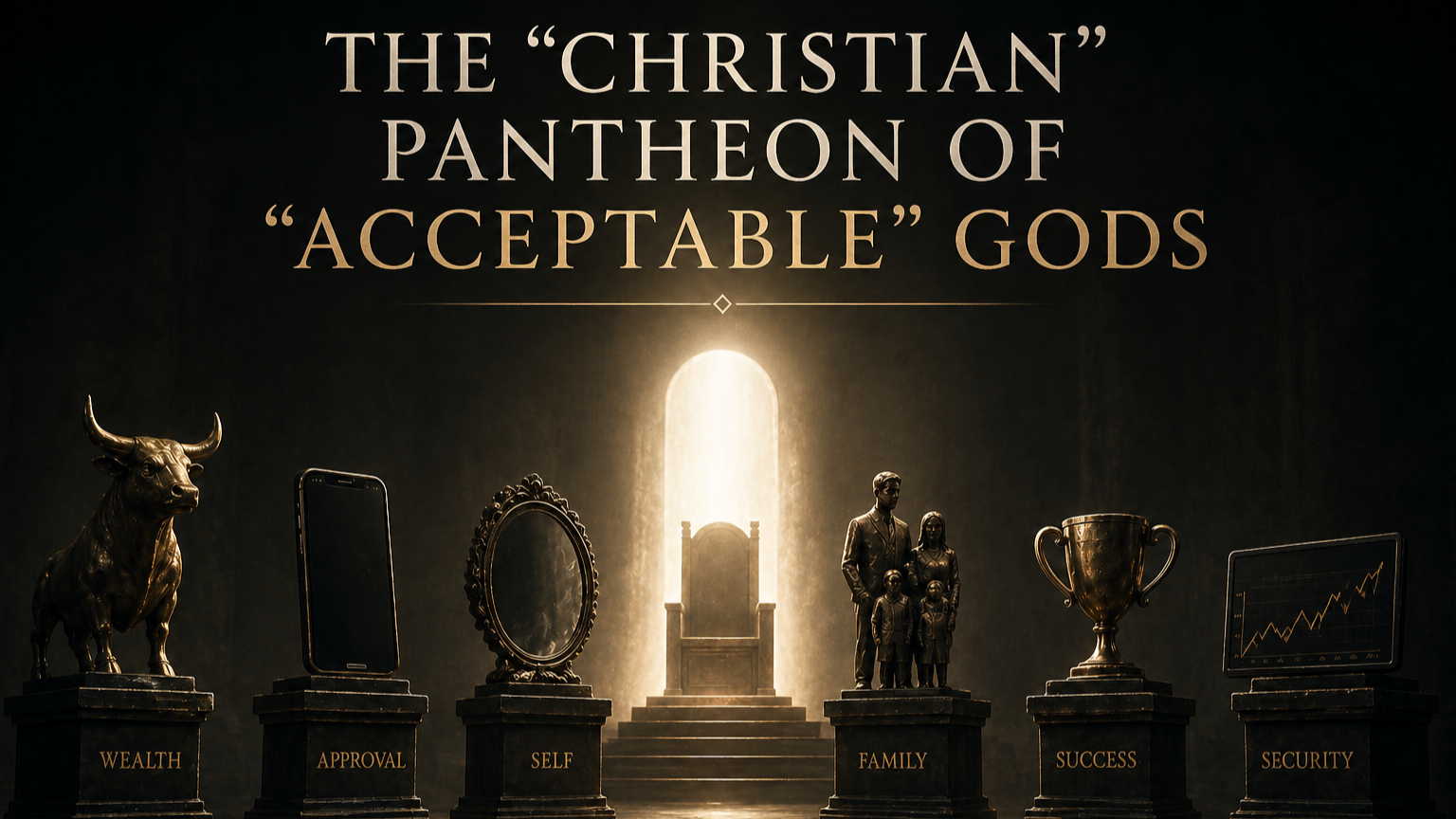
There is a curious thing about the first commandment, which is that almost no one believes they have broken it. Murder, yes. Theft, perhaps. Adultery, well, of the eyes if not of the body. But idols? Idols are wooden men in jungles and golden calves in deserts and fat little statues in temples on the other side of the world. The modern man hears Thou shalt have no other gods before me and feels a faint, rather pleasant solidarity with Moses, the way one feels solidarity with a man condemning a crime one has not yet thought of committing.
The truth is that we break this commandment before breakfast.
We break it in the silent thirty seconds before our feet hit the floor, when the soul, still warm and unguarded, leans toward whatever it has decided is the meaning of its life and whispers good morning. We break it in the soft glow of the phone we keep face down on the nightstand like a small dark altar. By nine in the morning most of us have committed more idolatry than the high priests of Baal managed in a season, and we have done it while believing ourselves to be reasonable, civilized, modern people who would never bow to a calf.
The Lord knew. That is why He spoke this commandment first.
Hear the order at Sinai. Before God told them not to kill, He told them where to put their hope. Before He forbade theft, He forbade misplaced worship. I am the LORD thy God, which have brought thee out of the land of Egypt, out of the house of bondage. Thou shalt have no other gods before me. The grace comes first. The God who breaks the chains tells the freed slaves, with the iron dust still gritting their wrists, where to set their hearts now that the chains are off.
What He says, before all else, is do not love anything more than Me, because nothing else can love you back.
A father tells his children, do not eat the berries from that bush. He is not a tyrant. He is a botanist. He has seen what the berries do. The first commandment is not a fence God built to keep us out of joy. It is a fence God built around joy itself, to keep us from wandering into a meadow full of beautiful poisons.
It is not first by accident, either. It is first because every other commandment grows from its root the way every branch in the vineyard grows from the trunk. The husband who lied to his wife lied because his reputation was his god. The boy who went to the bottle went because oblivion was his god. The merchant who short weighted his customers short weighted them because Mammon was his god, and Mammon is a hard master who counts. We do not break the first commandment when we break the others. We break the others because we have already broken the first. Pull up the root, and the rest of the weeds come with it.
Now hear me on a thing that may sting before it heals.
The strange thing about idolatry is that it is not chiefly wicked. It is chiefly silly. Picture the spectacle. A man made in the image of God, with a soul the size of a cathedral, kneeling before a screen the size of a candy bar to ask whether the world likes him today. A woman who could have moved mountains by faith, lying awake at three in the morning rehearsing what her mother in law said at Easter dinner. A pastor who could have wrestled angels at dawn, scrolling his rivals' sermon downloads with the small bitter pleasure of a man counting another man's sheep. The God who hung the Pleiades and stitched the platypus together for the fun of it is on offer, and we keep choosing the slot machine. We are not so much wicked as we are bored, and we have managed to be bored in front of an open heaven. The first sin in Eden was not chiefly cruel. It was unimaginative. It traded a garden for a piece of fruit, and we have not even improved the menu.
So the question is not whether you have idols. You have many. The question is which one you would sell the others to keep.
Brothers and sisters, we were made to hope. The human soul is an anchor in search of a rock. The writer of Hebrews calls hope the anchor of the soul, both sure and steadfast, and he treats it not as one virtue among many but as the rope without which the ship of you drifts onto the rocks before nightfall. The man who claims to have lost all hope has merely transferred his hope to despair, which is its own little god, with its own dark liturgy. The cynic hopes the world will disappoint him so he can be proven right, which is itself a hope, and a sad one. There is no neutral. There is no pause button on the worshipping heart.
So you do hope. The only question Scripture is interested in is where you have driven the anchor down.
Hear Jeremiah in the ruins of Jerusalem. The temple is rubble. The walls are smoke. Children lie dead in the streets where, a year ago, they had played at marbles. The prophet's eyes are caverns of weeping, and in the third chapter of Lamentations he says his strength is perished, and his hope is perished from the LORD. He has hit the floor of the floor and found, to his astonishment, that the floor has a basement. And then, in the middle of that black abyss, the gospel breaks like a dawn no one was expecting and no one had earned.
“This I recall to my mind, therefore have I hope. It is of the LORD's mercies that we are not consumed, because his compassions fail not. They are new every morning: great is thy faithfulness. The LORD is my portion, saith my soul; therefore will I hope in him.” - Lamentations 3:22-23
The Hebrew word is cheleq. Portion. Inheritance. Share. It is the word you use when you are dividing a field among brothers, standing at the boundary stone and saying, this row of olives is mine, and that row is yours. It is the word a Levite could not use. While the other tribes carved up Canaan with stakes and surveyor's cords, the priests were given nothing to carve. The Levite was the only Israelite in the land of milk and honey who could not point to a hill and say, this hill is mine.
The reason God gave was the most extravagant sentence in the Old Testament. I am thy part and thine inheritance among the children of Israel. The Levite who walked past his brother's wheat field at harvest, empty handed and hungry, was meant to remember he had something better than wheat. He had Yahweh. He was meant to look at the gold sheaves bending in the wind and say, yes, but I have the wind itself, and the One who sends it.
That is the cheleq. That is the slice of the universe a soul has decided is its own. And here is the diagnosis Scripture lays on every heart that has ever drawn breath. Whatever you call your portion is your god. You may not have built it a shrine in the back garden. You may not have lit candles to it in any room of the house. But your soul has knelt to it every morning, before the sun was up.
So look, with me, at the smaller gods. Look around the room. Look around the pew. Look, if you have the courage, in the mirror.
Some of you have made your portion your bank account. The number on the screen is the first thing you read in the morning and the last thing you check before bed, and there is a small altar to it on your nightstand that glows whenever it has news. You sleep with one eye on Tokyo and one eye on Frankfurt, because the markets do not rest, and your gods, like the gods of the heathen, demand a vigilance their worshippers cannot afford. The ticker does not know your name. It will not visit you in the hospital. When your daughter is married it will not weep at the wedding, and when your son is buried it will not come to the funeral. You are courting a number, and the number does not have eyes. That is idolatry. Repent.
Some of you have made your portion your children. You have asked of a child what God did not ask of Eden. You have demanded that a sapling be the forest. They were given to you to be loved, and you have made them load bearing walls in a cathedral they did not consent to build. They will spend the next forty years either trying to pay back a debt they never incurred or running so far from you that the air becomes breathable again, and you will not understand why, because you loved them so much, and that is precisely the trouble. You did not love them. You worshipped them, which is the cruelest thing a parent can do to a child, and the most disguised. That is idolatry. Repent.
Some of you have made your portion your spouse. You demanded of a sinner what only a Savior can give. You wanted to be known by them the way only the Bridegroom knows His bride. You wanted them to be heaven, and they wanted to be left alone to read the paper. When they failed you, as every spouse must fail every spouse on a long enough timeline, you concluded that love itself was a hoax. It is not a hoax. You were trying to drink the ocean from a teacup, and the teacup, which was never the problem, broke in your hand. That is idolatry. Repent.
Some of you have made your portion your reputation. The platform. The followers. The applause of strangers who would not stop their car if they saw you bleeding on the curb. You wake up checking the likes the way the priests of Baal cut themselves at noon, and the silence answers you the way it answered them. Every notification is a small wafer of communion with a god who has no body and no blood and no love, and you keep eating, and you keep starving. The mirror is the cheapest altar in the world, and the cruelest. That is idolatry. Repent.
Some of you have made your portion your sin. The pornography that has its own hour. The bottle that has its own chair. The grudge you nurse the way a widow nurses a candle that has gone out twice and that she keeps relighting because she cannot bear the dark. You return to it the way a dog returns to its vomit, because it gives you a flash of relief, a counterfeit of the joy your soul was made for. The lie cannot keep its promises. It is hollowing you out, and you can feel the floor of your own soul thinning, and still, in the morning, you go. That is idolatry. Repent.
And some of you, the saddest of all, have made your portion your own righteousness. The discipline. The reading plan. The sermon notebook. The distance you have so carefully maintained from the kinds of sinners other people commit. You have kept the law so well you suspect, in the back of a back room of your mind, that God owes you a favor. You worship the worshipper in the mirror. You hope in your own hope. You are the elder brother who never went into the field, too busy auditing the books to know there is a feast going on inside the house. That is idolatry. Repent.
Now lift your eyes.
Behold the LORD this morning. Behold the One whose mercies do not fail when the markets fail and the marriages fail and the children disappoint and the body gives way. Behold the Husband who never wandered, the Father who never lied, the Friend who did not flee in the garden when all the others fled. Behold the Shepherd who walked into the dark valley first and broke its jaw on the way through, so that when you walk it after Him you walk it through a mouth that can no longer bite. Behold the Son who hung on a tree where you should have hung, who drank a cup you should have drunk, who descended into a darkness you should have known forever, and came up the other side with the keys of death and hell on His belt and a song on His lips the angels had never heard before and have not stopped singing since. Behold the Risen King who at this moment, while your eyes move across this sentence, is reigning at the right hand of the Majesty on high, governing the nations with a rod of iron, breaking the kingdoms of men like a potter breaks a flawed vessel, and gathering the meek of the earth to inherit it. He is not retired. He is not on holiday. He is on the throne, and the throne is not in trouble.
That is your portion.
That is the rock the anchor was built for. That is the steadfast love that never ceases, the kindness that does not get tired of you, the welcome that does not turn cool when you arrive at the door for the hundredth time with mud on your shoes. His mercies were new on the morning your father died. They were new on the morning the doctor said the word cancer and the room went small. They will be new on the morning you die, and on the morning the trumpet sounds and every false god is melted in the fire like wax under a noon sun, and the LORD reigns, and the meek inherit the earth, and the man who once worshipped a number on a screen looks at the New Jerusalem coming down out of heaven and laughs at himself the way a man laughs in a dream when he realizes, at last, that he is awake.
So lift your eyes. Lift them from the dust where you have been worshipping. Lift them from the screen and the mirror and the bottle and the bed. Lift them from the wreckage of every cistern you have dug, and watched leak, and patched, and watched leak again. There is only one God. There has only ever been one God. And He has loved you with an everlasting love, and given Himself to you as your cheleq, the slice of the field that is yours forever, and that no thief can carry off, and no market can devalue, and no fire can burn, and no grave can hold.
Have no other gods before Him.
He is enough.
He has always been enough.
And He will be enough when every other portion is gone.