
The Wilderness is Patient
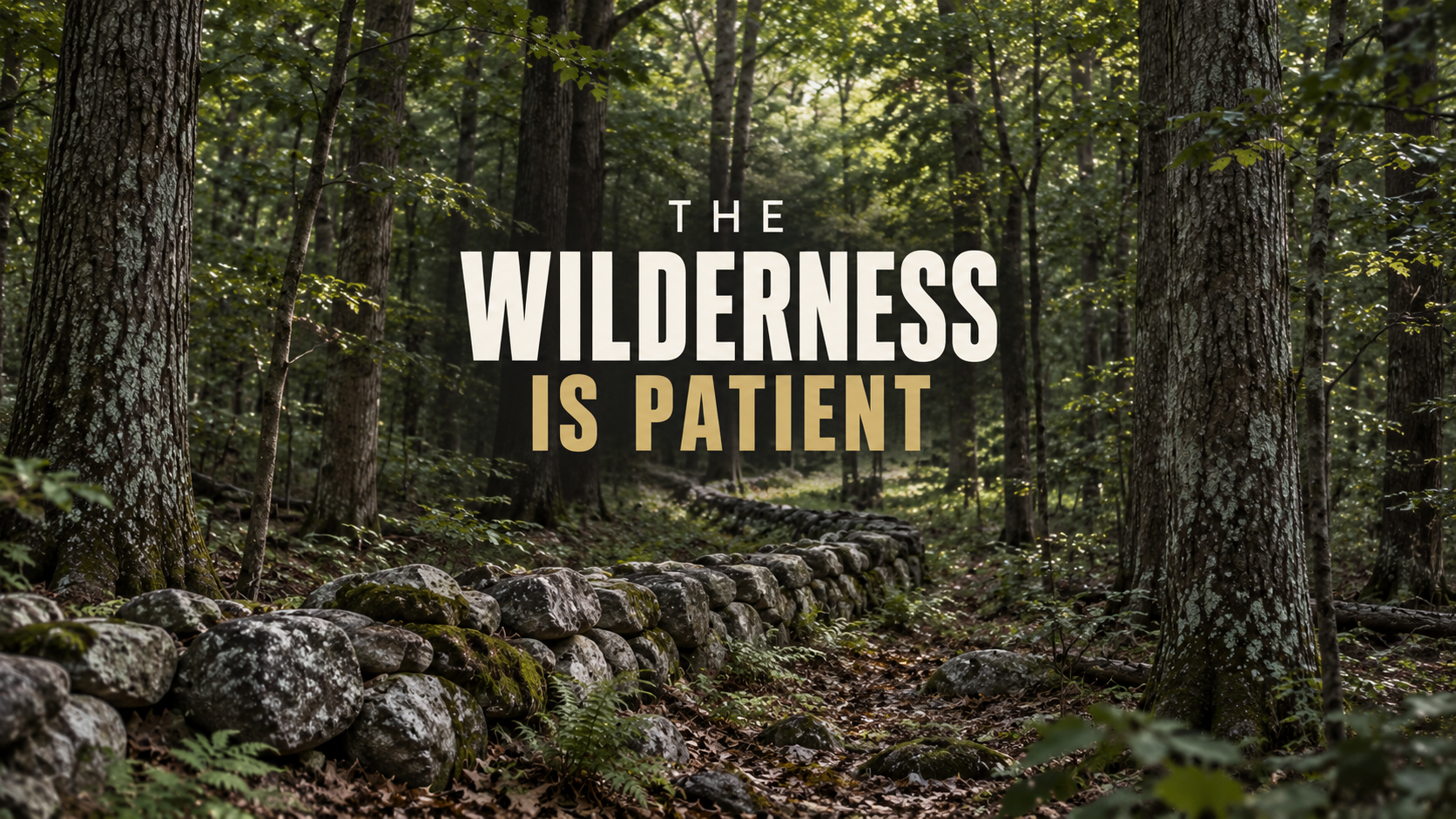
Across New England, which boasts one of the longest histories of continuous English settlement in our country, you will find innumerable relics of our American past, from sites associated with Paul Revere’s late-night ride and the Battle of Bunker Hill to the Old North Bridge and many others. But among the most curious tokens of yesteryear are the old stone walls constructed entirely from the rocks that were once removed from fields to prepare the soil to become rich and verdant farmland. And during any short car ride through the more historic towns of Massachusetts, you will see a great number of them, marking out the borders of what used to be settlers’ fields.
Yet an even more curious feature is how some of these walls now run completely through fully grown forests. And if you are not careful, you could look at these walls with a sideways glance, thinking to yourself, “Why would anyone build a wall right through a grove of oak trees towering above the stones?” But that is just it. These walls used to mark out farmlands, but through inactivity and neglect, the forest grew up all around them, leaving behind an overlooked reminder of what used to be in what is now overgrown.
And this is comical in one sense because someone once removed the trees through very difficult labor. They worked the ground, which was filled with large stones, dug them out, and built these walls as a living testimony that the ground had been made ready: “Here is the visual evidence staring at you in my wall.” And I am sure that on the same land now knotted with roots, vegetables, grains, and livestock were once raised to feed many hungry mouths.
But in the course of time, the work eventually stopped. For whatever reason, plows stopped agitating the land, seeds stopped being planted, and fields were allowed to grow. At first, they produced weeds. Then came thorns and thistles. And eventually, fully grown forests appeared. This demonstrates a pretty obvious point. And that is this: just because a plot of land was cultivated once does not mean it will remain so. Through ongoing blood, sweat, and tears, you must continue to fight back the chaos, or, with no effort whatsoever, it will come back with a vengeance and bury all the progress you once made. This does not happen overnight, but it will happen if it is not violently resisted.
This is because the wilderness is patient.
But the wilderness doesn’t merely come for fields. In a very real sense, the thorns and thistles, the chaos and entropy, will gradually come into any area of life that we neglect. Think about it: If you leave a garden to itself for long enough, it will eventually be overrun with weeds. If you stop thinking about what you eat long enough, you will soon notice the jeans don’t fit and a plump little muffin top is starting to hang over your belt buckle. If you stop pouring into your marriage, stop investing, stop communicating, stop clinging to one another, you can bet your bottom dollar that any remaining fire will soon be snuffed out. The same is true with children: if you refuse to correct them and prioritize their comfort over their character and their wants over their needs, you should not be surprised when they slowly transform into little devils.
In almost every area of life, if we do not intentionally cultivate what is good and deliberately drive back the chaos, disorder will inevitably and eventually creep in. Whatever God has given us to govern will soon be governing us if we refuse to take dominion over it. This is simply how life in a post-fall world works, and the only way around it is to be diligent in our labors.
And if we are honest, we already know where this is happening. We know full well where we are coasting, where we are autopiloting, and where we are just flat out given over to laziness. We know the areas where we were once excited and faithful but have now stopped developing. We know the relationships that we have grown comfortable and slack in. We know the unkind words that warrant an apology. We know that avoidance is not a virtue, and yet, like Adam, we hide whenever that thing comes looking for us. We know that stonewalling isn’t a helpful posture towards our wives and that it actually won’t fix the problem, and yet we hold out for days, burying the problem in silence, thinking this time it will not resurface again later. All of us know that going through the motions and being totally checked out at our jobs will not lead us anywhere good and are a terrible witness of our faith, but we keep on doing it because we fail to see the thorns and thistles forming. There are endless areas of your life where the chaos is encroaching, and its desire is to completely suffocate you. The question, therefore, is: where are you allowing it? And what are you going to do about it?
Now, at this point, many will object and point to all of the areas of their life where they are doing quite well. They are orderly and disciplined. They are structured and on top of things. But I would remind us that dominion in one area does not excuse us from passivity and sloth in another. You can keep your lawn trimmed, your bills paid, and your business running like a well-oiled machine while neglecting your wife, and the weeds of bitterness, detachment, and even divorce are slowly growing around you. You can be the employee of the year, the high-achieving CEO of a growing company, the person everyone depends upon, while your Bible gathers dust on the bookshelf and God has never felt more distant. We have this incredible ability to glamorize the areas where we are doing well and to forget the areas where we have thrown up the white flag in surrender. We point to our accomplishments as though they excuse our disobedience, and all the while, the very sins we refuse to address are becoming more deeply rooted.
Because the wilderness is patient.
This is where we begin to see something far more serious about ourselves. Think about it: God has commanded us to love Him and to love our neighbors, and yet we repeatedly arrange our lives around avoiding the cost that love demands. We want the benefits of a good marriage without the sacrifices it will take. We want a healthy body without giving up the Five Guys double bacon burger. We long to have well-behaved children but refuse to show up when they need counseling, put our phone down when they need instruction, engage when they need discipline, or set aside our TV series when they need affection and attention. We want the kind of relationship with God that cost the righteous men of old blood, sweat, and many tears while holding the Almighty at arm’s length like a pesky relative we only plan to see on holidays.
And this trouble runs all the way back to Adam. Remember, Adam was given a garden that had never produced a single thorn. He was not exhausted from fighting back centuries of overgrowth, nor was he trying to repair the damage someone else had left behind. He stood in a good world, surrounded by God’s provision, and still decided that he would rather disobey the God who had given him everything. Before there were thorns in the ground, there was rebellion in the man appointed to cultivate it. And we have been following our father’s example ever since, wanting to enjoy what God has given while resisting His authority over how we use it.
That leaves us with a problem we cannot work our way out of. The same sinful heart that keeps surrendering ground to the wilderness cannot deliver us from its dominion. We need someone who can deal with our guilt before God, change the desires that keep drawing us back into disobedience, and overcome the curse that Adam brought upon us. We need another Man, one who would obey where Adam rebelled, remain faithful where we have surrendered, and bring us back to the God we keep pushing away.
And that is precisely whom God has given us in Jesus Christ. Here is a true Man who obeyed His Father completely, who loved those entrusted to Him, and who finished the work He had been given to do. When obedience became costly, He kept going. When it required suffering, He submitted to it. When the thorns and thistles came calling, He took them upon His own head, allowing them to kill Him in our place, but rising from the grave to kill them in theirs.
And having conquered the chaos and overturned the power of death, He ascended to His Father's right hand, where He reigns supreme until every enemy has been put beneath His feet. This means not only that Christ triumphed over the chaos that was bearing down at Calvary on Him, but that He will also be bearing down on it, ripping it out, displacing it, chasing it to the ends of the earth, until the only thing left is a world ordered by Him! Paul tells us that the last enemy to be destroyed is death itself, which means Christ intends to reign and conquer a whole lot of enemies before we get to that final one. Tremendous aspects of the curse will be overcome in His reign, much disorder will be ordered in His reign, and overwhelming victory will come because of His reign. The curse that overcame Adam will finally be overcome by Christ, and when He has finished that work and returns to slay death, even the bodies of His people will be raised from the dust and freed from the curse of chaos forevermore (1 Corinthians 15:20–28).
The wilderness is patient. But it cannot outlast the reign of Jesus Christ.
And if you belong to Him, you have work to do. The very areas of life where you have allowed sin to grow are places where you must now learn to obey your King and pray His Kingdom victory will come as it already is in heaven. Remember: You have been forgiven, you have been given His Spirit, and you have been brought under the care of a Savior who intends to make you holy. So, in Jesus’ name, bring the neglected parts of your life before Him, confess what you have allowed to take root, and begin doing what He has commanded.
That may mean going to your wife tonight and asking her forgiveness without wasting away in excuses about how she provoked you. It may mean turning off the television, sitting down with your children, and beginning the instruction you should have been giving them all along. It may mean completing the work you were paid to do, telling the truth about something you have concealed, or seeking help from your pastor with a sin you have been protecting. Whatever the duty, repentance will require more from us than feeling bad or expressing regret at how overgrown things have become. You will have to put your hands to the work.
“but if by the Spirit you put to death the deeds of the body, you will live.” - Romans 8:13