
Pompey Didn’t Find A god
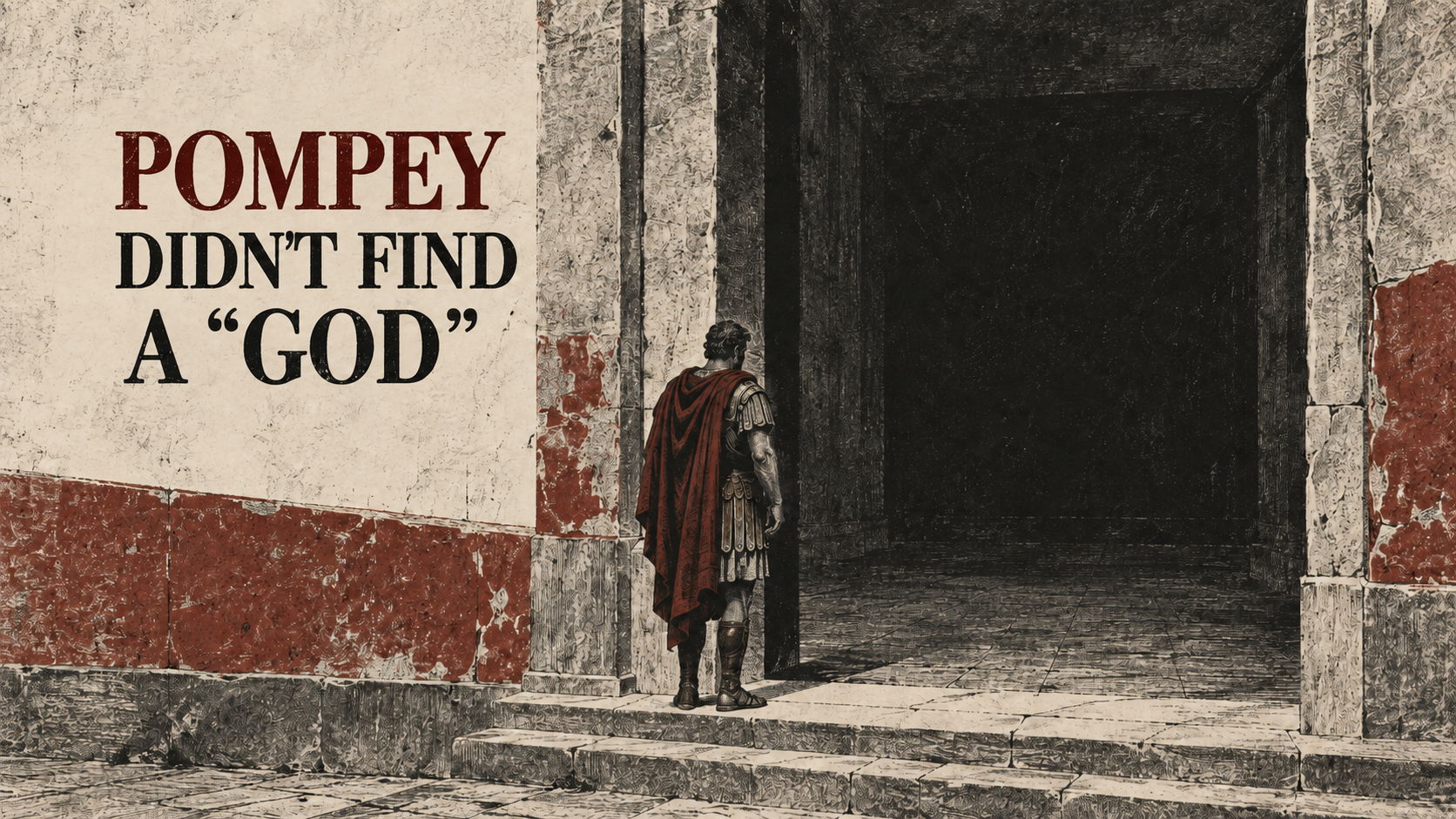
Pompey expected to find a god.
And this was because Rome had become quite good at finding the gods of rival nations. Once her soldiers had killed enough worshipers, the gods were usually discovered hiding inside a temple, carved in stone, hammered from gold, or standing helplessly upon a pedestal. Rome would seize them, carry them home, and parade them with the rest of the loot as visible proof that her gods had conquered theirs.
But when Pompey conquered Jerusalem in 63 BC and entered the Jewish temple, he found everything except what he expected. He found an innermost sanctuary, with all sorts of gold, precious stones, sacred furnishings, blood droplets from sacrifices, and ornamental symbols of the Jewish faith. But what he did not find was an image of the Jewish God. There was no golden face staring back at him. No sacred animal crouched in the shadows. No statue waiting to be taken captive.
What Pompey discovered was that the most sacred room in Judah was entirely empty. At least, it was empty of anything Pompey could put his hands upon and steal.
That was astonishing because ancient temples were built to house divine images. In Mesopotamia, for instance, craftsmen made the idol and priests later performed ceremonies to make it come “alive.” They carried the statue to the riverbank and then into a sacred orchard, where they performed rituals known as the mīs pî and pīt pî, which are translated as the “washing of the mouth” and the“opening of the mouth” ceremonies. At these sacramental occasions, the priest would open the idol’s mouth and “airways” so it could supposedly breathe, eat, smell incense, see offerings, and hear the prayers of the faithful. Then the priest dressed it, fed it, perfumed it, and carried it through the streets. It was an impressive beginning for a lifeless object that could not even scratch its own nose.
Yet, Israel’s temple had no such face because Israel’s God had deliberately withheld one. Moses explained this by reminding the people what happened at Mt Sinai: “You heard the sound of the words, but saw no form; you only heard a voice” (Deuteronomy 4:12). Then he drew the unavoidable conclusion: “Take careful heed to yourselves, for you saw no form when the LORD spoke to you at Horeb…lest you act corruptly and make for yourselves a carved image” (Deuteronomy 4:15–16).
The argument was simple: God showed Israel no form, so Israel was to make none. This was neither oversight nor inability. The infinitely powerful God could have appeared in a reproducible likeness or authorized an image to assist His people’s worship. Instead, He withheld every likeness, forbade every attempt to invent one, and threatened judgment against those who tried, because every man-made image would inevitably replace the truth about God with a lie.
God did not forget to sit for His portrait session. The absence of any likeness was itself part of the revelation. At Sinai, God gave Israel everything the ear could receive and nothing the eye could reproduce. He filled the mountain with His voice and left the sculptor empty-handed.
This prohibition was also not limited to making images of foreign gods. The First Commandment had already forbidden Israel from worshiping other gods. The Second commandment went further, forbidding her from forming, forging, casting, or inventing a visible form even for Yahweh. The Golden Calf proves this.
Israel, gathered in the valley below the mountain, did not imagine that it had abandoned Yahweh for an Egyptian deity. When Aaron finished the calf, the people declared, “This is your god, O Israel, that brought you out of the land of Egypt!” Aaron then announced, “Tomorrow is a feast to the LORD” (Exodus 32:4–5). The name translated “LORD” is Yahweh. Israel was not claiming that this particular cow had gone to war against the Egyptian pantheon and parted the Red Sea with its hooves. The calf was meant to provide a visible representation of the God who had delivered them. It was meant to be a teaching aid for all the visual learners who could not picture a God they could not see. In that, Aaron was not changing religions. He was merely improving the worship service.
And Aaron could have defended the calf as a visual aid. Gold represented divine glory, preciousness, and purity, all things true of YHWH. It could even have represented His triumph over Egypt, since God had caused the Egyptians to surrender the very gold from which the calf was made. Even the bull could have been defended as a deliberate theological choice. Pharaoh wore the serpent upon his brow, while the bull crushed the serpent beneath its hooves. The symbolism would have been unmistakable: our God has crushed the serpent’s head, with even a little Genesis 3:15 sprinkled in. Every artistic decision could therefore be defended as thoughtful, theological, and pedagogically useful. The finished image was still an abomination against God’s nature and a violation of His revealed will. Good intentions could not turn rebellion into worship.
Yet… Before the day was up, Moses had melted down the calf, ground it into powder, scattered it upon the water, forced Israel to drink it, and left three thousand men lying dead on the desert floor. Clearly, God did not take kindly to this well-intentioned scene.
And this is what makes the modern defense of images of Christ so curious: it repeats the logic of the calf. Men say, “Of course I do not worship the picture of Jesus. It merely helps me worship Him.” But if an image helps us think about Christ, then it is necessarily teaching us something about Christ. The question is not whether it teaches, but whether what it teaches is true.
For instance, Jesus came in the flesh, which means that He took on an image. But, the incarnation does not make every invented face we could assign to Him truthful. Yes, the eternal Son truly assumed our flesh and became visible among us. Christ had a real human face. Mary saw it. The apostles saw it. Wicked men struck it and spat upon it. Yet no inspired writer ever dared to describe it.
That silence is remarkable because the Gospel writers loved physical detail. John remembers in vivid detail the six stone waterpots at Cana and recounts the precise number of fish the disciples hauled in, one hundred fifty-three, when they encountered the post-ressurection Jesus by the sea. Mark tells us the grass was green. Luke records that Christ’s sweat fell like great drops of blood. We know the name of the servant whose ear Peter severed and how the linen cloths were arranged inside the empty tomb. These men loved details, and yet something as basic as face shape was left out? Clearly this was on purpose!
God preserved enough detail for us to count the fish but not enough to paint the Fisher of Men.
Further, this silence gives us an inspired commentary on how the apostolic church understood the Second Commandment after the incarnation. The men who saw Jesus could have recorded specific details about His appearance, yet not one inspired writer supplied them. Had they believed images of Christ were lawful and useful aids to worship, they could have served every subsequent generation by giving Christian artists an authoritative description. Instead, they left the church without so much as the color of His eyes. This was either the greatest pedagogical whiff in human history, or their silence was deliberate. The apostles did not treat the incarnation as permission to invent a likeness God had chosen not to reveal. They gave us everything necessary to trust Him and nothing necessary to draw Him.
But our ignorance of Christ’s facial features is only the beginning of the problem. Even if an authenticated portrait of Jesus had survived, it could truthfully preserve the contours of His human face. But once presented as an image of Christ for worship, it would be asked to do what pigment cannot. Christ is not merely an extraordinary man who happens to share space with God. He is one Person, the eternal Son, subsisting in two complete and distinct natures, truly God and truly man, inseparably united without confusion or division. A canvas can reproduce the visible features of His humanity, but it cannot portray His eternal deity or the hypostatic union. It can paint the face of a man, but once that fragment is presented as the whole Christ, it reduces Him until the God-man disappears behind the portrait.
Either way, the picture necessarily lies about the very Person it claims to reveal. The problem is not that the artist needs better references. He needs a medium capable of portraying the uncreated Son, and a canvas is not it. If Christ cannot be truthfully imaged with the tools by which we would image Him, then His image should not be commissioned.
And finally, perhaps the biggest issue involved, is that we do not need an image to obey Him. We should instead listen to Him!
Jesus Himself did not say: “Look at my face and follow me.” He said: “My sheep hear My voice,” Jesus says, “and I know them, and they follow Me” (John 10:27). He does not say that His sheep recognize His cheekbones, He says they hear, know, and follow His voice.
This brings us back to Pompey. He entered the Holy of Holies expecting to expose Israel’s secret and found no face, no statue, and no deity that Rome could carry away. He likely believed he had entered the poorest sanctuary in the ancient world because there was nothing inside it he could take.
In truth, he had entered the only sanctuary whose God could not be taken.
He saw no form.
We need no form.
In the Spirit and the Word, we have heard His voice.