When Your Truth Is Not His Truth
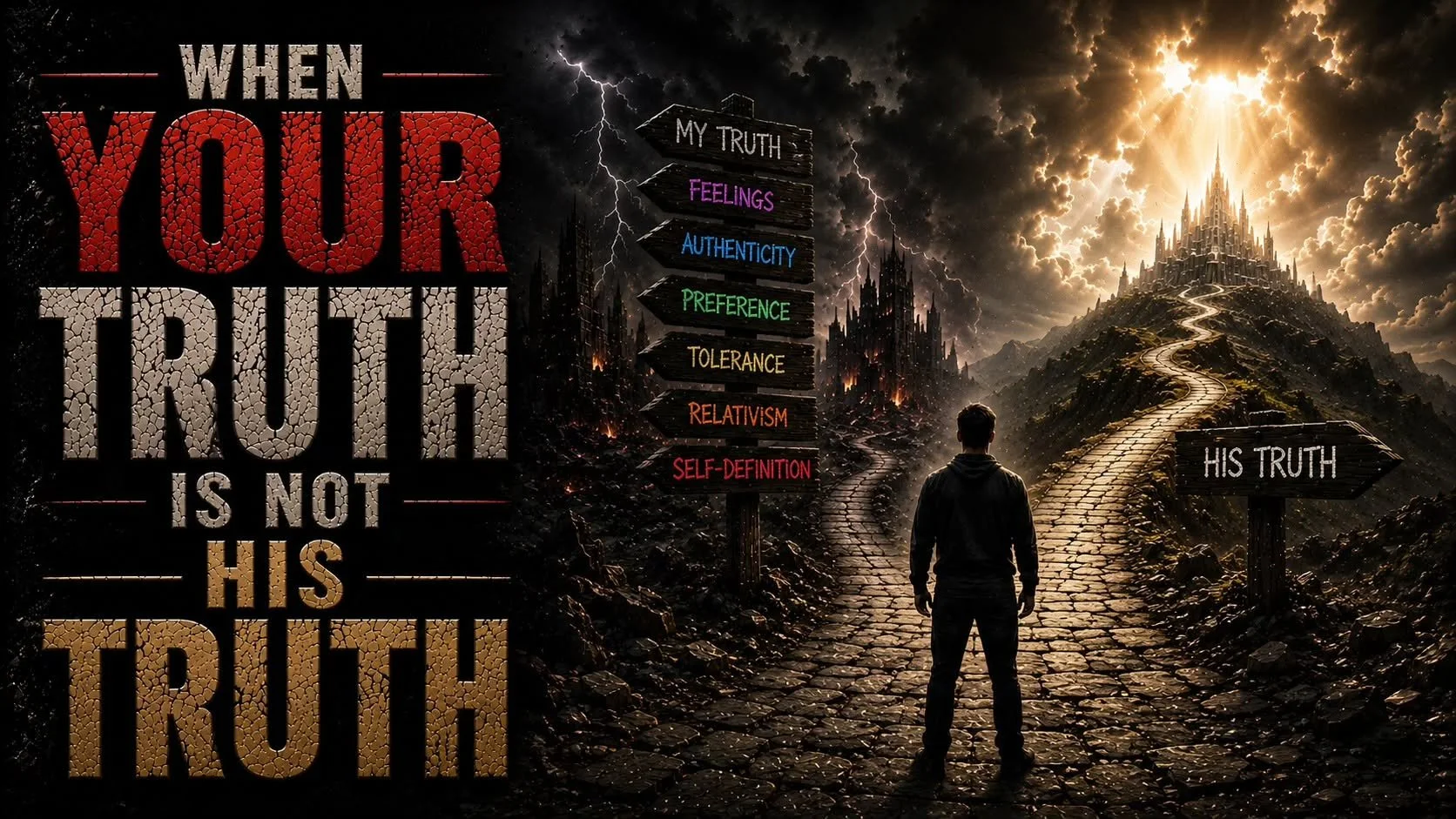
Few phrases better summarize the insanity of the modern world than the expression, "my truth." We hear it everywhere. "My truth." "Your truth." "Speak your truth." "Live your truth." The phrase is repeated so often that most people no longer stop to ask whether it means anything at all. Imagine applying the concept to mathematics. Two plus two equals four. "Well, that's your truth." Imagine applying it to gravity. If you step off a ten-story building, you will fall. "Well, that's your truth." Imagine applying it to biology. Human beings require oxygen to survive. "Well, that's your truth." The absurdity becomes obvious immediately. Truth, by definition, is that which corresponds to reality. It is not created by our preferences. It is not determined by our emotions. It does not bend itself around our desires. Truth exists independently of our approval.
Which is precisely why modern man hates it. Truth is stubborn. Truth refuses to negotiate. Truth does not care about our feelings. Truth does not ask permission before being true. And that is exactly the problem. The modern world is not merely rebelling against God's moral standards. It is rebelling against the very idea that there is an objective reality outside of itself. The issue is not ultimately homosexuality, transgenderism, abortion, feminism, or any other cultural controversy. Those are downstream effects. The real revolution began much farther upstream. The revolution began when man decided that he would rather interpret reality than receive it.
The first temptation in human history was not sexual. It was epistemological. The serpent did not begin by offering Eve forbidden fruit. He began by offering her a new theory of knowledge. "Indeed, has God said?" Those four words changed the world. The serpent's strategy was brilliantly simple. Before Eve could reject God's command, she first had to question God's authority to define reality. Before she could rebel against God's truth, she had to entertain the possibility that God's truth was negotiable. The first sin therefore began with a challenge to revelation. Who gets to determine what is true? God or me?
That same question echoes through every page of Scripture. Pharaoh asked it when he scoffed, "Who is the LORD?" Pilate asked it when he cynically sneered, "What is truth?" The builders of Babel asked it when they sought to ascend into heaven and make a name for themselves. The men of Sodom asked it when they redefined righteousness according to their own desires. Every rebellion begins with the same fundamental assumption: God may have spoken, but His word is no longer final. The modern phrase "my truth" is simply the latest version of the oldest lie in history.
The phrase sounds humble. It sounds tolerant. It sounds compassionate. In reality, it is one of the most arrogant statements a human being can utter. Truth belongs to God because reality belongs to God. The Creator determines the meaning of creation. The potter defines the purpose of the clay. The architect determines the purpose of the building. The author determines the meaning of the story. The creature does not possess the authority to redefine the world any more than a character in a novel possesses the authority to rewrite the book. Yet this is precisely what modern man attempts to do. "My truth" is not a statement of humility. It is a declaration of sovereignty. It is a claim that the individual possesses the authority to determine reality for himself. It is the language of self-deification.
The phrase sounds therapeutic because modern culture has wrapped rebellion in the language of healing. We are told that authenticity requires us to discover our truth, speak our truth, and live our truth. Yet beneath the soft language lurks the oldest temptation ever whispered into human ears: "You will be like God." That has always been the goal. The issue has never merely been behavior. The issue is authority. Who gets to define reality? Who gets to define morality? Who gets to define identity? Who gets to define truth? The answer modernity gives is remarkably simple: I do.
That is why the phrase "my truth" inevitably leads to chaos. If truth is personal, then disagreement becomes impossible. If truth is personal, correction becomes oppression. If truth is personal, morality becomes preference. If truth is personal, reality itself becomes negotiable. And if reality becomes negotiable, civilization itself begins to dissolve. This is precisely what we are witnessing today. Men insist they are women. Women insist they are men. Marriage becomes whatever we wish it to be. Identity becomes whatever we feel it to be. Morality becomes whatever we prefer it to be. The result is confusion because reality has been severed from revelation.
A society that abandons objective truth is like a ship that throws its compass overboard. It may continue moving for a while, but it no longer knows where it is going. This is why Christianity has always insisted that truth is not invented but revealed. We do not create it. We receive it. We do not author reality. We submit to reality. We do not sit in judgment over God. God sits in judgment over us.
The Christian therefore begins with a radically different assumption than the modern world. The Christian does not ask, "What is my truth?" The Christian asks, "What has God said?" Those two questions lead to two entirely different civilizations. One ends in Babel. The other ends in the New Jerusalem. One enthrones man. The other worships God. One begins with pride. The other begins with repentance.
And that is why every rebellion begins by dethroning truth. Before man can become his own god, he must first convince himself that God's voice is no longer supreme.
The phrase "my truth" therefore turns out to be one of the most revealing confessions modern man has ever uttered. It is not really about truth at all. It is about authority. It is not a statement about reality. It is a statement about sovereignty. It is not the language of humility. It is the language of a usurper climbing onto a throne. When a man says, "my truth," he is not merely expressing an opinion. He is claiming the authority to interpret reality according to his own desires. He is attempting to seize the Creator's crown and place it upon his own head.
The serpent offered that crown in Eden. Babel pursued it. Pharaoh demanded it. Pilate mocked it. Every rebel in history has reached for it. Modern man has simply given it a new name: "my truth." The slogan sounds harmless enough. It sounds compassionate. It sounds therapeutic. It sounds enlightened. Yet beneath the soft language lurks the oldest temptation ever whispered into human ears. The promise has never changed. "You will be like God."
But reality does not belong to us. Truth does not belong to us. The universe does not belong to us. They belong to God. The Creator determines the meaning of creation. The Author determines the meaning of the story. The Potter determines the purpose of the clay. We do not possess the authority to redefine reality any more than a character in a novel possesses the authority to rewrite the book in which he appears.
The day is coming when every competing truth, every competing morality, every competing identity, and every competing kingdom will collapse beneath the weight of God's reality. Every rival throne will be overturned. Every counterfeit sovereignty will be exposed. Every proud imagination raised against the knowledge of God will be cast down. The question is not whether His truth will prevail. The question is whether we will bow before it willingly now or be crushed beneath it later.
For there is no such thing as my truth. There is only His