
You Are Not Your Genitals
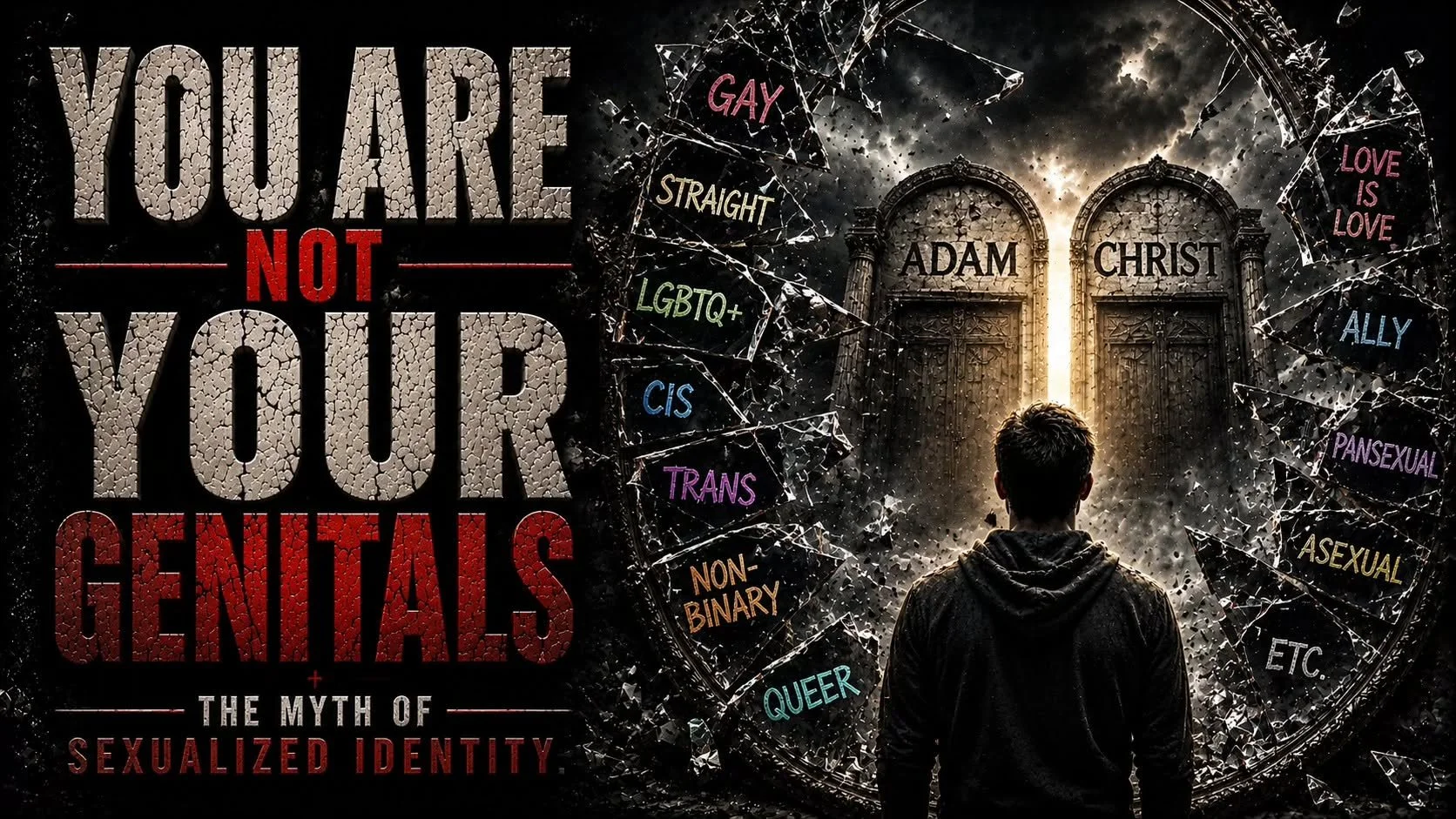
One of the strangest ideas ever smuggled into the modern mind is the notion that a person's deepest identity can be discovered by where he inserts his genitals.
Think about that for a moment. Of all the things that could possibly define a human being, modernity has settled upon sexual preference as the most important. Not whether a man loves God. Not whether he is faithful, courageous, honest, sacrificial, holy, wise, or self-controlled. Not whether he is a husband, father, son, brother, neighbor, church member, or citizen. Not whether he is dead in Adam or alive in Christ. We are told instead that the deepest truth about a human being can be discovered by examining his sexual desires and practices.
The idea is so absurd that previous generations would scarcely have known how to respond to it. Imagine introducing yourself this way: "Hello, my name is Bob. I enjoy medium-rare cheeseburgers, India Pale Ale, and having heterosexual intercourse with my wife." No sane person talks that way because we instinctively understand that appetites are not identities. The fact that I enjoy burgers does not make me a burger-person. The fact that I enjoy cigars does not become the defining feature of my existence. The fact that I enjoy a particular style of music does not transform itself into the deepest truth about who I am. Yet modern civilization has elevated one appetite above all others and crowned it king. An entire generation has been taught to believe that the defining reality of a human life is sexual desire.
This did not happen accidentally. It happened because modernity quietly replaced the Bible's doctrine of identity with an entirely different doctrine. Historically, Christians understood the difference between what a person does and who a person is. Scripture speaks of adulterers, drunkards, thieves, idolaters, liars, and those engaged in various forms of sexual immorality. In every case, the emphasis falls upon conduct rather than ontology. These are descriptions of behavior. They are not descriptions of an immutable self. The distinction matters because behaviors can be repented of, forsaken, mortified, and forgiven. The Christian faith assumes transformation is possible because the Gospel assumes that our sins are not our identity.
Modernity overturned this assumption. What was once behavior became identity. What was once temptation became personhood. What was once sin became self.
The transformation happened gradually enough that many people never noticed it occurring. The sodomite became the homosexual. The homosexual became the gay person. The gay person became a member of a sexual identity group. With each successive step, the discussion moved farther away from conduct and closer to ontology. The language changed because the theology changed. Once a behavior becomes an identity, repentance begins to look cruel. Transformation begins to look oppressive. Correction begins to sound hateful. After all, if this is who I am, then any challenge to the behavior becomes a challenge to my very existence.
That is precisely why the language changed. The human heart has always searched for hiding places. Ever since Adam stitched fig leaves together in Eden, fallen man has looked for ways to escape the implications of God's judgment. Entire philosophical systems have been built for this purpose. Political movements have been constructed for this purpose. Therapeutic frameworks have been developed for this purpose. Anything is preferable to repentance. Anything is preferable to hearing God say, "Turn from your sin and live."
This is why euphemisms matter. Language often reveals what a civilization is trying to hide. Consider the progression: sodomite, homosexual, gay, love is love. The behavior never changed. Only the marketing changed. The word "sodomite" immediately recalls Genesis 19 and divine judgment. The word "homosexual" sounds clinical and scientific. The word "gay" sounds cheerful and harmless. The phrase "love is love" sounds like something embroidered onto a decorative pillow. Each step moves farther away from moral clarity. Each step softens reality. Each step attempts to separate conduct from consequence.
The remarkable thing is that modern sexual identities would have sounded utterly foreign to most of human history. The Apostle Paul never introduced himself as a former heterosexual. Augustine never described himself as a recovering bisexual. Calvin never identified himself primarily according to sexual orientation. The Puritans never organized conferences around sexual identity. Why? Because Christians understood something we have largely forgotten. Sexuality is not identity. Sexuality is appetite.
The Bible's categories are infinitely larger than the categories of modern activism. Scripture does not divide humanity into gay and straight. Scripture divides humanity into Adam and Christ. Scripture does not divide humanity into LGBTQ and ally. Scripture divides humanity into darkness and light. Scripture does not divide humanity into queer and cisgender. Scripture divides humanity into flesh and Spirit. The Bible's concern is not where a person locates his desires but where he stands before God.
This is because God is interested in something deeper than our appetites. He is interested in ownership. Who owns you? Who defines you? Who rules you? Who redeemed you? Who will judge you?
The great tragedy of modern identity politics is that it takes one appetite, one temptation, one aspect of human experience, and elevates it to the defining feature of a person's existence. A man may be a husband, father, son, neighbor, employee, church member, image-bearer, and immortal soul destined to stand before God in judgment. Modernity responds by asking a radically different question. It insists that the deepest truth about him is his sexual orientation.
The reduction is astonishing. An eternal soul is collapsed into an appetite. A creature made in the image of God is reduced to desire. The glory of human personhood is flattened into a sexual category.
The Gospel refuses this reduction. The Gospel insists that our deepest identity is not found in our temptations but in our covenant head. The great question of Scripture is not, "What do you desire?" The great question of Scripture is, "To whom do you belong?"
That is why there are ultimately only two identities capable of surviving eternity: Adam or Christ. Every other identity will perish. Political identities will perish. National identities will perish. Generational identities will perish. Sexual identities will perish. The question that will matter when heaven and earth flee away is not whether you were straight or gay, conservative or progressive, rich or poor, popular or forgotten. The question will be whether you remained in Adam or whether you were united to Christ.
Modernity tells us to look within ourselves to discover who we are. The Gospel tells us to look to Christ. Modernity tells us that our desires define us. The Gospel tells us that our Creator defines us. Modernity tells us that authenticity comes through self-expression. The Gospel tells us that life comes through repentance and faith.
The myth of sexualized identities therefore collapses under the weight of Scripture. Our identity is not found in what we crave. It is not found in what we do. It is not found in where we place our bodies. It is not found in the passions that wage war within us. Our deepest identity is found in our covenant representative. You are either in Adam or you are in Christ. Every other identity is far too small to carry the weight of an immortal soul.